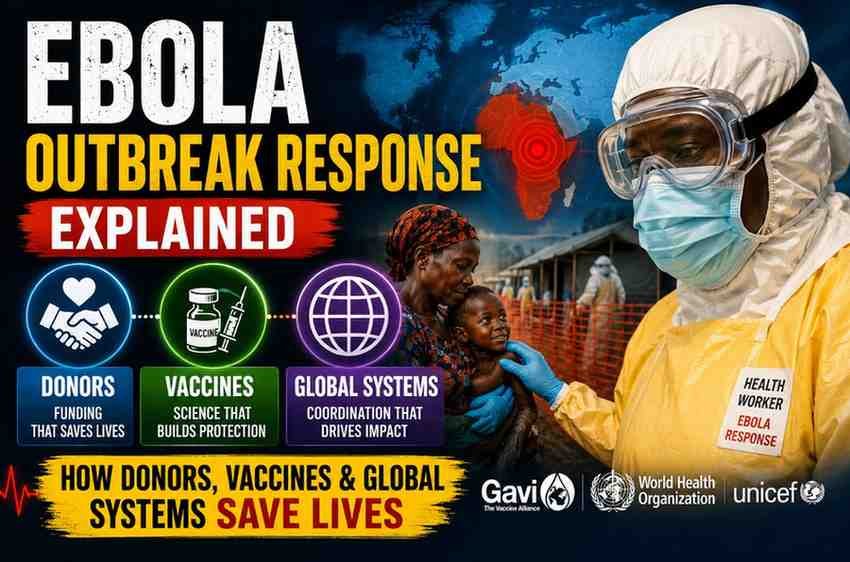
When an Ebola outbreak makes headlines, it often feels sudden and terrifying but behind every response is a complex global effort involving governments, healthcare workers, and crucially, donors. Ebola virus disease (EVD) continues to pose a serious threat in parts of Africa, requiring rapid, coordinated action to prevent widespread loss of life. This article explores who is involved in the fight against Ebola, what strategies are used, when outbreaks typically emerge, where they occur, why</strong global collaboration matters, and how</strong donor contributions and preparedness systems are transforming outcomes. More importantly, it goes beyond surface level reporting to analyze what truly determines success and what still needs to change.
Understanding Ebola Virus Disease: Context and Background
Ebola virus disease is a severe and often fatal illness in humans, caused by infection with one of several Ebola virus species. First identified in 1976 near the Ebola River in Central Africa, the disease has since triggered multiple outbreaks, primarily in regions with limited healthcare infrastructure.
Transmission occurs through direct contact with bodily fluids of infected individuals or contaminated surfaces. Symptoms often begin with fever, fatigue, and muscle pain, progressing to more severe complications if untreated.
While Ebola is not as easily transmissible as airborne diseases, its high fatality rate and potential for rapid spread make it a Global Health priority.
A Timeline of Key Ebola Outbreaks
| Year | Location | Significance |
|---|---|---|
| 1976 | DRC & Sudan | First recorded outbreaks |
| 2014 2016 | West Africa | Largest outbreak in history |
| 2020 | DRC | Second-largest outbreak, improved response systems |
| 2022 | Équateur Province, DRC | Rapid containment due to prior preparedness |
This timeline highlights a crucial pattern: response systems are improving. But why? The answer lies in funding, preparedness, and community trust.
The Role of Donors: More Than Just Funding
At first glance, donor contributions may seem like simple financial support. In reality, they are the backbone of outbreak response systems.
Donors—including governments, international organizations, and private foundations enable:
- Rapid deployment of healthcare workers
- Access to vaccines and therapeutics
- Community education and awareness campaigns
- Infrastructure development in vulnerable regions
Without these contributions, even the most advanced medical knowledge would struggle to reach affected populations in time.
Unique Insight: Speed Matters More Than Scale
One overlooked reality is that speed of funding often matters more than the total amount. Delays in releasing resources can allow outbreaks to escalate exponentially. Modern response frameworks now prioritize flexible, rapid funding mechanisms—an evolution driven by lessons from past failures.
Community Engagement: The Hidden Key to Containment
Medical intervention alone cannot stop Ebola. Community behavior plays an equally critical role.
In earlier outbreaks, mistrust of healthcare systems led to resistance against treatment and containment measures. Today, strategies have shifted toward community-first engagement.
- Local leaders are involved in awareness campaigns
- Culturally sensitive communication replaces generic messaging
- Survivors are integrated into advocacy efforts
This shift has significantly improved cooperation, leading to faster containment.
Comparison: Then vs Now
| Aspect | Earlier Outbreaks | Recent Responses |
|---|---|---|
| Community Trust | Low | Improving |
| Response Speed | Delayed | Rapid deployment |
| Vaccination Access | Limited | Targeted and scalable |
| Outcome | High spread | Faster containment |
Vaccines, Therapeutics, and Clinical Advancements
Scientific progress has dramatically changed the Ebola landscape. Vaccines and treatments that were once experimental are now central to response strategies.
Key developments include:
- Ring vaccination strategies to contain outbreaks
- Improved survival rates with early treatment
- Specialized care for survivors
However, access remains uneven. This is where donor support continues to play a crucial role.
Expert-Level Insight: Preparedness vs Reaction
The biggest shift in Ebola management is the move from reactive to proactive systems. Instead of waiting for outbreaks, health organizations now invest in:
- Surveillance systems
- Healthcare worker training
- Stockpiling essential resources
This approach reduces both response time and overall impact.
Why Ebola Still Matters Globally
It is easy to assume Ebola is a localized issue. That assumption is risky.
In a connected world, infectious diseases can cross borders quickly. Even if Ebola outbreaks remain geographically concentrated, their implications are global:
- Strain on international health systems
- Economic disruption
- Risk of mutation and wider spread
Global health security depends on controlling outbreaks at their source.
Real-World Impact: Lives, Systems, and Economies
The impact of Ebola extends beyond immediate health effects.
For individuals: Survivors often face long-term health challenges and social stigma.
For healthcare systems: Resources are diverted, affecting routine medical care.
For economies: Trade, travel, and local businesses suffer during outbreaks.
Donor-funded programs help mitigate these effects by supporting recovery alongside containment.
The Missing Piece: Mental Health and Survivor Care
One critical area often overlooked in Ebola response is mental health.
Survivors, families, and even healthcare workers experience psychological stress that can persist long after the outbreak ends. Addressing this requires:
- Long-term counseling services
- Community reintegration programs
- Public awareness to reduce stigma
This is an emerging focus area—and one that could define the next phase of global health strategy.
Prediction: The Future of Ebola Preparedness
Looking ahead, several trends are likely to shape Ebola response efforts:
- Stronger local healthcare systems: Reducing dependence on external intervention
- AI driven surveillance: Detecting outbreaks earlier
- Decentralized funding models: Faster resource allocation
- Integrated disease response: Combining Ebola preparedness with broader health systems
These developments suggest a future where outbreaks are not just controlled but anticipated and prevented.
Conclusion: From Crisis Response to Sustainable Preparedness
Ebola virus disease remains a serious global health challenge, but the narrative is changing. What was once defined by reactive crisis management is now evolving into a model of proactive preparedness, driven by donor support, scientific advancement, and community engagement.
The key takeaway is clear: effective Ebola response is not just about medicine it is about systems, trust, and timing.
As global health strategies continue to evolve, the lessons learned from Ebola are shaping responses to other infectious diseases as well. The real success lies not just in stopping outbreaks, but in building a world where they are less likely to happen in the first place.
For breaking news and live news updates, like us on Facebook or follow us on Twitter and Instagram. Read more on Latest Health on thefoxdaily.com.




COMMENTS 0