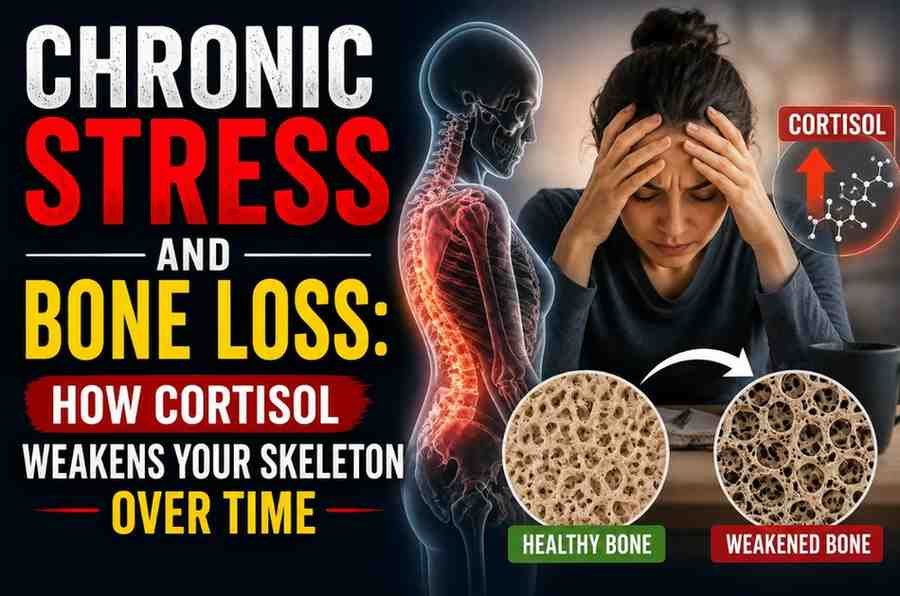
Stress has become so normalised in modern life that its physical consequences are routinely underestimated. Deadlines, financial pressure, relationship strain, sleep deprivation the body processes all of it through the same ancient biological alarm system. And one of the least-discussed casualties of that alarm system running continuously on high alert is bone density. The connection between chronic psychological stress and skeletal fragility is real, measurable, and increasingly well-documented in medical literature. Yet it remains almost entirely absent from mainstream Health conversations.
This is the story of what chronic stress actually does to your skeleton and why understanding it may be one of the most important things you can do for your long-term health.
Understanding the Stress-Bone Connection: The Biology Behind the Breakdown
To understand how stress damages bones, you first need to understand what stress does to the body at a hormonal level. When the brain perceives a threat whether that threat is a predator or an overflowing inbox it triggers the hypothalamic-pituitary-adrenal (HPA) axis, flooding the bloodstream with cortisol, the body’s primary stress hormone.
Cortisol is not inherently harmful. In short bursts, it sharpens focus, mobilises energy, and prepares the body for action. The problem begins when stress is chronic and cortisol levels remain persistently elevated. At that point, cortisol stops being a survival tool and sarts becoming a demolition agent and bone tissue is one of its primary targets.
Here is the mechanism, broken down clearly:
- Cortisol suppresses osteoblasts the cells responsible for building new bone tissue. When osteoblast activity slows, the body’s ability to repair and regenerate bone is compromised.
- Cortisol activates osteoclasts the cells that break down old bone. With osteoblasts weakened and osteoclasts overactive, the balance tips decisively toward bone loss.
- Cortisol impairs calcium absorption in the intestine and increases calcium excretion through the kidneys. Since calcium is the primary structural mineral in bone, its loss directly weakens skeletal density.
- Cortisol suppresses sex hormones oestrogen and testosterone both of which play critical roles in maintaining bone mass. This suppression accelerates the very bone loss pattern typically associated with ageing and menopause.
- Chronic stress disrupts sleep, and deep sleep is when the body releases growth hormone, a key driver of bone repair and regeneration. Poor sleep means poor bone recovery, compounding the damage.
The result of all these mechanisms operating simultaneously is a skeleton that is ageing faster than its owner’s birth certificate would suggest.
Cortisol, Osteoporosis, and the Research Evidence
The link between elevated cortisol and reduced bone mineral density (BMD) is not theoretical it is documented across multiple lines of clinical evidence.
The clearest natural experiment comes from studying people with Cushing’s syndrome, a condition characterised by chronically very high cortisol levels due to a tumour or prolonged steroid medication use. Osteoporosis and vertebral fractures are among the most consistent and severe complications of Cushing’s syndrome a direct demonstration of what sustained cortisol elevation does to the skeleton when taken to an extreme.
But you do not need Cushing’s syndrome to experience cortisol-driven bone loss. Studies in general populations have found that individuals with high perceived stress scores and elevated cortisol markers show measurably lower bone mineral density, particularly in the spine and hip the two sites most clinically significant for fracture risk. Research published in peer-reviewed journals including the Journal of Bone and Mineral Research has linked psychological stress, depression, and anxiety all conditions associated with HPA axis dysregulation with increased fracture risk and accelerated bone ageing.
Particularly concerning is evidence from studies of younger adults. Bone mass peaks in the late twenties. If chronic stress is suppressing bone-building activity during the critical years of peak bone mass accumulation, the long-term skeletal consequences extend decades into the future.
| Biological Mechanism | Effect on Bone Health | Clinical Consequence |
|---|---|---|
| Elevated cortisol suppresses osteoblasts | Reduced bone formation | Lower bone mineral density over time |
| Elevated cortisol activates osteoclasts | Accelerated bone resorption | Net bone loss, increased porosity |
| Impaired calcium absorption and excretion | Calcium deficiency in bone tissue | Structural weakening, fracture risk |
| Suppression of oestrogen and testosterone | Loss of hormonal bone protection | Accelerated osteoporosis, especially post-menopause |
| Disrupted sleep — reduced growth hormone | Impaired overnight bone repair | Cumulative skeletal deterioration |
| Stress-driven inflammation (elevated IL-6, TNF-α) | Inflammatory bone resorption | Increased osteoclast activity, joint and bone damage |
The Inflammation Factor: Stress Does More Than Just Cortisol
Cortisol is the most studied pathway, but chronic stress harms bone through a second, equally damaging route: systemic inflammation. Psychological stress elevates pro-inflammatory cytokines — particularly interleukin-6 (IL-6) and tumour necrosis factor-alpha (TNF-α). These inflammatory signals are well-established drivers of osteoclast activity. In practical terms, chronic stress creates an inflammatory environment in the body that actively promotes bone breakdown independent of cortisol.
This inflammation-bone connection explains why conditions like rheumatoid arthritis, inflammatory bowel disease, and major depressive disorder — all conditions with significant inflammatory components — are associated with significantly elevated rates of osteoporosis and fracture. It also explains why stress management is not merely a quality-of-life recommendation but a bone-health intervention.
Who Is Most at Risk?
While chronic stress poses a threat to bone health across all demographics, certain groups face compounded vulnerability.
- Perimenopausal and postmenopausal women are particularly at risk. The steep decline in oestrogen at menopause already accelerates bone loss significantly. When chronic stress suppresses what little oestrogen production remains, the dual assault on bone density is severe.
- Young adults aged 20–30 who experience chronic stress during the peak bone mass accumulation window may never reach their genetic bone density potential — setting the stage for earlier-onset osteoporosis in midlife.
- People with anxiety disorders or clinical depression have consistently shown lower bone mineral density in research studies, likely due to sustained HPA axis dysregulation, elevated inflammation, and behavioural factors such as physical inactivity and poor nutrition.
- Individuals on long-term corticosteroid medication for conditions such as asthma, lupus, or Crohn’s disease face pharmacological cortisol loading on top of whatever endogenous stress response they carry — making bone protection a clinical priority in their management.
- People with chronic sleep disorders — themselves both a cause and consequence of chronic stress — face impaired overnight bone repair cycles compounding the daytime hormonal damage.
The Behaviours That Make It Worse
Chronic stress does not damage bones only through direct hormonal and inflammatory pathways. It also drives a cluster of behaviours that compound skeletal harm.
Stressed individuals are significantly more likely to smoke — and smoking is one of the most well-documented risk factors for osteoporosis, reducing oestrogen levels and impairing bone-building cell function. Alcohol consumption rises under chronic stress, and heavy alcohol intake directly suppresses osteoblast activity while interfering with vitamin D and calcium metabolism. Physical activity — one of the most powerful stimuli for bone density maintenance — declines when people are exhausted and overwhelmed. Dietary quality deteriorates under stress, reducing intake of calcium, vitamin D, magnesium, and vitamin K2, all nutrients critical for bone health.
Chronic stress, in other words, creates a self-reinforcing biological and behavioural environment in which bone loss accelerates from multiple directions simultaneously.
Detecting the Damage: When Bone Loss Becomes Visible
One of the most medically significant aspects of stress-related bone loss is that it is clinically silent until it is not. Bone density reduction causes no pain, no symptoms, no warning signs. The first indication that something is wrong is often a fracture — frequently of the wrist, spine, or hip — that occurs with surprisingly little force. A vertebral compression fracture from bending to pick something up. A wrist fracture from a minor fall. These are the moments when decades of silent skeletal erosion suddenly become visible.
DEXA (dual-energy X-ray absorptiometry) scanning is the gold standard for measuring bone mineral density and is recommended for women over 65, men over 70, and earlier for those with significant risk factors. Chronic psychological stress, particularly when combined with other risk factors, arguably warrants earlier screening conversations with a GP or endocrinologist.
Protecting Your Bones: What the Evidence Supports
The good news — and it is genuinely good news — is that the same interventions that reduce chronic stress also directly protect bone health, creating a virtuous cycle that works in your favour.
- Weight-bearing exercise is the single most powerful bone-protective behaviour available. Running, walking, resistance training, and dancing all stimulate osteoblast activity directly. Exercise also reduces cortisol, lowers inflammation, and improves sleep quality — addressing three bone-damaging stress mechanisms simultaneously.
- Mindfulness-based stress reduction (MBSR) and cognitive behavioural therapy (CBT) have demonstrated measurable reductions in cortisol levels and inflammatory markers in clinical trials. They are not soft-wellness interventions — they are hormonal regulators with skeletal implications.
- Sleep optimisation is non-negotiable. Seven to nine hours of quality sleep per night allows growth hormone to drive overnight bone repair. Sleep hygiene — consistent sleep times, screen-free wind-down periods, cool dark sleeping environments — is a bone health strategy as much as a mental health one.
- Calcium and vitamin D adequacy become even more critical under chronic stress conditions, given cortisol’s role in impairing calcium absorption. Adults generally need 1,000–1,200 mg of calcium daily and sufficient vitamin D (ideally confirmed through blood testing) to maintain bone density.
- Reducing alcohol and eliminating smoking removes two of the most significant behavioural amplifiers of stress-driven bone loss.
Conclusion: The Skeleton Is Listening to Everything
The bones are not passive scaffolding. They are metabolically active, hormonally responsive tissue that registers the state of the body’s stress system every single day. When that stress system is chronically activated — as it is for a very large proportion of working-age adults in contemporary life — the skeleton pays a long-term price that only becomes apparent years or decades later, often in the form of a fracture that changes everything.
The conversation around bone health has historically focused on calcium, menopause, and old age. It needs to expand urgently to include chronic psychological stress as a primary modifiable risk factor — one that affects people decades before osteoporosis would conventionally be on anyone’s radar.
Looking ahead, the integration of mental health assessment into routine bone health screening protocols is both logical and overdue. As research into the HPA axis-bone axis deepens, expect clinical guidelines to increasingly acknowledge chronic stress management as a first-line bone protection strategy alongside nutrition and exercise. Your skeleton is not just a structural framework. It is a living record of everything your nervous system has been through. Taking care of your mental health is, quite literally, taking care of your bones.
For breaking news and live news updates, like us on Facebook or follow us on Twitter and Instagram. Read more on Latest Health on thefoxdaily.com.






COMMENTS 0