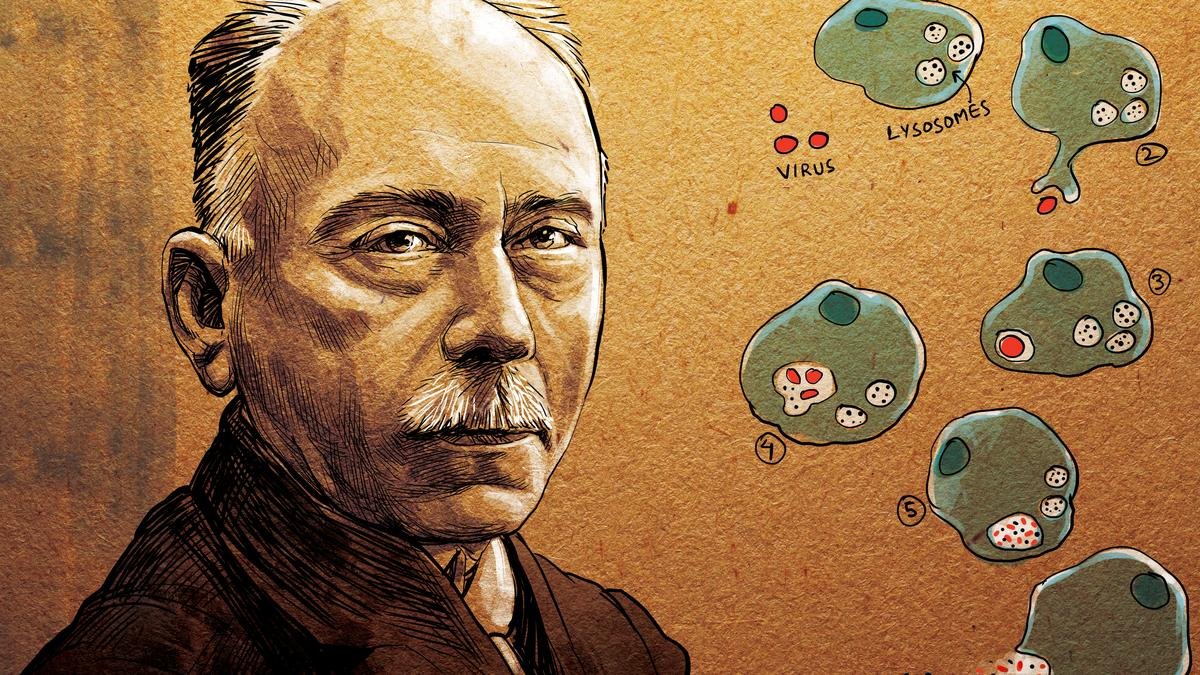
Jules Bordet’s Nobel Prize in Physiology or Medicine in 1919 was not simply a reward for discovering another way to study infectious disease. It recognised a body of work that helped scientists understand a deeper question: how does blood distinguish a harmful microorganism from the body it is trying to protect?
Bordet, a Belgian bacteriologist and immunologist who worked at the Institut Pasteur in Paris before establishing his own research institute in Brussels, investigated the interaction between antibodies and another component of blood that he called alexin, now known as the complement system. His experiments showed that antibodies alone did not explain every form of microbial destruction. Other substances in blood could cooperate with immune molecules to damage or eliminate invading organisms.
That insight changed immunology. It also created a bridge between laboratory observation and practical medicine. The principles emerging from Bordet’s work eventually influenced serological diagnosis, complement-fixation testing, vaccine research and the broader study of immune reactions.
More than a century later, the importance of Jules Bordet’s Nobel-winning discoveries lies in the same idea that continues to define immunology: the immune response is not a single weapon but a coordinated system in which different components recognise, signal, bind and destroy biological threats.
Why Jules Bordet’s Nobel Prize mattered in 1919
The timing of Bordet’s Nobel recognition is important. The Nobel Prize in Physiology or Medicine was not awarded from 1915 through 1918, a period dominated by the disruption of the First World War. When the medicine prize was awarded again, Bordet received it for his discoveries relating to immunity.
By then, scientists already knew that exposure to certain infections could produce protective substances in the blood. The work of researchers including Emil von Behring, Shibasaburo Kitasato, Paul Ehrlich and Elie Metchnikoff had established major pieces of the emerging science of immunity.
But the field still contained a fundamental mystery. What exactly happened when immune serum encountered a microorganism?
Bordet approached the question experimentally. Rather than treating immunity as an abstract property of the body, he studied measurable reactions in blood and serum. This was crucial because it allowed scientists to connect an invisible biological process with visible laboratory effects such as bacterial clumping and destruction of cells.
His contribution therefore belongs to a pivotal period in medical history when immunology was moving from observation toward mechanism.
Who was Jules Bordet?
Jules Jean-Baptiste Vincent Bordet was born in Belgium in 1870. He became interested in bacteriology and immunology at a time when the germ theory of disease was rapidly changing medicine.
Bordet joined the Institut Pasteur in Paris, where he worked in the scientific environment created by Louis Pasteur and his colleagues. His research focused heavily on the biological reactions that occur when infectious agents meet blood and immune factors.
In 1901, he returned to Brussels and founded what became the Institut Pasteur du Brabant. His research career subsequently helped establish Belgium as an important centre for bacteriological and immunological research.
Bordet was not merely interested in identifying microbes. His more consequential question was how the host responded to them. That shift in perspective helped push infectious-disease research toward what would become modern immunology.
The scientific problem Bordet helped solve
One of the most important ideas to understand about Bordet’s work is that antibodies are not always the entire story.
Antibodies are proteins produced by the adaptive immune system. They can recognise particular molecules on microbes or other foreign targets. Depending on the antibody and the biological situation, they can neutralise pathogens, cause them to clump together, mark them for destruction or help recruit other immune mechanisms.
Bordet’s experiments helped reveal that another part of blood could cooperate with these immune substances. This heat-sensitive component became known as alexin and was later understood as part of the complement system.
Complement is now recognised as a network of proteins that can be activated through several pathways. Once activated, complement can help opsonise microbes, promote inflammation and, in some circumstances, directly damage cell membranes.
The modern understanding is much more sophisticated than anything available in Bordet’s laboratory. Yet the central experimental lesson remains remarkably relevant: immune defence depends on interactions between biological systems rather than isolated molecules acting independently.
Antibodies and complement: the partnership that changed immunology
A useful way to understand Bordet’s contribution is to imagine antibodies as highly selective recognition tools and complement as part of the immune system’s amplification and attack machinery.
An antibody may recognise a specific structure on a pathogen. When certain antibody classes bind to a target, they can help initiate complement activation. Complement proteins then participate in a cascade of reactions that can intensify the immune response.
This does not mean that every antibody automatically activates complement, nor that complement always destroys a pathogen directly. Modern immunology has revealed multiple complement pathways and highly regulated interactions with antibodies, immune cells and tissues.
What Bordet helped establish was the experimental principle that specific immune recognition and nonspecific serum factors could work together.
That distinction was revolutionary because it challenged the idea that immunity could be explained by a single protective substance. It suggested instead that the body possessed layers of defence, with different components performing different jobs.
From bacterial destruction to the complement system
Bordet’s studies of bacteriolysis were particularly significant. Researchers were attempting to understand why certain immune sera could kill bacteria under particular conditions.
The answer involved more than the antibody-like substances that recognised the bacteria. Bordet demonstrated that serum contained another factor required for certain destructive reactions and that this factor behaved differently under heat.
This helped establish the distinction between what later became known as antibody activity and complement activity.
That distinction may sound routine today, but it was an important conceptual breakthrough. It gave researchers a way to dissect immune reactions experimentally: one component could provide specificity while another supplied destructive or effector activity.
In modern terms, this helped lay groundwork for understanding how the immune system converts recognition into action.
The Bordet-Gengou phenomenon and the rise of laboratory diagnosis
Bordet also worked with Octave Gengou on immune reactions involving bacteria and serum. Their research contributed to the development of methods for detecting antibodies through changes in microbial behaviour.
One important outcome was the Bordet-Gengou reaction, associated with the diagnosis of whooping cough, or pertussis. The technique relied on complement-related principles and demonstrated how discoveries in basic immunology could move toward clinical diagnosis.
This transition is one of the most important lessons of Bordet’s career. A discovery does not become medically transformative merely because it explains biology. Its wider significance emerges when the underlying principle can be converted into a reliable laboratory method.
That pattern now defines modern biomedical research: mechanism leads to measurement, measurement leads to diagnosis, and diagnosis can eventually influence treatment and prevention.
Complement fixation: one of Bordet’s most influential ideas
Bordet’s work also contributed to the development of the complement-fixation reaction, an approach that became an important tool in serology.
The basic principle is elegant. If an antibody in a patient’s serum reacts with a particular antigen, complement can become involved in the reaction. Researchers can then use an indicator system to determine whether complement has been consumed or “fixed” during the immune reaction.
This created a laboratory strategy for indirectly detecting evidence of an immune response.
Complement-fixation methods were subsequently used in the investigation and diagnosis of several infectious diseases. Their historical importance is especially notable because they helped establish a broader principle of laboratory medicine: the immune system itself can become a diagnostic instrument.
Modern diagnostics now use technologies such as enzyme immunoassays, immunofluorescence, chemiluminescence and molecular testing. These methods are far more advanced, but the underlying philosophy remains familiar: detect a biological interaction that reveals something about infection, immunity or disease.
How Bordet’s discoveries influenced vaccine science
It would be inaccurate to describe Bordet as the inventor of modern vaccines. Vaccination had already developed substantially before his Nobel Prize, most famously through the work of Edward Jenner and later Louis Pasteur.
His contribution was different and more foundational.
By clarifying how immune substances interact with infectious agents, Bordet’s research strengthened the scientific framework used to understand immune protection after exposure or vaccination.
Vaccines work by training the immune system to recognise specific threats without requiring the person to experience the full disease. Antibodies are often central to that protection, but modern vaccine science also considers memory B cells, T cells, innate immune responses, antigen presentation and complement interactions.
Bordet’s work belongs to the historical transition that made it possible to think about immunity in mechanistic terms rather than simply observing that a person became protected after exposure.
A century-old discovery that still explains modern immunology
The most striking aspect of Bordet’s legacy is how much the language of modern immunology still reflects questions raised during his era.
- Serology: Laboratory tests can detect antibodies or other immune markers associated with infection or immune status.
- Complement biology: Complement remains a major part of research into infection, inflammation and immune-mediated disease.
- Vaccinology: Researchers study how vaccination produces durable immune responses and how different immune pathways cooperate.
- Autoimmune disease: Abnormal activation or regulation of complement can contribute to tissue injury in certain diseases.
- Infectious disease research: Scientists continue to investigate how pathogens evade antibodies, complement and other immune defences.
This is where Bordet’s legacy becomes larger than the Nobel citation itself. He helped create an experimental vocabulary for asking how immunity works.
Jules Bordet versus the modern immune system: what changed?
The contrast between Bordet’s era and present-day immunology is striking.
Early twentieth-century researchers were largely working with serum, bacteria, visible reactions and relatively crude experimental tools. Today, scientists can examine immune interactions at the level of individual proteins, genes and cells. Structural biology can reveal molecular binding sites, while genomic and proteomic technologies can map complex immune responses.
Yet technological sophistication has not made Bordet’s central insight obsolete. Instead, it has expanded it.
The immune system is now understood as a vast network involving innate immunity, adaptive immunity, complement, antibodies, cytokines, immune cells and physical barriers. The more researchers learn, the less convincing the idea of a single “immune weapon” becomes.
Bordet’s greatest scientific legacy may therefore be conceptual: immunity works through cooperation.
Why his work matters beyond infectious diseases
Complement is not relevant only when the body encounters bacteria. Its activity is connected to inflammation and immune regulation, which means that complement biology has implications far beyond classical infectious disease.
Researchers now investigate complement involvement in a range of conditions, including inflammatory and immune-mediated disorders. Therapeutic strategies that target specific components of the complement system have also emerged in modern medicine.
This development illustrates an important feature of scientific discovery. A finding made while studying infectious organisms can eventually become relevant to diseases in which infection is not the central problem.
The same biological pathway can be protective in one context and harmful when excessively activated, poorly regulated or directed against the wrong target.
The overlooked lesson from Bordet’s Nobel-winning research
There is a temptation to remember Nobel laureates through one famous discovery. Bordet’s career shows why that can be misleading.
His importance was not limited to identifying a single molecule or naming a single immune mechanism. He helped demonstrate how careful experimentation can separate different biological functions that initially appear to be one process.
That approach remains essential to modern science. When a patient has an immune reaction, for example, researchers may need to distinguish antibodies from complement activation, inflammatory signalling, cellular responses and tissue damage. Understanding which part of the system is responsible can determine how a disease is diagnosed or treated.
In that sense, Bordet’s legacy is methodological as much as biological.
Jules Bordet Nobel Prize timeline
- 1870: Jules Bordet is born in Belgium.
- 1890s: He develops his scientific career in bacteriology and immunology.
- 1899: Bordet begins important work at the Institut Pasteur in Paris.
- Early 1900s: His investigations into bacteriolysis, antibodies and serum factors deepen understanding of immune reactions.
- 1901: He returns to Belgium and establishes a research institute that becomes an important centre for bacteriology.
- 1900s: Work with Octave Gengou contributes to complement-related diagnostic methods.
- 1919: Bordet receives the Nobel Prize in Physiology or Medicine for discoveries relating to immunity.
- Later decades: Complement biology and serological methods become increasingly important across infectious disease research and laboratory medicine.
What Bordet’s legacy means for the future of immunology
The next phase of immunology is unlikely to abandon the principles Bordet helped establish. Instead, it will make them increasingly precise.
Researchers are studying how immune pathways differ between individuals, how pathogens manipulate complement and antibodies, and how immune responses can be selectively strengthened or suppressed. These questions are important for vaccines, infectious diseases, autoimmune disorders and emerging immune-based therapies.
The future may therefore bring a more personalised understanding of immunity. Rather than asking simply whether a person has an immune response, medicine may increasingly ask which immune pathway is active, how strongly it is responding, when it began and whether that response is protective or damaging.
That is a remarkably modern question—and one that traces back to the experimental logic of researchers such as Jules Bordet.
Conclusion: why Jules Bordet still matters
Jules Bordet’s Nobel Prize recognised a turning point in the scientific understanding of immunity. His research helped establish that antibodies could work alongside heat-sensitive serum factors, providing crucial insight into what is now understood as the complement system.
His discoveries helped move immunology beyond the simple observation that blood could protect against infection. They showed that immune defence could be broken down into interacting mechanisms that could be studied, measured and eventually used for diagnosis.
The technology of immunology has changed dramatically since 1919. Scientists now have molecular tools that Bordet could scarcely have imagined. But the fundamental lesson remains: the immune system is a coordinated network, not a single line of defence.
That is why Bordet’s work continues to matter. His experiments belong to the history of infectious disease research, but their influence reaches into serology, complement biology, vaccine science, immunodiagnostics and modern immune medicine. More than a century after his Nobel recognition, the questions he helped frame remain at the centre of biomedical research.
For breaking news and live news updates, like us on Facebook or follow us on Twitter and Instagram. Read more on Latest Health on thefoxdaily.com.

COMMENTS 0