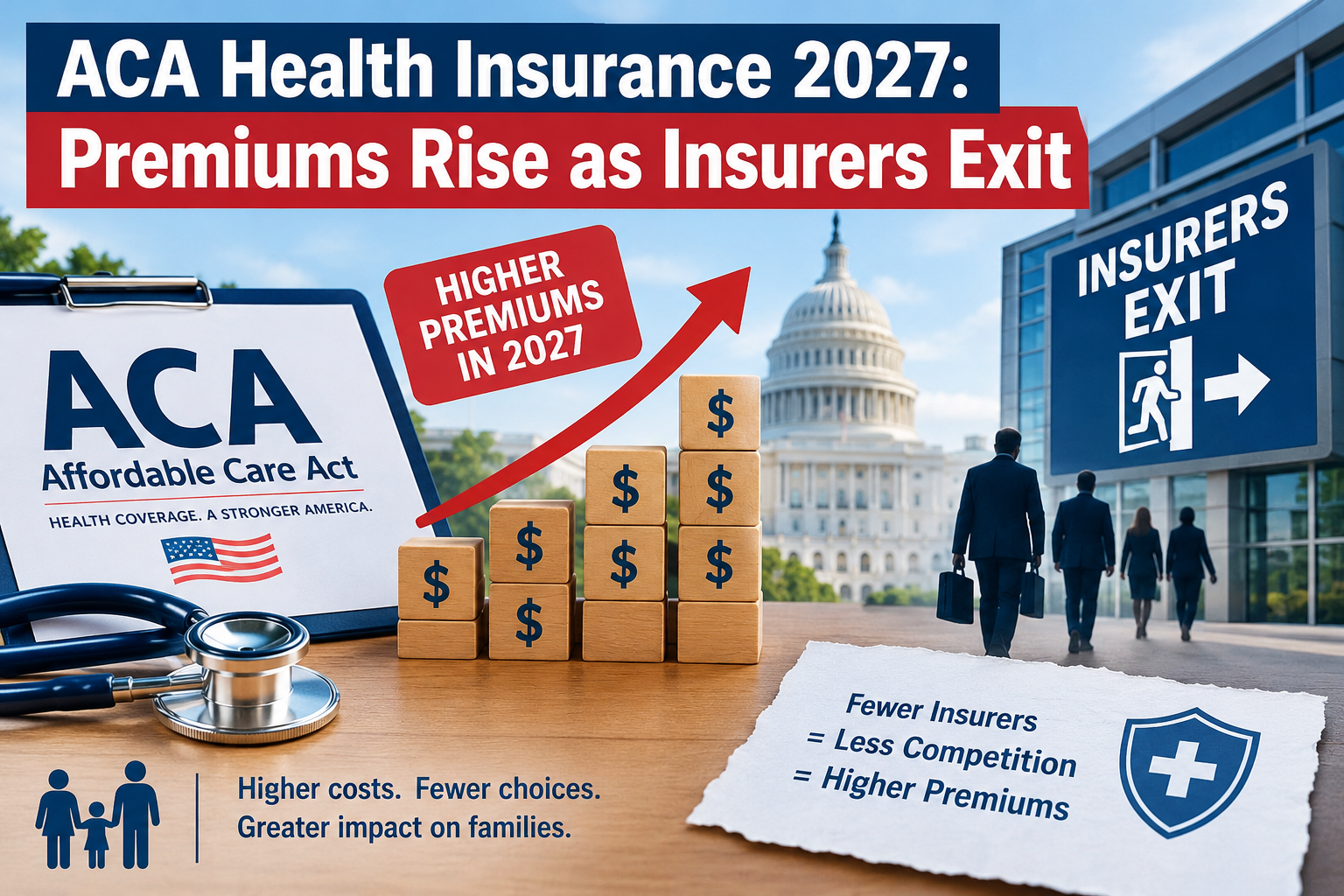
Americans who purchase Health Insurance through the Affordable Care Act (ACA) marketplaces are facing another difficult year as insurers prepare to withdraw from several state markets and propose further premium increases. For people who rely on these plans to manage chronic illnesses, access specialist care or protect themselves against unexpected medical expenses, the changes could mean more than a higher monthly bill. They could also require finding new doctors, comparing unfamiliar policies and reconsidering whether insurance remains affordable.
The scale of the challenge is becoming clearer ahead of the 2027 coverage year. According to an analysis by KFF, a nonpartisan health policy research organisation, insurers have proposed average premium increases of approximately 15% for 2027. This would mark the second consecutive year of double-digit increases. At the same time, 11 insurers have announced plans to leave ACA marketplaces in at least some states where they currently operate, while six insurers have announced plans to enter new marketplaces.
One of the most significant departures is Cigna’s decision to exit all 11 states where it offers ACA marketplace plans. The company has more than 350,000 ACA enrollees. Its withdrawal illustrates how insurer decisions can affect consumers who may have spent years building relationships with doctors and choosing coverage around their medical needs.
The combination of rising premiums, changing financial assistance and insurer exits raises a central question for 2027: how can consumers maintain access to reliable health coverage when both the cost and availability of plans are changing?
Why ACA Marketplace Customers Are Facing Another Difficult Year
The ACA marketplaces were established under the Affordable Care Act to give individuals and families a way to compare and purchase health insurance outside traditional employer-sponsored coverage. They are particularly important for people who are self-employed, work for employers that do not provide insurance or do not yet qualify for Medicare.
Consumers can compare plans with different premiums, deductibles, out-of-pocket costs and provider networks. Depending on their circumstances and eligibility, they may also qualify for financial assistance that reduces the cost of coverage.
However, the availability of affordable plans depends partly on insurers’ willingness to participate in each marketplace and on the financial arrangements supporting enrolment. When an insurer leaves, customers may need to choose a different company, even if they were satisfied with their existing plan.
For 2027, the situation is complicated by two developments occurring together. Insurers are proposing substantial premium increases, and some companies are withdrawing from markets altogether. A customer who loses an existing plan may therefore have to find replacement coverage in a market where the available alternatives are also becoming more expensive.
The effects will not necessarily be identical across the United States. Insurance companies make participation decisions market by market, and the plans available to consumers differ by state and location. Some customers may still have several alternatives, while others could face a narrower selection of insurers and provider networks.
Why Are Health Insurance Companies Leaving ACA Marketplaces?
Insurer departures reflect a combination of rising medical expenses, changing enrolment patterns and uncertainty about the financial outlook for individual health insurance. The expiration of enhanced federal premium tax credits at the end of 2025 has added pressure to a market already dealing with higher healthcare costs.
1. The expiration of enhanced premium tax credits
Enhanced premium tax credits helped eligible Americans reduce the monthly cost of ACA marketplace coverage. Their expiration at the end of 2025 meant that many consumers had to pay more for insurance in 2026, even before considering further premium increases proposed for 2027.
The original ACA premium tax credits remain available to eligible consumers, but the additional assistance introduced during the pandemic period is no longer available under the same terms. Consequently, some households have experienced a substantial increase in their share of monthly premiums.
Higher costs can lead people to reconsider their coverage. Some may move to plans with lower monthly premiums but higher deductibles, while others may drop insurance altogether if they believe they cannot afford it.
These decisions can affect the wider insurance market. When healthier people leave, those who remain enrolled may have greater average medical needs, increasing the expected cost of providing coverage.
2. Rising hospital, prescription drug and medical service costs
Insurers must account for the cost of the healthcare their members are expected to use. Hospital stays, physician visits, prescription medicines, specialist treatments and other medical services all contribute to the expenses covered by Insurance Premiums.
KFF’s analysis of proposed 2027 rates identified rising healthcare prices as a major factor behind premium increases. Insurers have also pointed to general inflation and labour costs in the healthcare sector.
Prescription drugs can add further pressure, particularly when treatment involves expensive specialty medicines. The financial impact varies according to the population covered by a plan and the healthcare services its members use.
Higher medical expenses do not automatically mean every insurer will leave a marketplace. Companies assess their own enrolment, expected claims, operating costs and business priorities. However, when costs rise while the number of potential customers falls, maintaining a financially sustainable insurance business can become more difficult.
3. A shrinking marketplace enrolment base
The expiration of enhanced tax credits has coincided with declining ACA marketplace enrolment. KFF reported that enrolment fell by roughly 3 million in the period described in its analysis, reflecting the effect of higher costs and changes in financial assistance.
For insurers, fewer customers can mean a smaller pool over which to spread administrative expenses and the financial risk of medical claims. If healthier consumers are disproportionately likely to leave, the remaining membership may also become more expensive to cover on average.
This creates a potential feedback loop. Higher premiums can encourage some customers to leave, while a smaller and potentially less healthy enrolment pool can contribute to pressure for further premium increases. Insurers may respond by raising rates, reducing their geographic presence or withdrawing from particular markets.
The process is not inevitable in every state. Local competition, state policies, the availability of subsidies and the medical needs of the population can all influence how individual marketplaces develop.
How Much Could ACA Premiums Increase in 2027?
KFF’s analysis of proposed rates across all 50 states and Washington, D.C., found a median proposed premium increase of approximately 15% for 2027. The proposals represent a second consecutive year of double-digit increases, although the final rates may differ after state reviews and other applicable regulatory processes.
It is important to distinguish a proposed premium increase from the amount a consumer will actually pay. Insurers submit rates for their plans, but the financial assistance available to an eligible enrollee can reduce the amount paid out of pocket.
The effect of a premium increase therefore depends on several factors:
- The insurer’s final rate: A proposed increase may change during the rate review process.
- The plan selected: Premiums differ across bronze, silver, gold and other available coverage options.
- Eligibility for financial assistance: The amount of premium tax credit available can affect the final monthly bill.
- Household circumstances: Income, family size, age and location can influence eligibility and the plans available.
- Changes in coverage: A new plan may have a different deductible, provider network or out-of-pocket limit.
For households that qualify for financial assistance, tax credits may cushion some of the impact of rising premiums. People who no longer qualify for the enhanced assistance, particularly those who earn too much to receive the remaining credits, may face a much larger increase in what they must pay themselves.
Consumers should therefore avoid assuming that a 15% proposed increase will translate into exactly the same percentage increase in their personal monthly bill. Their final costs depend on the plan, the approved rate and the assistance for which they qualify.
What Happens When an Insurer Leaves the ACA Marketplace?
When an insurance company withdraws from a marketplace, affected customers generally need to select another available plan if they want to maintain comparable coverage through the ACA system. The process can be more complicated than simply choosing a different company.
Insurance plans differ in their networks of hospitals, doctors, specialists and pharmacies. A replacement plan may have a lower monthly premium but exclude a patient’s established specialist or require different arrangements for prescription medicines.
For people with ongoing medical conditions, these differences can have significant consequences.
Chronic illnesses make switching more complicated
Consider someone who receives regular treatment for diabetes, asthma or another chronic condition. Their current insurance may cover a familiar combination of doctors, medicines, tests and follow-up appointments.
If the insurer exits the market, the patient may have to find a replacement plan that covers those services. Even when another policy is available, its provider network or prescription drug coverage may differ from the previous plan.
Miranda Yaver, an assistant professor of health policy and management at the University of Pittsburgh, warned that insurer exits could create disruptions in care and coverage, particularly for people with chronic illnesses.
The practical challenge is not limited to finding a plan with an affordable premium. Consumers also need to establish whether their doctors participate in the new network, whether their medicines are covered and how much they could pay for routine and unexpected treatment.
Lower premiums can come with higher out-of-pocket costs
When monthly premiums become difficult to afford, some consumers consider switching to a plan with a lower premium. However, a lower monthly payment does not necessarily mean lower overall healthcare expenses.
A plan with a higher deductible may require the enrollee to pay more before insurance begins covering certain services. Copayments, coinsurance and out-of-pocket limits can also differ.
Someone who rarely uses medical services may initially focus on the monthly premium. A person who needs regular imaging, specialist appointments or expensive prescriptions may place greater importance on deductibles and provider access.
The right comparison therefore involves both the predictable cost of maintaining coverage and the potential cost of actually using it.
Real-Life Examples Show the Financial Pressure on Families
The experiences of consumers affected by insurer withdrawals illustrate how rising premiums can influence household budgets and medical decisions.
Courtney Mroch faces uncertainty after Cigna’s planned exit
Courtney Mroch, a 56-year-old Nashville resident, has diabetes and asthma and is a cancer survivor. She reported paying $1,250 a month for a silver ACA plan in 2026, compared with $850 a month in 2025.
The increase has made insurance a major household expense. Her husband is enrolled in a separate, less expensive non-ACA plan to help manage the family’s costs.
Cigna’s planned withdrawal from the marketplace has added another layer of uncertainty. Mroch now faces the prospect of finding replacement coverage without knowing exactly which plans will be available or how much they will cost.
Her experience illustrates why insurer participation matters beyond competition between companies. For people who depend on regular medical care, changing insurers can mean reassessing the affordability and suitability of their entire healthcare arrangement.
A Colorado couple considers difficult financial choices
Denise O’Connor and her husband saw their monthly premiums rise from just over $900 to approximately $2,300 in Colorado in 2026. They had to draw on retirement savings to cover the expense.
The couple is also affected by Cigna’s planned marketplace exit. O’Connor intends to work with an insurance broker to explore alternatives, while her husband has considered going without insurance for about six weeks until he becomes eligible for Medicare.
The situation demonstrates the financial pressures that can arise when coverage costs rise sharply near retirement. Even a temporary gap in insurance can expose someone to substantial medical bills if an unexpected illness or injury occurs.
An Idaho winery owner weighs coverage costs against medical needs
Mark Lathrop, who lives in Idaho and owns a winery across the state line in Washington, said he and his wife were looking for replacement coverage after PacificSource decided to leave the ACA marketplace.
The couple does not qualify for the standard ACA subsidies, according to Lathrop. He said a comparable plan for 2027 would cost approximately $17,600, compared with about $16,000 the previous year.
Lathrop also needs an annual MRI to monitor a spinal cord injury. The scan costs about $2,400, making a plan with a relatively low deductible particularly important to him.
His circumstances highlight the trade-off facing consumers who must balance premiums against the cost of ongoing treatment. Choosing the cheapest available policy may not be the most affordable option overall if it leaves important medical services expensive to access.
Could Fewer Insurers Mean Less Competition?
Insurer departures can affect competition within individual marketplaces. When fewer companies offer plans in a particular area, consumers may have fewer opportunities to compare premiums, provider networks and coverage features.
However, the effect depends on where the departures occur and which insurers remain. A company leaving one state does not necessarily mean that every county in that state will lose coverage options. Likewise, a new insurer entering a marketplace does not guarantee that it will offer plans in every location.
KFF’s October 2026 tracking of marketplace participation identified 11 carriers planning to exit at least some state marketplaces for 2027 and seven planning to enter new state marketplaces. The changes vary by insurer and geography, so consumers need to check the specific companies serving their area.
There is also a distinction between an insurer withdrawing from a marketplace and an entire area losing access to marketplace plans. These are not the same outcome. The availability of alternative insurers can help determine how disruptive an exit becomes for local residents.
Even where other companies remain, replacing a departing insurer may not preserve the same benefits or doctors. Competition should therefore be assessed not only by the number of companies selling insurance but also by the practical suitability of the plans available.
What the Changes Could Mean for the Future of the ACA
The ACA marketplace was designed to provide access to individual health insurance, including for people who cannot obtain coverage through an employer. Its effectiveness depends partly on whether consumers can afford plans and find coverage that meets their needs.
Rising premiums and insurer exits could make that task more difficult. If some households leave the marketplace because of costs, enrolment could fall further. If healthier people are more likely to drop coverage, insurers may face a pool of members with higher average medical expenses.
That possibility creates a broader policy challenge. Financial assistance can make premiums more affordable for eligible consumers, while a stable and sufficiently broad enrolment base can help insurers manage the costs of covering a diverse population.
The end of the enhanced tax credits has already changed the financial calculation for many households. Whether enrolment stabilises or declines further will depend on factors including final premiums, remaining subsidies, household budgets and the availability of suitable plans.
Yaver has argued that the combination of higher costs and fewer choices could weaken public support for the ACA. KFF has also reported a decline in overall public favourability toward the law, from 64% to 58% in a recent poll cited in the supplied report.
These developments do not establish that the marketplace will collapse. They do, however, underline the importance of affordability and continuity of coverage to the law’s practical role in the healthcare system.
What ACA Enrollees Should Do Before Open Enrollment
Consumers affected by insurer withdrawals or premium increases should review their options rather than assume that their current policy will remain available on the same terms.
Jennifer Chumbley Hogue, an insurance broker in Texas, urged consumers to examine their options during open enrollment instead of relying solely on notices sent by insurers. The final premium and financial assistance available to an individual may differ from the figures shown in earlier communications.
Before choosing a plan for 2027, consumers should consider the following steps:
- Confirm whether the current insurer will remain available: Check the company’s plans for the specific state and location where coverage is needed.
- Compare the full cost of coverage: Review monthly premiums alongside deductibles, copayments, coinsurance and out-of-pocket limits.
- Check doctor and hospital networks: Confirm that established doctors, specialists and preferred hospitals participate in the replacement plan.
- Review prescription coverage: Check whether regular medicines are covered and whether restrictions or additional costs apply.
- Recheck financial assistance: Review eligibility and the amount of premium tax credit available for the household’s circumstances.
- Consider expected medical needs: People who require regular treatment may need to weigh higher premiums against lower deductibles or more suitable networks.
- Seek qualified assistance if needed: A licensed insurance broker or official marketplace assistance service may help explain available options.
Consumers should also pay attention to the applicable enrolment deadlines and the effective date of replacement coverage. Anyone changing plans should confirm when the new policy begins and whether there could be a gap between policies.
What to Watch Next in the 2027 ACA Insurance Market
The next important developments will include the final premiums approved for 2027, the precise range of plans available in each location and the extent to which consumers can find suitable replacement coverage.
Proposed rate increases provide an early indication of insurers’ expectations, but they are not the same as final premiums. The amount an individual ultimately pays will also depend on eligibility for financial assistance and the plan selected.
Insurer participation deserves equal attention. The departure of a company may be manageable where several suitable alternatives remain, but more disruptive where competing plans have limited provider networks or significantly different costs.
For consumers with chronic illnesses, nearing retirement or managing expensive treatment, the stakes are especially high. The ability to maintain insurance that covers their doctors and medical needs may matter as much as the monthly premium.
The 2027 ACA marketplace outlook is therefore about more than a single percentage increase. It reflects the interaction between healthcare costs, federal financial assistance, insurer participation and household affordability. For people buying their own coverage, carefully comparing the available options will be essential to making an informed decision for the coming year.
For breaking news and live news updates, like us on Facebook or follow us on Twitter and Instagram. Read more on Latest Health on thefoxdaily.com.





COMMENTS 0