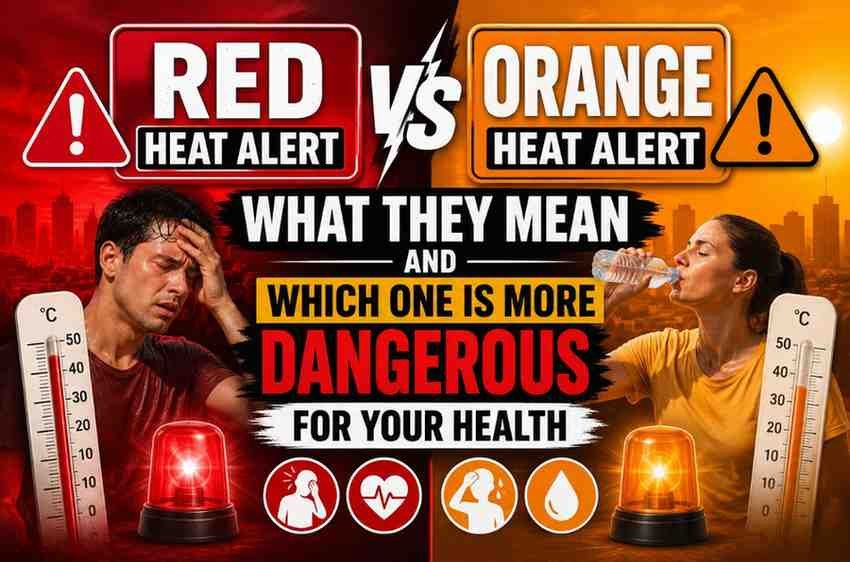
What do red and orange heat alerts really mean for your Health and which one should worry you more? As heatwaves become more frequent and intense, governments issue color coded warnings to signal danger. But for most people, these alerts can feel abstract. Who is at risk? Everyone from outdoor workers to elderly individuals and even healthy adults. What’s happening? Rising temperatures are pushing the human body beyond its natural cooling limits. When does it matter? During prolonged heatwaves, especially when nights remain hot. Where? Across urban and rural areas alike, but especially in densely built cities. Why does it matter? Because extreme heat affects the brain, heart, kidneys, and more. How can you stay safe? By understanding the real difference between heat alert levels and how your body responds.
Breaking Down Red and Orange Heat Alerts in Simple Terms
Heat alerts are designed to warn the public about dangerous temperature conditions, but the difference between orange and red alerts is more than just a color shift it reflects a significant escalation in risk.
| Alert Level | Temperature Severity | Health Risk | Typical Advisory |
|---|---|---|---|
| Orange Alert | High but manageable heat | Risk for vulnerable groups | Limit outdoor activity, stay hydrated |
| Red Alert | Extreme, life-threatening heat | Risk for entire population | Avoid exposure, emergency precautions |
In simple terms, an orange alert is a warning. A red alert is a crisis.
The Science: How Heat Affects the Human Body
Your body maintains a stable internal temperature through sweating and blood circulation. But extreme heat disrupts this balance.
- Dehydration: Excessive sweating leads to fluid and electrolyte loss
- Heat exhaustion: Fatigue, dizziness, nausea
- Heatstroke: A medical emergency where body temperature exceeds safe limits
During a red alert, these risks increase dramatically because the body simply cannot cool itself fast enough.
The Hidden Danger: Why Warm Nights Make Heatwaves Worse
Here’s the part most people underestimate: what happens at night matters just as much as daytime heat.
Doctors point out that when nights remain unusually warm, the body doesn’t get the chance to reset. Instead of recovering, it stays in a constant state of heat stress.
This creates a dangerous cycle:
- Daytime heat raises core body temperature
- Warm nights prevent cooling and recovery
- Stress accumulates across organs
- Risk of serious illness rises each day
Think of it like running a machine nonstop without giving it time to cool it eventually breaks down.
Red vs Orange Alert: Which Is More Dangerous?
The obvious answer is red alerts are more dangerous. But the reality is more nuanced.
Orange Alerts: The Underestimated Risk
Many people ignore orange alerts, assuming they’re not serious. But for:
- Elderly individuals
- Children
- People with heart or kidney conditions
Even “moderate” heat can trigger health issues.
Red Alerts: The Breaking Point
Red alerts signal conditions where:
- Even healthy individuals are at risk
- Outdoor exposure can become dangerous within minutes
- Hospitals may see spikes in heat related illnesses
Key insight: Orange alerts become dangerous when ignored. Red alerts become dangerous even when respected.
Urban Heat: Why Cities Feel Hotter Than Reality
Not all heat is experienced equally. Urban areas often trap heat due to concrete, traffic, and lack of greenery—a phenomenon known as the urban heat island effect.
This means:
- Nights stay warmer in cities
- Cooling is slower
- Residents face prolonged exposure
So an orange alert in a city can sometimes feel like a red alert in reality.
Real-World Impact: Who Faces the Highest Risk?
Heat doesn’t affect everyone equally. Some groups are far more vulnerable:
- Outdoor workers: Construction, delivery, agriculture
- Elderly people: Reduced ability to regulate temperature
- Low-income households: Limited access to cooling
- Urban residents: Higher nighttime temperatures
In many cases, the danger isn’t just the heat itself it’s the inability to escape it.
Comparison Insight: Heat vs Other Natural Risks
Here’s something surprising: heatwaves are often more deadly than floods or storms, but receive less attention.
| Hazard | Visibility | Immediate Impact | Long-Term Risk |
|---|---|---|---|
| Floods | High | Sudden | Moderate |
| Storms | High | Immediate | Moderate |
| Heatwaves | Low | Gradual | Severe and cumulative |
Heat is often called a “silent killer” because its effects build slowly but can be just as deadly.
How to Protect Yourself During Heat Alerts
Whether it’s an orange or red alert, smart precautions can make a huge difference.
During the Day
- Stay hydrated (don’t wait until you feel thirsty)
- Avoid direct sunlight between peak hours
- Wear light, breathable clothing
At Night
- Use fans or cooling methods to lower room temperature
- Keep windows ventilated if safe
- Take cool showers before sleep
Most important: Pay attention to nighttime temperatures they’re a key warning sign often overlooked.
Future Outlook: Why Heat Alerts Will Matter More Than Ever
Climate trends suggest that heatwaves are becoming:
- More frequent
- More intense
- Longer lasting
This means the difference between orange and red alerts will become increasingly critical not just for awareness, but for survival.
Prediction: In the future, nighttime temperatures may become a more important indicator than daytime highs when assessing heat risk.
Conclusion: The Real Danger Isn’t Just the Color It’s the Pattern
Red alerts are clearly more dangerous in the moment, signaling extreme and immediate risk. But orange alerts shouldn’t be underestimated especially when they stretch across multiple days with warm nights.
The real threat lies in cumulative heat exposure. When your body doesn’t get time to recover, even “moderate” heat can turn into a serious health risk.
So the next time you see a heat alert, don’t just look at the color. Pay attention to duration, nighttime temperatures, and your own environment. Because when it comes to heat, what builds quietly can hit the hardest.
For breaking news and live news updates, like us on Facebook or follow us on Twitter and Instagram. Read more on Latest Lifestyle on thefoxdaily.com.






COMMENTS 0