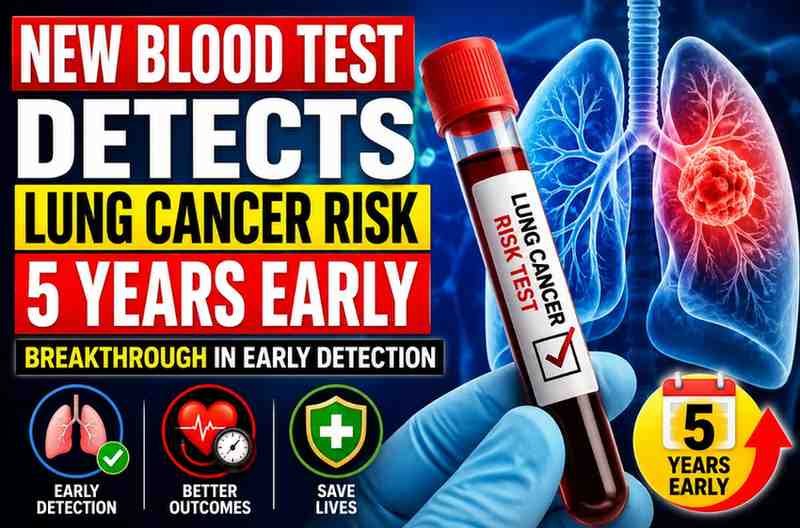
Every year, lung cancer kills more people than breast, colon, and prostate cancers combined. The brutal reason survival rates remain so poor just 20% at five years is not that the disease is untreatable. It is that it is almost always caught too late. By the time most patients experience symptoms or receive a diagnosis, the cancer has already spread beyond the point where curative surgery is possible. The new blood test research, published by scientists studying early cancer detection, may be the most significant shift in that grim equation in decades.
Researchers have identified a specific panel of 14 proteins circulating in the bloodstream that, when analyzed together, can flag a person’s elevated lung cancer risk years before a tumor becomes visible on any scan. The implications for screening programs, for high-risk smokers, for the economics of cancer care, and for millions of patients who currently receive their diagnosis when it is already too late are profound.
Why Lung Cancer Is a Late-Diagnosis Crisis
To understand why this discovery matters, it helps to understand just how badly the medical system currently fails lung cancer patients at the detection stage. Unlike breast cancer, which has widespread mammography screening, or colorectal cancer, which is routinely screened via colonoscopy, lung cancer has no universally adopted, accessible early detection tool.
Low-dose CT (LDCT) scanning exists and is recommended for high-risk individuals primarily long-term heavy smokers aged 50 to 80 but uptake is remarkably low. Studies suggest fewer than 10% of eligible Americans are actually getting screened. Barriers include lack of awareness, cost, access, and the fact that LDCT exposes patients to radiation and produces a high rate of false positives that lead to unnecessary, anxiety-inducing follow-up procedures.
The result is a diagnostic landscape where roughly 70% of lung cancer cases are still diagnosed at stage III or IV, when five-year survival rates collapse to under 10%. A blood test that could identify risk years in advance changes the entire upstream logic of how clinicians approach this disease.
The 14-Protein Blood Signature: How It Works
The research centers on proteomics the large-scale study of proteins expressed in the body. Unlike genetic mutations, which represent a fixed blueprint, proteins are dynamic. They reflect what is actually happening inside cells and tissues in real time. When cells begin the slow, precancerous process of malignant transformation, they produce altered proteins, and some of those proteins leak into the bloodstream long before a detectable tumor forms.
Scientists analyzed blood samples from thousands of participants in long-running population health studies, comparing samples taken years before a lung cancer diagnosis to those from matched individuals who never developed the disease. Using advanced machine learning models and mass spectrometry, they isolated 14 proteins whose combined presence and concentration levels were significantly associated with future lung cancer development.
Critically, this is not a single-protein biomarker a type of test that has historically failed to translate from lab to clinic due to poor specificity. The power of this model lies in its multi-protein panel approach. No single protein alone is a reliable signal; cancer biology is too complex for that. But 14 proteins working as a coordinated signature, analyzed together, deliver a predictive accuracy that has impressed researchers and clinicians reviewing the data.
The test demonstrated the ability to identify lung cancer risk up to five years before diagnosis, which in oncological terms represents a window of opportunity that could fundamentally alter patient outcomes.
What Five Years of Lead Time Actually Means in Cancer Medicine
Five years is not a clinical footnote. In cancer biology, it is an enormous intervention window. Here is why that timeline is so significant:
Lung cancer, in its early stages (Stage I and Stage IA specifically), is highly curable. Surgical resection of a localized tumor carries five-year survival rates exceeding 80-90%. The cancer does not become a death sentence at Stage I it becomes one at Stage IV. The distance between those two stages is time, and time is exactly what this blood test could provide.
A patient flagged as high-risk five years before their expected diagnosis could be enrolled in an intensive surveillance program LDCT every six to twelve months dramatically increasing the probability of catching any developing tumor while it is still small, localized, and surgically removable. They could also become candidates for chemoprevention trials, lifestyle intervention programs, and closer respiratory monitoring.
Perhaps most importantly, a positive blood test result communicates risk in a way that motivates behavior. Research on smoking cessation consistently shows that personalized, biological risk information is among the most effective motivators for quitting. Telling a patient that their blood chemistry shows pre-cancer warning signals is categorically different psychologically and clinically from telling them that their smoking history puts them in a statistical risk category.
How This Compares to Existing Lung Cancer Detection Methods
| Detection Method | Lead Time Before Diagnosis | Accessibility | False Positive Rate | Radiation Exposure | Current Screening Uptake |
|---|---|---|---|---|---|
| Low-Dose CT (LDCT) | 1–2 years (structural detection) | Moderate (specialist referral needed) | High (up to 96% of findings benign) | Yes (low dose) | ~10% of eligible patients |
| Symptom-Based Diagnosis | None (reactive) | Universal (primary care) | Low (but misses early disease) | None | Majority of current diagnoses |
| Liquid Biopsy (ctDNA) | 1–3 years (varies by cancer type) | Moderate (specialized labs) | Moderate | None | Limited (mostly post-diagnosis) |
| 14-Protein Blood Test (New) | Up to 5 years | High (standard blood draw) | Under investigation | None | Research phase |
The table above illustrates why the protein panel represents a qualitative leap rather than an incremental improvement. Its combination of early detection window, non-invasive collection method, and potential for primary care delivery puts it in a different category from any currently available tool.
The Science of Proteomics and Why This Approach Is Gaining Ground
Proteomic cancer detection is not entirely new, but it has historically struggled to cross the translation gap from research findings to validated clinical tools. Earlier efforts often identified single protein biomarkers CEA for colorectal cancer, PSA for prostate cancer that proved too imprecise in real-world populations to function as reliable standalone screening tests.
The evolution toward multi-marker panels, powered by machine learning pattern recognition, has changed the calculus considerably. The human proteome contains over 20,000 proteins, and the relationships between them in disease states are extraordinarily complex. What machine learning brings to this problem is the ability to identify non-obvious combinatorial patterns relationships between proteins that no individual researcher would intuitively connect, but that consistently differentiate pre-cancer blood profiles from healthy ones across large datasets.
This is the methodological breakthrough underpinning the 14-protein study. The researchers were not hunting for a single smoking gun. They were training algorithms to recognize a systemic biological fingerprint the body’s own chemistry beginning to shift years before the disease becomes structurally detectable.
Who Would Benefit Most and the Equity Dimension Nobody Is Discussing
The obvious primary beneficiaries of a validated lung cancer blood test are the populations currently eligible for LDCT screening: current and former heavy smokers, people with occupational exposures to carcinogens like asbestos and radon, and individuals with a family history of lung cancer. But there is a critically underexamined angle here that competitors in this coverage space are largely ignoring.
Lung cancer in never-smokers is a growing and deeply underserved clinical problem. Approximately 10-20% of lung cancer patients in Western countries and up to 50% in some Asian populations have never smoked. These patients are typically excluded from LDCT screening criteria entirely. They fall through every existing detection net because every existing detection net is designed around smoking history.
A protein-based blood test does not care about your smoking history. It reads your biology, not your behavior. If the 14-protein panel proves effective across both smoking and never-smoking populations, it could represent the first meaningful screening tool for a lung cancer demographic that currently has nothing no recommended screening, no routine testing, and consequently, some of the worst stage-at-diagnosis profiles in the entire disease population.
There is also a healthcare equity dimension. LDCT screening requires specialist referral, specialized equipment, and follow-up infrastructure. A blood test that can be ordered by any primary care physician run on the same laboratory equipment used for routine cholesterol or diabetes panels democratizes access in a way that imaging-based screening fundamentally cannot.
The Road From Research to Clinical Reality
It is important to be honest about where this technology actually stands. Identifying a promising biomarker panel in a research cohort is not the same as having a validated, approved clinical test. The path from here to routine use involves several demanding stages.
First, the findings require independent validation in separate, diverse populations. Research cohort findings do not always replicate across different ethnic groups, geographic populations, or healthcare settings. The protein signature needs to demonstrate consistent predictive accuracy in prospective studies meaning researchers follow people forward in time rather than analyzing historical samples before regulatory bodies will consider it for approval.
Second, clinical utility studies are needed. A test that predicts risk must be shown to actually change patient outcomes when deployed in clinical settings, not just predict them in a laboratory context. This requires demonstrating that patients who receive a positive result actually enter surveillance programs, that surveillance catches cancers earlier, and that earlier-caught cancers translate into improved survival.
Third, cost-effectiveness analyses will determine whether health systems are willing to fund the test at population scale. Given that lung cancer treatment at late stages costs orders of magnitude more than early-stage surgical cure, the economic case is intuitive but it still needs rigorous modeling across different healthcare systems with different reimbursement structures.
Optimistically, a validated, widely available version of this test could reach clinical practice within five to ten years, assuming research momentum is maintained and regulatory pathways are navigated efficiently.
What Patients and High-Risk Individuals Should Know Right Now
This test is not yet available outside of research settings, and it should not be misread as a reason to delay or forgo existing recommended screening. If you are a current or former heavy smoker between 50 and 80, low-dose CT screening is currently recommended and remains the standard of care. Speak with your physician if you have not yet been referred.
What this research does signal, however, is that the landscape of lung cancer early detection is shifting meaningfully. The coming decade is likely to produce blood-based screening tools that are simpler, cheaper, earlier-detecting, and more equitably accessible than anything available today. For a disease that has remained stubbornly lethal precisely because of late detection, that shift when it arrives will not be incremental. It will save lives on a scale that is difficult to overstate.
The Bigger Picture: Blood-Based Cancer Screening Is Coming
The 14-protein lung cancer study does not exist in isolation. It is part of a broader scientific movement toward multi-cancer early detection (MCED) blood tests platforms capable of simultaneously screening for multiple cancer types from a single blood draw. Companies and academic institutions worldwide are racing to develop tests that could flag colorectal, ovarian, pancreatic, and lung cancers years before symptoms emerge.
Lung cancer’s protein signature is one of the most advanced signals to emerge from this field so far, partly because lung cancer has been so thoroughly studied in large longitudinal cohorts that provide exactly the kind of long-term biological samples needed to identify pre-diagnostic markers.
The vision a routine annual blood panel that screens for multiple cancer types the way a lipid panel screens for cardiovascular risk is no longer science fiction. It is an engineering and regulatory challenge, and one that the scientific community is actively solving. The 14-protein discovery is a significant milestone on that road.
Conclusion: A Window That Has Never Existed Before
Lung cancer has long been defined by a brutal paradox: highly treatable when caught early, almost universally fatal when caught late and almost always caught late. The identification of a 14-protein blood signature that can predict risk five years before diagnosis does not solve that paradox yet. But it represents the clearest scientific pathway toward solving it that has ever existed.
The five-year lead time this test could provide is not just a statistical curiosity. It is a window a real, biological, actionable window into which clinicians, patients, and healthcare systems could pour surveillance, intervention, and potentially cure. For a disease that kills over 1.8 million people globally every year, that window is everything.
The science is not finished. The clinical validation work ahead is substantial. But the direction of travel is now unmistakable. Lung cancer’s defining problem finding it in time may finally be approaching a solution, and it may arrive not from a hospital scanner, but from a simple blood draw at your doctor’s office.
For breaking news and live news updates, like us on Facebook or follow us on Twitter and Instagram. Read more on Latest Health on thefoxdaily.com.




COMMENTS 0