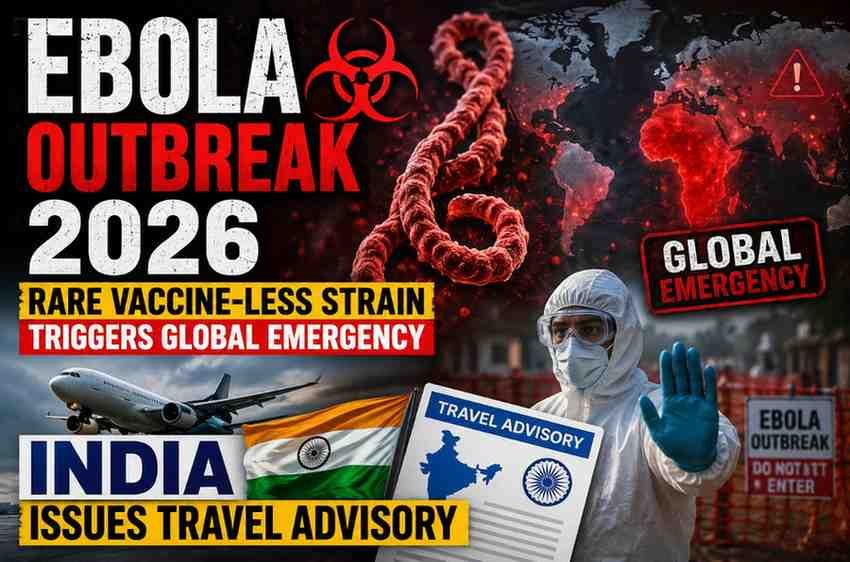
As a rare, vaccine-less strain of Ebola spreads rapidly across Central Africa and the WHO declares a global Health emergency, India moves swiftly to protect its citizens. Here is the full picture clearly explained.
When four healthcare workers die within four days from an unidentified illness in a remote mining town in the Democratic Republic of the Congo, the world pays attention — slowly at first, then all at once. That is exactly how the most dangerous Ebola outbreak in nearly a decade began. And it is precisely why India’s Ministry of Health and Family Welfare issued a formal Ebola travel advisory on May 21, 2026, warning all Indian citizens against non-essential travel to the Democratic Republic of the Congo (DRC), Uganda, and South Sudan.
This is not panic. This is pattern recognition. The same deadly virus, the same volatile region, and the same terrifying combination — a highly lethal pathogen with no approved vaccine and no specific treatment. India, home to over a billion people with significant diaspora ties to Africa, is right to act early and decisively. Here is everything that matters, explained plainly.
The Outbreak at a Glance: Numbers That Demand Attention
As of May 22, 2026, the World Health Organization has confirmed 836 suspected cases and at least 186 deaths across the DRC and Uganda. The confirmed case count stands at 85, but that number is expected to climb substantially as laboratory testing catches up with the explosive geographic spread. The WHO itself upgraded the DRC’s internal risk level to “very high” on May 22 — its most serious national alert category — while the regional risk level was rated “high”.
These are not projections from a worst-case simulation. They are the real, verified figures from active outbreak tracking. And the trajectory is still upward.
What Is the Bundibugyo Strain and Why Does It Change Everything
Most people who followed the 2014–2016 West African Ebola crisis learned about the Zaire ebolavirus — the strain responsible for over 11,000 deaths and the epidemic that reshaped global health preparedness. The vaccines and therapeutics developed in its aftermath, including Ervebo, were engineered specifically against the Zaire strain.
The 2026 outbreak is caused by a different and considerably rarer pathogen: bundibugyo ebolavirus (BDBV). First identified in Uganda’s Bundibugyo District in 2007, this strain has been responsible for only two previous outbreaks — one in Uganda in 2007–2008 and another in the DRC in 2012. What makes this uniquely dangerous in 2026 is a sobering medical reality: there is no licensed vaccine and no approved specific therapeutic for the Bundibugyo strain.
The epidemic is caused by the Bundibugyo ebolavirus, which may complicate response efforts as existing Ebola treatments are primarily tested and approved against the Zaire ebolavirus strain. Early supportive care remains the primary lifesaving intervention available to clinicians on the ground.
In plain terms: the enormous investment in Ebola countermeasures that the world made after 2014 does not neatly apply to this outbreak. Experimental Bundibugyo vaccines have been tested on macaques, and experts are debating whether to deploy Ervebo off-label for Bundibugyo patients — but these are options under active investigation, not solutions already in the field. The case fatality rate for the Bundibugyo strain in previous outbreaks ranged between 25% and 50%. That is not a typo.
How the Bundibugyo Strain Compares to the Zaire Strain
| Feature | Bundibugyo Ebolavirus | Zaire Ebolavirus |
|---|---|---|
| First Identified | 2007, Uganda | 1976, DRC |
| Total Known Outbreaks | 3 (including 2026) | Multiple, including 2014–2016 West Africa |
| Licensed Vaccine | None | Ervebo (rVSV-ZEBOV) |
| Approved Treatment | None | Inmazeb, Ebanga |
| Case Fatality Rate | 25%–50% | Up to 90% (untreated) |
| Transmission Route | Direct contact with bodily fluids | Direct contact with bodily fluids |
| WHO Risk Level (2026) | Very High (DRC national), High (regional) | Not current outbreak strain |
How This Outbreak Began: A Timeline of Events
Understanding the origin of this crisis is essential — not just medically, but as a lesson in how quickly a modern outbreak scales when early detection infrastructure is inadequate.
April 25, 2026 — The Index Case
The suspected index case, a healthcare professional working in Mongbwalu in DRC’s Ituri Province, develops symptoms. The disease goes unrecognized for nearly four weeks. Mongbwalu is a high-traffic gold mining hub with constant movement of workers and traders across the region — the worst possible environment for silent spread.
May 5, 2026 — WHO Receives the First Alert
The WHO is notified of an unknown illness with high mortality in Mongbwalu Health Zone, including reports of four health workers who died within four days. Rapid response teams are deployed to investigate.
May 13–15, 2026 — Laboratory Confirmation and Official Declaration
Laboratory testing by the Institut National de la Recherche Biomédicale in Kinshasa confirms Bundibugyo virus disease across at least three health zones in Ituri Province. DRC officially declares its 17th Ebola outbreak — just five months after the end of its previous one. Uganda confirms two imported cases within 24 hours, including a Congolese man who died in Kampala.
May 16–17, 2026 — WHO Declares a Global Health Emergency (PHEIC)
The WHO Director-General formally declares a Public Health Emergency of International Concern (PHEIC) — the highest tier of international health alert, reserved for the most critical global situations. The Africa Centres for Disease Control and Prevention (Africa CDC) simultaneously declares a Public Health Emergency of Continental Security (PHECS).
May 19, 2026 — First WHO Emergency Committee Meeting
The IHR Emergency Committee convenes and issues temporary recommendations, including enhanced surveillance at all points of entry globally for travelers arriving from affected areas showing unexplained fever.
May 21, 2026 — India Issues its Travel Advisory
India’s Ministry of Health and Family Welfare formally advises all Indian citizens to avoid non-essential travel to the DRC, Uganda, and South Sudan until further notice. Indians already in these countries are urged to strictly follow health precautions and register with local Indian diplomatic missions.
May 22, 2026 — WHO Upgrades DRC Risk to “Very High”
As the outbreak spreads into North Kivu, South Kivu, and reaches Kinshasa, the WHO elevates the DRC’s internal risk level to its highest category. Suspected cases now exceed 836 with 186 reported deaths.
Why India Issued the Advisory: The Reasoning That Matters
India’s travel advisory is not a reflexive gesture. It is a carefully calibrated response to a specific combination of risk factors. Understanding why India acted — and why South Sudan was included alongside DRC and Uganda — reveals how modern health diplomacy and outbreak intelligence work together.
The Four-Week Detection Gap: The Real Reason the Virus Spread
One of the most alarming features of this outbreak is the delay between the index case developing symptoms on April 25 and official laboratory confirmation on May 13 — a four-week detection gap. Africa CDC explicitly identified this gap as the primary factor enabling geographic spread before any containment effort could begin. Had detection occurred within the first week, the outbreak might have remained contained to a single health zone in a remote province.
This delay is not a failure unique to any one country’s health system. It reflects the genuine challenges of identifying a rare Ebola strain in a resource-limited mining region with limited diagnostic infrastructure and — critically — a low index of clinical suspicion among local providers who had never encountered Bundibugyo virus before. For India’s health planners, the lesson is stark: by the time a disease is confirmed internationally, it has almost certainly already traveled.
Why Ituri Province Is a Geographic Risk Multiplier
The outbreak’s epicenter, Ituri Province in northeastern DRC, is not a remote and isolated region. It is one of Central Africa’s busiest commercial and migration corridors. Ituri shares borders with both Uganda and South Sudan. Its provincial capital, Bunia, sits less than 500 kilometres from Kampala, Uganda’s capital. The province hosts active gold mining operations that draw transient workers from across the region, and cross-border movement — legal and informal — is a daily reality.
The imported case that reached Kampala confirmed what epidemiologists feared: the virus was already operating beyond its origin zone. South Sudan’s inclusion in India’s advisory reflects this same geographic logic. South Sudan borders Ituri directly, has fragile health infrastructure, and has active population movement with both Uganda and the DRC. Including it proactively is the right call.
India Has No Cases — And Intends to Keep It That Way
India has not reported a single confirmed or suspected case of Bundibugyo virus disease. This is the important baseline. But the travel advisory was issued precisely to preserve that status, not to respond to a domestic emergency. The Indian government formally ranked Ebola among the top 10 viral threats to India as far back as 2019. Significant Indian communities exist across Africa — professionals, traders, students, and workers with family ties spanning both continents. The advisory, combined with enhanced airport surveillance as recommended by the WHO Emergency Committee, is India’s early defensive line.
What Indian Citizens in These Countries Must Do Right Now
For those already present in the DRC, Uganda, or South Sudan, the advisory is not simply an instruction to leave. It is a practical health guidance document. Here is what the government’s recommendations translate to on the ground:
- Avoid all contact with sick individuals, particularly those showing unexplained fever, vomiting, diarrhea, or any form of bleeding — the hallmark symptoms of viral hemorrhagic fever
- Do not touch the bodies or bodily fluids of any person who has died from an unknown illness, including through local burial or mourning practices, which have historically been a major transmission vector in Ebola outbreaks
- Avoid contact with wild animals, including primates and fruit bats, which are believed to be natural reservoir hosts of ebolaviruses
- Practice rigorous hand hygiene at all times — frequent handwashing with soap and water, or alcohol-based hand sanitizer where water is unavailable
- Seek immediate medical attention if fever or flu-like symptoms develop within 21 days of returning to India from any of the affected countries, and proactively disclose your travel history to any healthcare provider
- Register with the nearest Indian embassy or high commission to remain informed of evacuation options and evolving local conditions
- Follow all instructions from local health authorities and do not rely on unverified information circulating on social media
The Deeper Problem: Why There Is Still No Bundibugyo Vaccine in 2026
After two previous Bundibugyo outbreaks 2007 in Uganda and 2012 in DRC the global medical community did not successfully develop and license a vaccine for this strain. Experimental candidates existed. Animal trials were conducted. But the funding and commercial incentives required to push a vaccine through full human clinical trials were simply not sustained for a strain that had caused only two relatively limited outbreaks.
This is the uncomfortable structural reality of outbreak preparedness financing. Diseases that do not kill frequently enough, or that have not yet generated a sufficiently largescale catastrophe, struggle to attract the sustained investment needed to build a full vaccine pipeline. The Bundibugyo strain in 2026 is, in part, paying the price of that gap and so are the patients in Ituri Province and Kampala.
Experts are now discussing accelerated deployment of Ervebo on a compassionate use or experimental basis for Bundibugyo patients, and an emergency research track to fast track a Bundibugyo-specific vaccine is expected to be on the agenda at upcoming WHO technical working group meetings. But these are conversations that, by rights, should have been concluded years ago.
The Broader Outlook: Grounds for Concern and Cautious Optimism
As of late May 2026, the outbreak’s trajectory remains deeply uncertain, and honest analysis requires acknowledging both the risks and the strengths of the current response.
Why the Situation Remains Serious
Geographic spread is the most alarming indicator right now. Cases have emerged not just in Ituri Province but in North Kivu, South Kivu, and Kinshasa DRC’s capital, home to nearly 17 million people, with international air connections to dozens of countries worldwide. A capital city presence fundamentally changes the containment calculus. Active conflict in eastern DRC continues to impede the deployment of response teams and the ability to conduct rigorous contact tracing the single most critical tool for breaking Ebola transmission chains.
Why the Response Is Better Than 2014
The WHO declared a PHEIC within days of the outbreak crossing into Uganda not months, as happened with catastrophic consequences during the 2014 West Africa crisis. The Africa CDC’s parallel PHECS declaration activated continental coordination mechanisms that did not exist a decade ago. India and other nations issuing proactive travel advisories, strengthening port of entry surveillance, and aligning with WHO temporary recommendations represents exactly what a functioning global health governance architecture looks like in operation.
The world is not helpless. It is, however, fighting this outbreak without its most powerful tools and that is a problem that extends well beyond the current crisis.
Conclusion: What This Moment Means and What Comes Next
India’s travel advisory against the DRC, Uganda, and South Sudan is the right decision at the right time. The 2026 Bundibugyo Ebola outbreak is the third of its kind in history and by far the largest, unfolding in a region where geography, population mobility, mining-industry transit, and proximity to conflict zones have combined to create near-ideal conditions for spread. With no approved vaccine and no specific treatment, the only tools available are the ones public health has always depended on: early detection, rapid containment, transparent communication, and precautionary action before crisis becomes catastrophe.
India has zero confirmed cases. It intends to keep it that way. For Indian travelers, expatriates, students, and families with ties to Central and East Africa, the message from the government is unambiguous: avoid non essential travel to DRC, Uganda, and South Sudan until the WHO lifts its emergency designation or India’s Ministry of Health issues an updated advisory.
Stay updated through official channels the Ministry of Health and Family Welfare, the WHO Disease Outbreak News, and the Africa CDC situation reports as this outbreak is active, fast-moving, and far from over.
For breaking news and live news updates, like us on Facebook or follow us on Twitter and Instagram. Read more on Latest Health on thefoxdaily.com.






COMMENTS 0