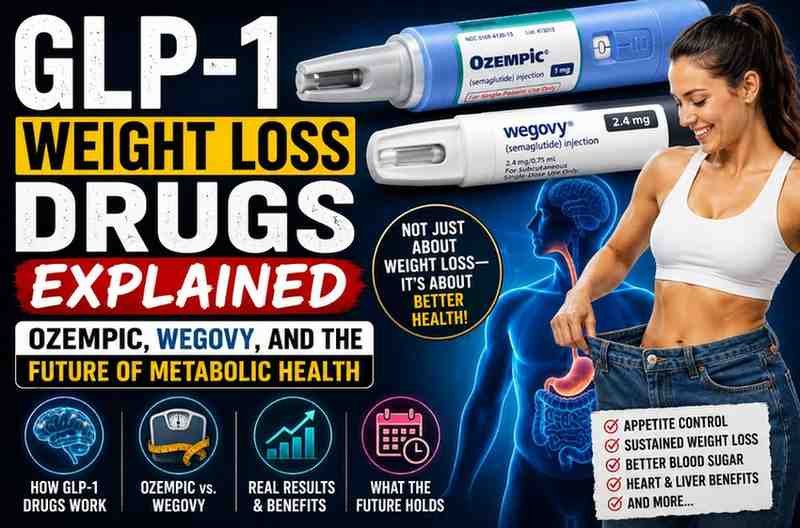
From Diabetes Management to Global Phenomenon
GLP-1 (glucagon-like peptide-1) receptor agonists were originally developed to manage type 2 diabetes. By mimicking a naturally occurring gut hormone, these drugs stimulate insulin secretion, suppress glucagon release, and critically signal the brain to reduce appetite and slow gastric emptying. The result is a powerful combination of blood sugar regulation and dramatic, sustained weight loss that earlier anti-obesity medications had never achieved.
Ozempic (semaglutide, 0.5–2mg weekly injection) was approved by the US FDA for type 2 diabetes in 2017. Its higher-dose sibling Wegovy (semaglutide 2.4mg) received obesity approval in 2021. Clinical trials showed average weight reductions of 15–17% of body weight figures that had previously only been associated with bariatric surgery.
Then came tirzepatide. Eli Lilly’s dual GIP/GLP-1 agonist, marketed as Mounjaro for diabetes and Zepbound for obesity, pushed efficacy even further, with some trial participants losing over 20% of body weight. The competitive landscape had been irrevocably altered.
The Social Media and Celebrity Effect: Separating Hype from Reality
No pharmaceutical product in recent memory has benefited or suffered from viral cultural attention the way GLP-1 drugs have. Social media platforms, particularly TikTok and Instagram, became informal patient communities where users documented dramatic transformations, shared injection tips, and debated side effects with the candour rarely found in clinical literature.
Celebrity influence amplified this further. While few A-listers have openly confirmed GLP-1 use, the visible physical transformations of numerous Hollywood figures combined with persistent industry rumours created an association between these drugs and aspirational thinness that both accelerated demand and, for many physicians, complicated the clinical narrative.
The consequence was a supply crisis. In 2022 and 2023, Ozempic shortages became a genuine public Health concern as off-label use by individuals without diabetes consumed stock intended for diabetic patients. Novo Nordisk and Eli Lilly were forced into unprecedented manufacturing expansions, with billions committed to new production facilities across the United States and Europe.
The cultural velocity of GLP-1 adoption is without modern pharmaceutical precedent. A drug class moving from diabetes treatment to mainstream lifestyle intervention within five years represents a convergence of clinical efficacy, celebrity amplification, and unmet patient need that the industry was not structurally prepared for.
Beyond Obesity: The Expanding Therapeutic Frontier
If the obesity story defined GLP-1’s first chapter, the expanding therapeutic pipeline defines its second and it is considerably more ambitious. Researchers and pharmaceutical companies are investigating GLP-1 receptor agonists across a remarkably broad spectrum of conditions, and early data is consistently compelling.
Cardiovascular Disease
The SELECT trial, published in 2023, demonstrated that semaglutide reduced major adverse cardiovascular events (MACE) by 20% in overweight or obese patients with established cardiovascular disease but without diabetes. This was not simply a consequence of weight loss the cardiovascular benefit appeared partly independent of body weight reduction, suggesting GLP-1 receptors in cardiac tissue play a direct protective role. The FDA subsequently approved Wegovy for cardiovascular risk reduction in 2024, marking a fundamental repositioning of the drug beyond obesity.
Non-Alcoholic Steatohepatitis (NASH)
Resmetirom (Rezdiffra) became the first FDA-approved NASH treatment in 2024, but semaglutide’s Phase III NASH trials (ESSENCE) have shown strong efficacy in resolving steatohepatitis without worsening fibrosis. Given NASH’s status as a leading driver of liver transplantation, GLP-1 approval in this indication would be transformative.
Addiction and Compulsive Behaviour
Perhaps the most unexpected frontier is neurological. Multiple studies and a growing body of patient anecdotes suggest GLP-1 agonists reduce cravings not just for food but for alcohol, nicotine, and opioids. Researchers hypothesise that GLP-1 receptors in the brain’s reward circuitry modulate dopaminergic responses to addictive stimuli. Clinical trials in alcohol use disorder and smoking cessation are now underway, with preliminary results described by investigators as “striking.”
Kidney Disease, Obstructive Sleep Apnoea, and Alzheimer’s
Semaglutide’s FLOW trial demonstrated a 24% reduction in kidney disease progression in patients with type 2 diabetes and chronic kidney disease. Tirzepatide trials have shown significant improvement in obstructive sleep apnoea severity. And in perhaps the most speculative but scientifically plausible extension, GLP-1 receptor agonists are being studied in early Alzheimer’s disease with the hypothesis that the drugs’ anti-inflammatory and neuroprotective properties may slow cognitive decline.
| Therapeutic Area | Drug / Trial | Key Finding | Regulatory Status (2025) |
|---|---|---|---|
| Type 2 Diabetes | Semaglutide (Ozempic) | HbA1c reduction up to 2.0%; established first-line agent | FDA Approved (2017) |
| Obesity | Semaglutide (Wegovy) | ~15–17% body weight reduction vs placebo | FDA Approved (2021) |
| Obesity (dual agonist) | Tirzepatide (Zepbound) | ~20–22% body weight reduction; superior to semaglutide | FDA Approved (2023) |
| Cardiovascular Risk | Semaglutide (SELECT trial) | 20% reduction in MACE events in non-diabetic obese patients | FDA Approved (2024) |
| Kidney Disease | Semaglutide (FLOW trial) | 24% reduction in kidney disease progression | FDA Approved (2024) |
| Sleep Apnoea | Tirzepatide (SURMOUNT-OSA) | ~63% reduction in apnoea-hypopnea index | FDA Approved (2024) |
| NASH / Liver Disease | Semaglutide (ESSENCE trial) | Significant NASH resolution; Phase III ongoing | Under Review |
| Alcohol Use Disorder | Semaglutide / Exenatide | Preliminary reduction in alcohol cravings and consumption | Phase II/III Trials |
| Alzheimer’s Disease | Semaglutide / Liraglutide | Potential neuroprotective effect; anti-inflammatory pathway | Early Phase Trials |
The Metabolic Health Reframe: Why This Is Not a Crash Diet
One of the most significant — and underreported — shifts in GLP-1 discourse has been the migration from aesthetic framing to metabolic framing. Early media coverage leaned heavily on celebrity weight loss and the drug’s cosmetic appeal. Medical and scientific communities have been working against that narrative, insisting on a more rigorous understanding: GLP-1 drugs are not accelerated calorie restriction. They are interventions in a complex neuroendocrine system.
Obesity is now understood by most major medical associations not as a behavioural failure but as a chronic, relapsing disease driven by biological and genetic factors. GLP-1 drugs treat that biology directly. The appetite suppression they induce is not willpower it is pharmacological recalibration of hunger signals that, in many patients with obesity, are dysregulated at a hormonal level.
This matters because it changes the conversation around long-term use. Unlike crash dieting, which produces metabolic adaptation and near-inevitable rebound, patients on GLP-1 therapy tend to maintain weight loss as long as they continue treatment. Critically, studies show that discontinuation leads to rapid weight regain not because patients lack discipline, but because the underlying biological drivers reassert themselves. This has led to growing clinical consensus that GLP-1 therapy, like hypertension medication, may need to be maintained indefinitely for sustained benefit.
Access, Affordability, and the Global Equity Gap
At approximately $900–$1,400 per month in the United States without insurance, Wegovy and Zepbound remain inaccessible to the majority of the global population that could benefit. Compounded semaglutide prepared by independent pharmacies emerged as a lower-cost alternative, though the FDA has moved to restrict this practice as brand-name supplies stabilise.
In markets such as India, where type 2 diabetes prevalence is estimated at over 100 million patients, the economics of brand-name GLP-1 therapy make widespread adoption virtually impossible at current pricing. Generic versions of liraglutide (an earlier GLP-1 agonist) are available in India at significantly lower cost, and there is growing domestic pharmaceutical interest in developing biosimilar semaglutide though regulatory and intellectual property hurdles remain substantial.
This access gap is not merely a commercial concern. It is an equity issue with civilisational stakes. If GLP-1 drugs ultimately prove effective across cardiovascular disease, kidney disease, metabolic dysfunction, and potentially neurodegeneration, their restriction to wealthy populations will perpetuate and widen the chronic disease burden in lower-income countries at precisely the moment when a pharmacological lever is available.
Risks, Side Effects, and the Limits of the Revolution
No honest assessment of GLP-1 drugs can omit their limitations. Nausea, vomiting, and gastrointestinal distress remain the most common adverse effects, affecting a significant minority of patients and causing discontinuation in some. Reports of muscle mass loss alongside fat loss have raised concerns about body composition changes, particularly in older patients, and the importance of resistance training and adequate protein intake during GLP-1 therapy is increasingly emphasised.
More seriously, rare cases of aspiration pneumonia during anaesthesia (in patients with delayed gastric emptying from GLP-1 use) have prompted new pre-operative guidelines. And signals around a potential increased risk of thyroid C-cell tumours seen in rodent studies continue to warrant surveillance, though human data has not confirmed this risk to date.
There is also the psychological dimension. For individuals with a history of disordered eating, GLP-1-induced appetite suppression can interact unpredictably with existing patterns. The clinical community is increasingly attentive to the need for psychological support alongside pharmacological treatment a component notably absent from many telehealth prescribing models that have proliferated in the GLP-1 boom.
The Next Generation: Oral Formulations and Triple Agonists
The GLP-1 pipeline does not end with semaglutide and tirzepatide. Novo Nordisk’s oral semaglutide (Rybelsus, already approved for diabetes) is under development in higher-dose formulations for obesity a needle-free option that could dramatically expand the addressable patient population. Oral delivery of peptide drugs has historically been a formidable pharmaceutical challenge, making progress here genuinely significant.
Further along the experimental frontier, triple agonists targeting GLP-1, GIP, and glucagon receptors simultaneously are showing remarkable early efficacy. Eli Lilly’s retatrutide demonstrated weight loss exceeding 24% in Phase II trials approaching the outcomes of surgical intervention. If Phase III data holds, the ceiling on pharmacological obesity treatment will be pushed substantially higher.
The decade ahead is likely to see GLP-1-class drugs not merely as weight-loss interventions but as foundational components of metabolic Medicine used preventively, maintained long-term, and prescribed across a spectrum of chronic conditions that, until recently, were managed only symptomatically.
Conclusion: A Pharmaceutical Inflection Point
The GLP-1 revolution represents one of those rare moments when a single drug class genuinely alters the trajectory of medicine. The viral celebrity story that drove initial public awareness was, in retrospect, a superficial prologue to a far deeper narrative: the pharmacological treatment of metabolic dysfunction at a biological root cause, with downstream effects rippling across cardiology, hepatology, nephrology, neurology, and addiction medicine.
The challenges ahead access equity, long-term safety surveillance, healthcare system adaptation, and the psychological complexity of medicalising body weight are real and significant. But the clinical evidence accumulating across indication after indication suggests that GLP-1 receptor agonists are not a trend. They are infrastructure. And the question facing medicine, regulators, and health systems globally is not whether these drugs will reshape chronic disease management but how equitably and thoughtfully that reshaping will be allowed to occur.
For breaking news and live news updates, like us on Facebook or follow us on Twitter and Instagram. Read more on Latest Health on thefoxdaily.com.






COMMENTS 0