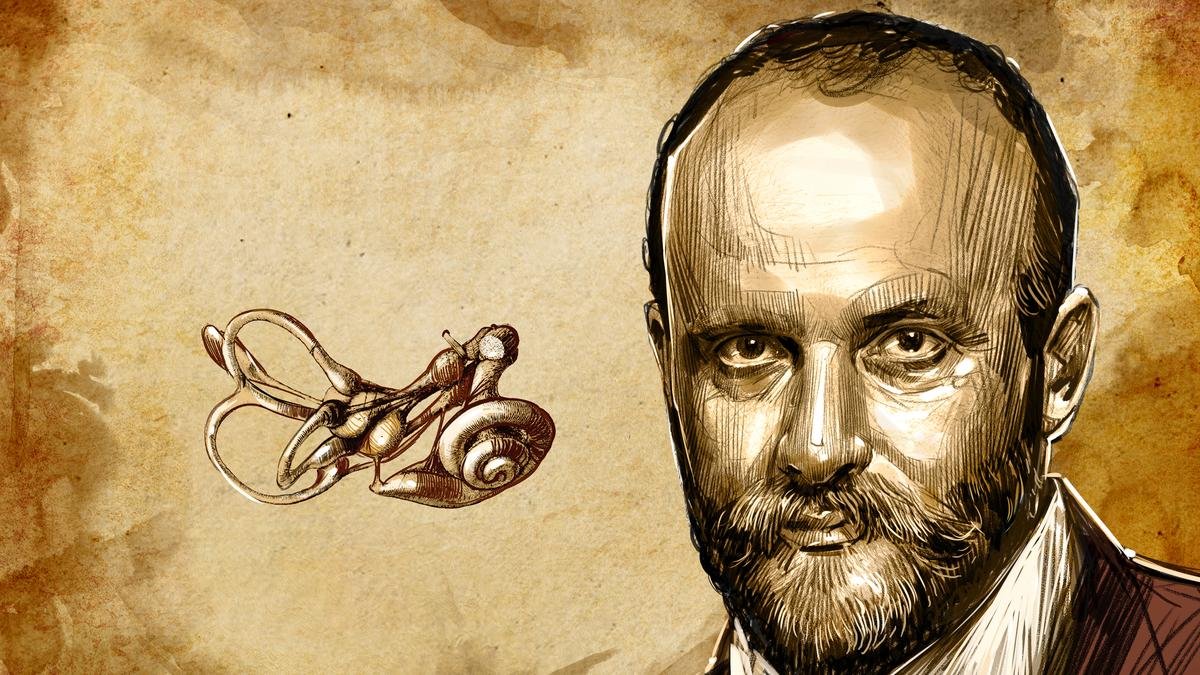
Robert Bárány’s Nobel Prize-winning work changed the way doctors understood one of the human body’s most easily misunderstood sensations: dizziness. Before his research, vertigo, imbalance and involuntary eye movements were often difficult to connect to a specific part of the nervous system. Patients could feel that the room was spinning, yet physicians had limited ways to determine whether the problem came from the ear, the brain or another part of the body.
Bárány’s investigations into the vestibular apparatus transformed that situation. His experiments demonstrated that the inner ear contains a sophisticated system capable of detecting movement and contributing to spatial orientation. His work on the caloric reflex, in particular, showed that changing the temperature of the ear could produce predictable movements of fluid within the semicircular canals, triggering vertigo and characteristic involuntary eye movements known as nystagmus.
The significance went far beyond one unusual laboratory experiment. Bárány helped turn balance from an anatomical mystery into a physiological system that physicians could test.
That shift created the foundations of modern vestibular medicine. Today, clinicians use principles derived from vestibular physiology to investigate vertigo, dizziness, abnormal eye movements and balance disorders. Modern tests are vastly more sophisticated than the techniques available to Bárány, but many still depend on the same basic insight: the eyes and inner ear provide measurable clues about how the brain is processing movement and orientation.
Why Robert Bárány’s Nobel Prize was a turning point
The Nobel Prize in Physiology or Medicine awarded to Robert Bárány in 1914 recognised his work on the physiology and pathology of the vestibular apparatus. The award was reserved for a year, and Bárány formally received the prize in 1915.
The timing was significant. At the beginning of the twentieth century, physicians were increasingly aware that the inner ear did much more than support hearing. Anatomical research had identified structures associated with equilibrium, including the semicircular canals, but knowing where a structure was located was not the same as understanding what it did.
Bárány helped bridge that gap.
He approached dizziness as a physiological problem that could be experimentally investigated. Instead of treating vertigo as a vague symptom, he studied the relationship between stimulation of the ear, sensations of movement and involuntary eye responses.
This was a major conceptual advance. A patient’s description of “the room spinning” could now be considered alongside observable neurological signs.
Who was Robert Bárány?
Robert Bárány was born in Vienna in 1876 and trained as a physician before developing his career in otology, the medical specialty concerned with the ear.
He worked at the University of Vienna and became deeply interested in the relationship between the inner ear and balance. His research emerged during an era when physiology was becoming increasingly experimental. Physicians were no longer satisfied with describing symptoms; they wanted to understand the mechanisms producing them.
Bárány’s work fitted perfectly into this transformation.
His research also developed in a practical clinical environment. Ear specialists regularly encountered patients with dizziness, abnormal eye movements and equilibrium problems, but the connection between these signs and the vestibular organs was still being worked out.
Bárány’s experiments provided a way to provoke and measure vestibular responses under controlled conditions.
The inner ear is not only an organ of hearing
One of the most important lessons from Bárány’s research is that the ear is actually home to two closely related sensory systems.
The cochlea is primarily responsible for hearing. The vestibular system, located within the inner ear, provides information about head movement and position.
The vestibular apparatus includes three semicircular canals as well as the otolith organs, the utricle and saccule.
The semicircular canals are particularly important for detecting angular acceleration—in other words, changes in rotational movement of the head. The utricle and saccule contribute to sensing linear acceleration and the effects of gravity.
These organs continuously send information to the brain. The brain then integrates vestibular signals with information from vision and proprioception—the sensory information generated by muscles, joints and other tissues about the body’s position.
This integration explains why balance is not controlled by the inner ear alone.
The vestibular system supplies information; the brain combines it with information from other sensory systems to construct an internal estimate of where the body is and how it is moving.
What is the caloric reflex?
The caloric reflex became one of the most important practical outcomes of Bárány’s research.
In simplified terms, introducing warm or cool water into the external ear canal can change the temperature of the nearby tissues and create convection-related movement in the fluid of the horizontal semicircular canal when a person is positioned appropriately.
The resulting vestibular stimulation can cause a sensation of movement and produce characteristic involuntary eye movements.
The eye response is called nystagmus. It consists of rhythmic, involuntary eye movements that occur as part of the vestibulo-ocular reflex.
The phenomenon gave physicians something extremely valuable: a visible response to controlled vestibular stimulation.
That was a major advance because the inner ear itself cannot be directly observed during ordinary clinical examination. Instead, clinicians could infer how the vestibular system was functioning by observing the eyes and the patient’s response to stimulation.
Why moving the eyes can reveal what is happening in the ear
The connection between the vestibular system and eye movements is one of the most elegant aspects of human physiology.
When the head moves, the eyes need to compensate if the visual world is to remain relatively stable on the retina. The vestibulo-ocular reflex, or VOR, helps accomplish this.
For example, when the head turns to one side, the eyes automatically move in the opposite direction. This response happens rapidly and largely without conscious effort.
Without an effective VOR, even ordinary head movements can make the visual environment appear to jump or blur.
Bárány’s work helped physicians understand that abnormal eye movements were not merely incidental findings. They could provide important information about vestibular function.
This principle remains central to modern vestibular examination.
Why vertigo feels so strange
Vertigo is often described simply as dizziness, but the distinction matters.
Vertigo is an illusion of movement. A person may feel that they are spinning, tilting, falling or that the surrounding environment is moving even when the body is stationary.
The sensation can occur when the brain receives conflicting information from the sensory systems responsible for orientation.
Imagine that the vestibular system signals that the head is rotating while the eyes provide information suggesting that the environment is stationary. The brain must reconcile those conflicting messages.
That mismatch can produce powerful symptoms such as spinning, nausea, imbalance and abnormal eye movements.
This helps explain why vestibular disorders can be so disorienting. The problem is not simply that a person “feels dizzy.” The brain’s internal model of movement and orientation has been disrupted.
From Bárány’s experiments to modern vestibular diagnosis
Bárány’s work established a diagnostic philosophy that remains highly relevant: stimulate the balance system, observe the response and use the pattern to identify dysfunction.
Modern vestibular medicine has expanded this principle dramatically.
- Caloric testing: Controlled thermal stimulation can assess the function of the horizontal semicircular canals and vestibular pathways.
- Video head impulse testing: High-speed cameras can measure eye movements during rapid head rotations.
- Rotary chair testing: Controlled rotational stimulation can assess vestibular responses under different conditions.
- Vestibular evoked myogenic potentials: These tests can provide information about specific otolith-related pathways.
- Eye movement examination: Clinicians analyse nystagmus and other eye movements for clues about vestibular or neurological dysfunction.
These technologies are far removed from the equipment available to Bárány. Yet they all reflect the same broader scientific strategy: turn an invisible sensory process into measurable physiological data.
The overlooked importance of nystagmus
One of the most valuable clinical lessons associated with vestibular physiology is that the direction and characteristics of nystagmus can contain diagnostic information.
Clinicians do not simply ask whether a patient’s eyes move involuntarily. They examine how the eyes move, under what conditions the movement appears and whether other neurological signs are present.
This matters because not every cause of dizziness originates in the inner ear.
Peripheral vestibular disorders involve structures such as the inner ear or vestibular nerve. Central causes can involve the brainstem, cerebellum or other parts of the central nervous system.
Careful eye-movement examination can therefore help clinicians decide whether symptoms are more consistent with a peripheral vestibular problem or whether further neurological evaluation may be necessary.
Bárány’s legacy is particularly powerful here: an eye movement can become a window into a sensory system that cannot easily be inspected directly.
Benign positional vertigo and the importance of head movement
Modern vestibular medicine has also revealed that some of the most common causes of vertigo are mechanical.
Benign paroxysmal positional vertigo, commonly called BPPV, occurs when tiny calcium carbonate crystals called otoconia become displaced from their normal location within the otolith organs and enter a semicircular canal.
When the head changes position, these displaced particles can move through the canal and generate abnormal signals.
The result can be brief episodes of intense positional vertigo, often accompanied by characteristic nystagmus.
BPPV is an excellent example of how far vestibular medicine has progressed since Bárány. Physicians now understand not only that head movement can trigger vertigo but also how physical particles inside the inner ear can alter the sensory signal.
Treatment can sometimes involve specific repositioning manoeuvres that use gravity and controlled head movements to return the displaced particles to an appropriate location.
Not all dizziness is an inner-ear disorder
This is perhaps one of the most important points for understanding Bárány’s legacy accurately.
His work demonstrated the importance of the vestibular apparatus, but modern medicine does not interpret every episode of dizziness as an ear problem.
Dizziness can have many causes, including vestibular disorders, neurological conditions, medication effects, cardiovascular problems, visual disturbances and other systemic factors.
Some causes can be relatively benign, while sudden dizziness accompanied by neurological symptoms can signal a medical emergency.
This is why modern vestibular diagnosis depends on history, examination and targeted testing rather than one universal test.
The enduring lesson is not that the ear explains every dizzy spell. It is that balance symptoms can be investigated systematically by understanding how sensory systems interact.
Robert Bárány’s contribution compared with modern vestibular science
The contrast between 1914 and today illustrates the extraordinary progress of medical science.
- Bárány’s era: Physicians were establishing the physiological relationship between the inner ear, eye movements and balance.
- Mid-twentieth century: Researchers increasingly clarified vestibular pathways connecting the inner ear with the brain and eye-movement systems.
- Modern era: Video-based eye tracking, sophisticated vestibular testing and neuroimaging allow clinicians to analyse balance disorders with much greater precision.
But technological progress has not replaced the physiological framework established during the early twentieth century. It has refined it.
The modern vestibular laboratory can be viewed as an extremely advanced extension of Bárány’s original approach: create a controlled stimulus, measure the body’s response and use physiology to understand disease.
Why Bárány’s discovery matters beyond vertigo
Balance is often taken for granted until it fails. The vestibular system contributes to far more than preventing falls.
It helps stabilise vision during movement, supports posture and contributes to spatial orientation. It also interacts with systems involved in navigation, motion perception and autonomic responses.
This explains why vestibular disorders can produce symptoms extending beyond spinning sensations.
A disturbance of vestibular function may be associated with nausea, visual instability, difficulty walking and problems maintaining balance. In some patients, symptoms can become chronic and affect work, mobility and quality of life.
The consequences are especially important for older adults, for whom impaired balance can increase the risk of falls.
The vestibular system is a sensor, not a simple “balance organ”
Calling the inner ear a “balance organ” is convenient, but it can hide how sophisticated the system really is.
The vestibular apparatus does not simply tell the brain whether someone is balanced or unbalanced. It detects different kinds of movement and orientation information.
The brain then combines that information with vision and proprioception.
Consider walking in darkness. Vision becomes less reliable, so the brain must depend more heavily on vestibular and proprioceptive signals. Now consider standing on an unstable surface while looking at a moving visual scene. The sensory information becomes even more complicated.
The ability to remain upright under these conditions demonstrates that balance is a continuous computational process rather than a static function.
Bárány helped medicine begin to see that process as something that could be experimentally measured.
A unique insight: the eyes can act as a diagnostic “readout”
The most enduring insight from Bárány’s work may not be the caloric test itself. It is the broader idea that the body’s compensatory responses can reveal what is happening inside a hidden sensory system.
The inner ear is difficult to examine directly during normal function. The eyes, however, move in ways that reflect vestibular activity.
This makes eye movement a physiological readout.
Modern medicine has taken this principle much further through cameras and digital tracking systems that can measure tiny eye movements with remarkable precision.
In a sense, the modern vestibular laboratory is using technology to make visible what Bárány first recognised through careful observation.
What the future of vestibular medicine may look like
The next generation of vestibular medicine is likely to become increasingly quantitative.
Digital eye tracking, wearable motion sensors, improved vestibular testing and computer-assisted analysis could allow clinicians to measure subtle abnormalities that are difficult to detect during a conventional examination.
Another important direction is rehabilitation. Vestibular rehabilitation already uses carefully designed exercises to help the brain adapt to abnormal or reduced vestibular input. Future approaches may become increasingly personalised, using measurements of eye movements, balance and motion sensitivity to tailor treatment.
The larger trend is clear: the field is moving from simply asking “Why is this person dizzy?” toward asking “Which part of the sensory network is producing the mismatch, and how can the nervous system be helped to compensate?”
Robert Bárány Nobel Prize timeline
- 1876: Robert Bárány is born in Vienna.
- Early 1900s: He develops his medical and scientific career in otology.
- Early twentieth century: His investigations focus on vestibular physiology, vertigo, nystagmus and the body’s responses to stimulation of the inner ear.
- 1914: Bárány is awarded the Nobel Prize in Physiology or Medicine for his work on the physiology and pathology of the vestibular apparatus.
- 1915: He receives the Nobel Prize formally after the award had been reserved for a year.
- Later twentieth century: Vestibular testing develops into an increasingly sophisticated clinical field.
- Today: Caloric testing, eye-movement analysis, video head impulse testing and vestibular rehabilitation continue to build on principles established by early vestibular researchers.
Conclusion: why Robert Bárány still matters
Robert Bárány changed the medical understanding of balance by showing that the inner ear could be studied as a dynamic sensory system rather than simply an anatomical structure.
His work on the caloric reflex demonstrated that controlled stimulation of the ear could produce predictable vestibular responses, including vertigo and nystagmus. More importantly, it gave physicians a practical way to investigate the hidden machinery responsible for equilibrium and spatial orientation.
Modern vestibular medicine has moved far beyond Bárány’s original experiments. Doctors now have sophisticated eye-tracking systems, specialised vestibular tests, neurological examination techniques and targeted treatments. Yet the central logic remains remarkably familiar.
The inner ear senses movement. The brain integrates that information with vision and proprioception. The eyes provide an observable response. And when those systems disagree, symptoms such as vertigo can emerge.
More than a century after his Nobel Prize, Bárány’s greatest legacy is therefore not simply a test named after an old experiment. It is the idea that balance can be understood through physiology—and that understanding can turn an otherwise mysterious symptom into a diagnosable medical problem.
For breaking news and live news updates, like us on Facebook or follow us on Twitter and Instagram. Read more on Latest Health on thefoxdaily.com.


COMMENTS 0