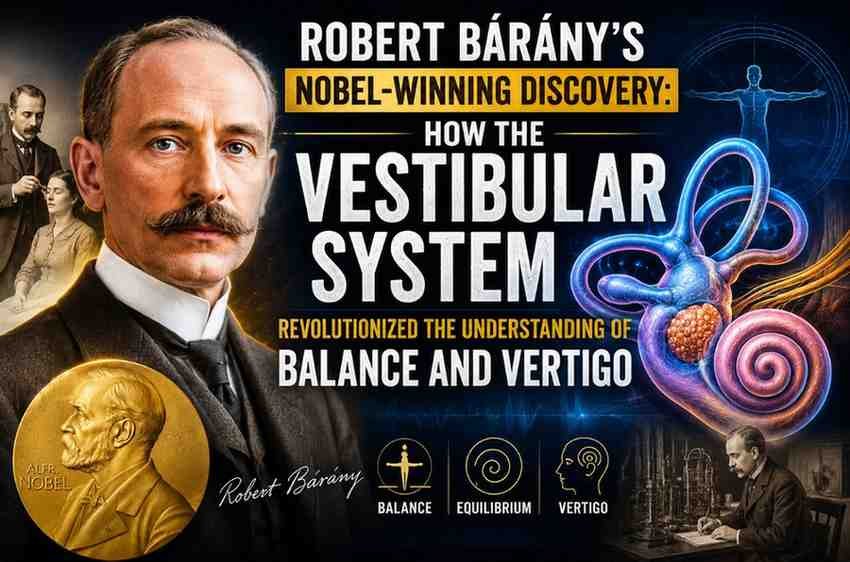
Dizziness is among the most common reasons people visit a doctor. From brief episodes of spinning sensations to debilitating balance disorders, millions worldwide experience vertigo at some point in their lives. Yet until the early 20th century, physicians had only a limited understanding of why people lost their sense of balance.
That changed thanks to the work of Robert Bárány, an Austrian physician whose curiosity about the inner ear led to one of medicine’s most important discoveries. His pioneering research revealed how the vestibular system the body’s balance center functions and how disturbances within it cause vertigo and dizziness.
For this work, Bárány received the 1914 Nobel Prize in Physiology or Medicine. More than 110 years later, his discoveries remain central to Neurology, otolaryngology, and rehabilitation medicine.
The Mystery of Balance Before Robert Bárány
Before Bárány’s research, doctors understood that the inner ear played a role in hearing, but its involvement in balance remained poorly understood.
Patients suffering from dizziness or vertigo often experienced symptoms that were difficult to explain.
Common complaints included:
- Spinning sensations.
- Loss of balance.
- Nausea.
- Difficulty walking.
- Abnormal eye movements.
- Motion sickness.
Physicians lacked reliable ways to determine whether these symptoms originated in the brain, nerves, or inner ear.
Who Was Robert Bárány?
Robert Bárány was born in Vienna in 1876. After studying medicine, he developed a particular interest in ear diseases and neurology.
His work at the University of Vienna exposed him to patients suffering from unexplained dizziness and hearing problems. Rather than accepting prevailing theories, Bárány investigated the mechanisms behind these symptoms through careful observation and experimentation.
His curiosity would eventually reshape an entire field of medicine.
The Accidental Observation That Led to a Breakthrough
Some of the greatest scientific discoveries begin with unexpected observations.
While treating patients, Bárány noticed that flushing the ear with warm or cold water triggered unusual eye movements and sensations of spinning.
This phenomenon fascinated him.
Through systematic experiments, he demonstrated that temperature changes affected fluid inside structures known as the semicircular canals, which are part of the vestibular system.
The resulting stimulation produced predictable eye movements called nystagmus and altered a person’s sense of balance.
This finding provided the first clear evidence of how the inner ear contributes to orientation and equilibrium.
Understanding the Vestibular System
The vestibular system is located within the inner ear and helps the brain determine body position and movement.
Its functions include:
- Maintaining balance.
- Coordinating eye movements.
- Detecting head motion.
- Supporting posture.
- Helping spatial orientation.
When this system malfunctions, people may experience vertigo, dizziness, imbalance, and motion sensitivity.
Bárány’s experiments provided the first practical way to assess these functions.
The Caloric Test: A Century-Old Diagnostic Tool Still Used Today
One of Bárány’s most important contributions was the development of the caloric test.
By introducing warm or cold water or later airminto the ear canal, physicians could stimulate the vestibular system and observe eye movements.
The test helps evaluate whether each inner ear is functioning properly.
Even with modern imaging technologies, variations of this method remain valuable in diagnosing balance disorders.
Timeline of Robert Bárány’s Major Contributions
| Year | Milestone | Significance |
|---|---|---|
| 1876 | Birth in Vienna | Future pioneer of vestibular medicine |
| Early 1900s | Research into ear diseases | Focused on vertigo and balance disorders |
| 1906 | Published findings on vestibular function | Explained the role of semicircular canals |
| 1914 | Awarded Nobel Prize | Recognition of groundbreaking discoveries |
| 1915 | Received Nobel Prize after wartime delay | Honored while recovering from imprisonment during World War I |
Why His Discovery Changed Medicine
Bárány’s work transformed the understanding of how humans maintain balance.
His findings helped doctors distinguish between disorders originating in:
- The inner ear.
- The brain.
- The nervous system.
- Vestibular pathways.
His research also laid the foundation for modern neuro-otology, a specialty focused on disorders involving hearing and balance.
An Insight Competitors Often Miss: Balance Depends on Three Systems Working Together
Many people assume balance is controlled solely by the ears. In reality, equilibrium depends on a sophisticated partnership between three major systems:
- The vestibular system in the inner ear.
- Vision.
- Sensory information from muscles and joints.
The brain constantly integrates signals from all three sources.
When one system becomes impaired, dizziness and instability can occur.
Bárány’s work highlighted the importance of the vestibular system, but modern neuroscience has revealed how deeply interconnected balance truly is.
Conditions Diagnosed Using Principles Derived From Bárány’s Work
Today, physicians rely on concepts pioneered by Bárány to diagnose numerous disorders, including:
- Benign paroxysmal positional vertigo (BPPV).
- Vestibular neuritis.
- Ménière’s disease.
- Labyrinthitis.
- Vestibular migraine.
- Central nervous system disorders.
These conditions affect millions of people and can significantly impact quality of life.
The Nobel Prize Amid World War I
Bárány was awarded the Nobel Prize in Physiology or Medicine in 1914 for his work on the vestibular apparatus.
However, history added an unusual twist.
During World War I, he served as a military physician and was captured by Russian forces. His Nobel Prize ceremony was delayed until 1915 after diplomatic efforts secured his release.
This extraordinary chapter adds another layer to the story of his scientific legacy.
How Modern Medicine Has Expanded Upon His Discoveries
Since Bárány’s era, technology has dramatically improved the diagnosis of balance disorders.
Modern tools include:
- Videonystagmography.
- Vestibular evoked myogenic potentials.
- Rotational chair testing.
- Computerized posturography.
- MRI and CT imaging.
Despite these advances, many diagnostic principles still trace back to Bárány’s original observations.
Prediction: The Future of Vertigo Treatment May Be Digital
Researchers are exploring wearable sensors, virtual reality rehabilitation, artificial intelligence, and advanced vestibular implants to improve the management of dizziness and balance disorders.
As technology evolves, future therapies may become increasingly personalized.
Yet the scientific foundations of these innovations remain rooted in discoveries made more than a century ago.
Conclusion
Robert Bárány’s Nobel-winning research fundamentally changed humanity’s understanding of balance and vertigo. By revealing how the inner ear communicates with the brain and influences movement, he transformed a mysterious collection of symptoms into a field grounded in science.
His discovery of the vestibular system’s role and the development of the caloric test continue to influence clinical practice around the world. More than a hundred years later, countless patients suffering from dizziness and balance disorders still benefit from the insights of a physician whose curiosity turned a simple observation into one of medicine’s enduring achievements.
Sometimes, the greatest revolutions in science do not begin with grand theories they begin with a doctor asking why a patient feels dizzy.
For breaking news and live news updates, like us on Facebook or follow us on Twitter and Instagram. Read more on Latest Health on thefoxdaily.com.





COMMENTS 0