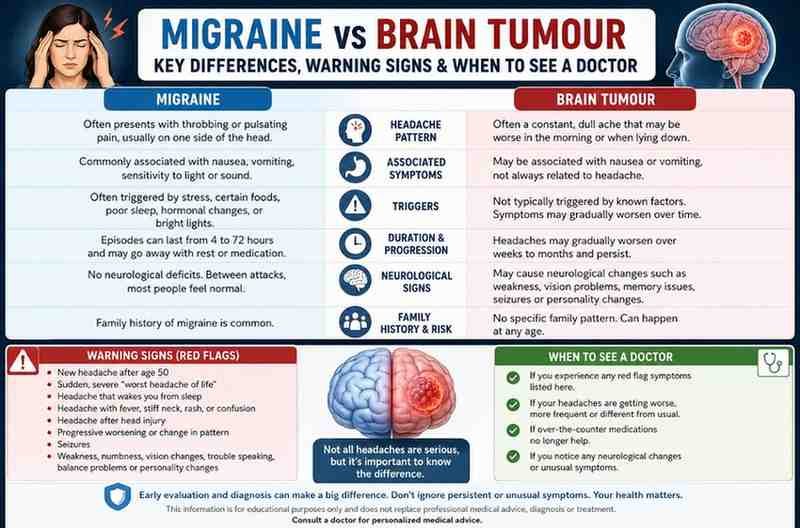
<p><strong>Migraine vs brain tumour</p><p><strong>Search Intent:</strong> Informational users want to understand symptoms, differences, and when to seek medical help</p><p><strong>headache causes, migraine symptoms, brain tumour symptoms, chronic headache warning signs, neurological symptoms, when to see a doctor for headache, severe headache causes, migraine aura, intracranial pressure symptoms, headache red flags</p><h2>Introduction: When a Headache Feels Like More Than Just Pain</h2><p>A headache is one of the most common health complaints in the world. But when it becomes intense, persistent, or unusual, a troubling question often arises: <strong>Is this just a migraine, or could it be something more serious like a brain tumour?</strong></p><p>This concern isn’t rare. With rising health awareness and easy access to information, people are increasingly alert to subtle symptoms. However, this awareness can also lead to unnecessary fear.</p><p><strong>Who is affected?</strong> Anyone from teenagers to older adults can experience migraines or develop brain tumours.<br><strong>What’s the confusion?</strong> Both conditions can cause headaches, nausea, and visual disturbances.<br><strong>When does it matter?</strong> When symptoms change pattern, worsen, or include neurological signs.<br>
Where does the problem lie? In the brain but with entirely different underlying mechanisms.
Why is it important? Because early recognition can be life-saving in rare cases.
How can you tell the difference? That’s exactly what this guide explains—clearly, factually, and without panic.
Context: Why Migraines Are Common but Brain Tumours Are Rare
<p>One of the biggest misconceptions is assuming that severe headaches are usually dangerous. In reality, <strong>migraines are extremely common</strong>, while brain tumours are relatively rare.</p><p>Migraines affect millions globally and are a leading cause of disability among young adults. Brain tumours, on the other hand, occur in a much smaller percentage of the population.</p><p>This difference matters because it shifts the probability: statistically, a recurring headache is far more likely to be a migraine than a tumour.</p><p>Yet, the fear persists mainly because both conditions involve the brain and can share overlapping symptoms.</p><h2>What Is a Migraine? More Than Just a Headache</h2><p>A migraine is a <strong>neurological condition</strong>, not just a bad headache. It involves complex changes in brain activity, nerve signaling, and blood vessels.</p><p>Key characteristics include:</p><ul><li>Throbbing or pulsating pain, often on one side</li><li>Sensitivity to light and sound</li><li>Nausea or vomiting</li><li>Visual disturbances (aura)</li><li>Triggers like stress, sleep changes, or certain foods</li></ul><p>Migraines often follow a pattern patients can predict their onset and identify triggers over time.</p><h2>What Is a Brain Tumour? A Structural Problem</h2><p>A brain tumour is an <strong>abnormal growth of cells in the brain</strong>. It can be benign (non-cancerous) or malignant (cancerous), but both can cause symptoms due to pressure on brain structures.</p><p>Unlike migraines, tumours are not episodic. They tend to cause <strong>progressive symptoms</strong> that worsen over time.</p><p>Symptoms depend on the tumour’s size and location but often include:</p><ul><li>Persistent, worsening headaches</li><li>Seizures</li><li>Weakness or numbness in limbs</li><li>Speech or vision problems</li><li>Personality or cognitive changes</li></ul><h2>Key Differences: Migraine vs Brain Tumour</h2><div class=”tfd_table_content”><table><tr><th>Feature</th><th>Migraine</th><th>Brain Tumour</th></tr><tr><td>Onset</td><td>Sudden, episodic</td><td>Gradual, progressive</td></tr><tr><td>Pain Pattern</td><td>Comes and goes</td><td>Persistent, worsening</td></tr><tr><td>Triggers</td><td>Common (stress, food, sleep)</td><td>None identifiable</td></tr><tr><td>Time of Day</td><td>Anytime</td><td>Often worse in morning</td></tr><tr><td>Neurological Symptoms</td><td>Temporary (aura)</td><td>Persistent or worsening</td></tr><tr><td>Relief</td><td>Improves with medication/rest</td><td>Limited or no relief</td></tr><tr><td>Progression</td><td>Stable over years</td><td>Gradually deteriorates</td></tr></table></div><h2>Red Flag Symptoms You Should Never Ignore</h2><p>Neurologists emphasize that certain symptoms often called <strong>“red flags”</strong> require immediate medical attention.</p><ul><li>A sudden, severe “worst headache of your life”</li><li>Headaches that wake you up from sleep</li><li>Persistent vomiting without clear cause</li><li>New headaches after age 50</li><li>Seizures</li><li>Weakness, confusion, or personality changes</li><li>Vision loss or double vision</li></ul><p>These symptoms don’t automatically mean a brain tumour but they do signal the need for urgent evaluation.</p><h2>The Neurologist’s Perspective: Pattern Recognition Is Key</h2><p>Doctors don’t rely on a single symptom to differentiate between migraine and brain tumour. Instead, they look at <strong>patterns over time</strong>.</p><p>A migraine tends to be:</p><ul><li>Recurrent</li><li>Predictable</li><li>Triggered by specific factors</li></ul><p>A tumour-related headache tends to be:</p><ul><li>New and unfamiliar</li><li>Progressively worsening</li><li>Accompanied by neurological deficits</li></ul><p>This pattern-based approach is often more reliable than any single test or symptom.</p><h2>Why Morning Headaches Matter More Than You Think</h2><p>One subtle but important distinction is timing. Headaches caused by increased intracranial pressure common in brain tumours are often worse in the morning.</p><p>This happens because lying down overnight can increase pressure inside the skull. As a result, patients may wake up with:</p><ul><li>Severe headache</li><li>Nausea</li><li>Vomiting</li></ul><p>Migraines, in contrast, don’t follow this specific pattern.</p><h2>The Role of Imaging: When Do You Need a Scan?</h2><p>Not every headache requires a brain scan. In fact, overuse of imaging can lead to unnecessary anxiety and costs.</p><p>Doctors usually recommend MRI or CT scans when:</p><ul><li>Red flag symptoms are present</li><li>Headache pattern changes suddenly</li><li>Neurological deficits appear</li><li>There is no response to standard treatment</li></ul><p>This selective approach ensures that serious conditions are not missed without over-testing low-risk cases.</p><h2>Real-World Impact: The Cost of Misinterpretation</h2><p>Misunderstanding the difference between migraine and brain tumour has real consequences.</p><p><strong>Overestimation of risk</strong> can lead to:</p><ul><li>Health anxiety</li><li>Unnecessary tests</li><li>Increased healthcare costs</li></ul><p><strong>Underestimation of warning signs</strong> can delay diagnosis of serious conditions.</p><p>The balance lies in awareness not fear.</p><h2>Unique Insight: Why Anxiety Amplifies Headache Perception</h2><p>One overlooked factor is the role of mental health. Anxiety can intensify headache perception and make symptoms feel more severe than they are.</p><p>In the age of online self-diagnosis, people often jump to worst-case scenarios. This creates a feedback loop:</p><ul><li>Headache → worry → increased sensitivity → worse headache</li></ul><p>Understanding this cycle is crucial. Not every intense headache is dangerous but ignoring persistent changes is equally risky.</p><h2>Prediction: The Future of Headache Diagnosis</h2><p>Emerging technologies are changing how we approach neurological conditions.</p><p>Future trends include:</p><ul><li>AI-assisted diagnosis based on symptom patterns</li><li>Wearable devices tracking neurological changes</li><li>Personalized migraine treatment plans</li></ul><p>These innovations could reduce both misdiagnosis and unnecessary fear, making it easier to distinguish benign from serious conditions.</p><h2>Conclusion: Clarity Over Fear</h2><p>The difference between <strong>migraine vs brain tumour</strong> ultimately comes down to pattern, progression, and associated symptoms.</p><p>Most headaches even severe ones are not caused by brain tumours. Migraines are far more common and manageable with the right treatment.</p><p>However, ignoring warning signs is not an option. The key is to stay informed, observe changes, and seek medical advice when something feels different.</p><p><strong>Bottom line:</strong> Don’t panic but don’t ignore your body either. In medicine, awareness is powerful but clarity is life-saving.</p>
For breaking news and live news updates, like us on Facebook or follow us on Twitter and Instagram. Read more on Latest Lifestyle on thefoxdaily.com.






COMMENTS 0