readers want to understand who Robert Bárány was, what he discovered about the inner ear and balance, why he received the Nobel Prize, and how his work continues to influence modern diagnosis of vertigo and vestibular disorders.
Primary keyword: Robert Bárány Nobel Prize discovery
Related semantic keywords: vestibular system, inner ear balance, vertigo, Vestibular Medicine, semicircular canals, caloric test, dizziness, spatial orientation, vestibular disorders, balance system
Long before modern brain imaging, digital balance tests and sophisticated vestibular clinics, physicians faced a deceptively difficult question: why does a person suddenly feel as if the room is spinning? Robert Bárány, an Austrian physician and scientist, helped provide one of the most important answers.
His pioneering work on the physiology and diseases of the inner ear earned him the 1914 Nobel Prize in Physiology or Medicine. Bárány’s achievement was not simply the discovery of a single structure or a single cause of vertigo. His broader contribution was to demonstrate how the vestibular organs of the inner ear interact with the nervous system to produce sensations of movement, orientation and balance.
That insight changed medicine because dizziness could no longer be treated merely as a vague complaint. Physicians could begin examining the body’s balance machinery systematically, looking for measurable signs of dysfunction in the inner ear and its connections to the brain.
More than a century later, the principles behind Bárány’s work remain embedded in vestibular medicine. Every time clinicians investigate positional vertigo, abnormal eye movements or an unexplained loss of balance, they are working within a scientific tradition that his research helped establish.
Who was Robert Bárány?
Robert Bárány was born in Vienna in 1876 and trained as a physician at the University of Vienna. His career developed during an era when medical science was increasingly turning toward experimental physiology — the study of how organs actually function rather than simply describing diseases.
The inner ear was particularly fascinating because it performed two seemingly unrelated jobs. The cochlea was associated with hearing, while structures deeper inside the ear were involved in detecting movement and maintaining equilibrium.
Bárány became especially interested in the vestibular apparatus and its relationship with eye movements, dizziness and balance. His work was closely associated with observations made during medical treatment and examination, particularly involving the ear and the effects of temperature changes in the ear canal.
His research eventually helped establish methods for testing vestibular function and interpreting the characteristic responses that could occur when the balance organs were stimulated.
What did Robert Bárány discover?
The simplest answer is that Robert Bárány helped establish how the vestibular organs of the inner ear contribute to balance and how their stimulation can produce predictable eye movements and sensations of motion.
But the significance goes deeper.
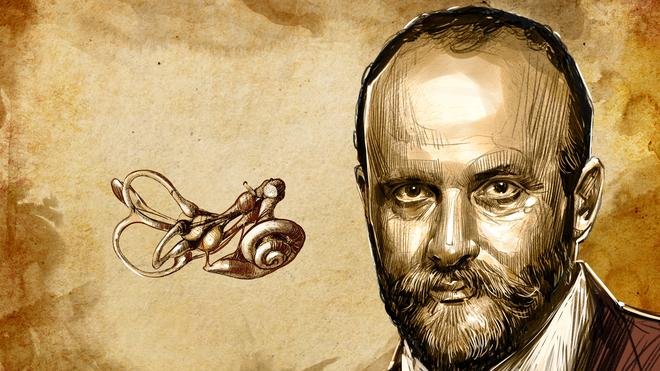
The vestibular system contains specialised structures that detect different forms of head movement. The semicircular canals are primarily sensitive to angular or rotational acceleration, while the otolith organs — the utricle and saccule — contribute to detecting linear acceleration and the effects of gravity.
These signals travel through the vestibular portion of the eighth cranial nerve to the brain, where they are integrated with information from vision and proprioception. The brain continuously compares these streams of information to estimate where the body is positioned and how it is moving.
This is why balance is not controlled by the ears alone. The inner ear supplies crucial motion information, but the brain must combine it with information from the eyes, muscles and joints.
The caloric test: the experiment that became a clinical tool
One of Bárány’s most important contributions was his work on what became known as the caloric test.
The principle is surprisingly elegant. Introducing water at a different temperature into the external ear canal can alter the temperature around the nearby horizontal semicircular canal. This creates movement within the canal’s fluid and stimulates the vestibular system.
The resulting vestibular signal can trigger involuntary rhythmic eye movements called nystagmus.
For clinicians, that response became valuable because the eyes can provide an observable window into the balance system. Instead of relying exclusively on a patient’s description of dizziness, physicians could examine an objective physiological response.
The caloric test therefore represents a major conceptual advance: stimulation of one part of the vestibular system could produce a measurable neurological response.
It also helped demonstrate the intimate relationship between the vestibular system and eye movement. The brain uses vestibular signals to stabilise vision when the head moves, a process known as the vestibulo-ocular reflex.
Why does the vestibulo-ocular reflex matter?
Imagine turning your head quickly to the left while trying to keep your eyes focused on a word on a page. Without a mechanism that compensates for head movement, the visual scene would move across the retina and appear blurred.
The vestibulo-ocular reflex solves much of this problem by generating compensatory eye movements in the opposite direction of head movement.
This is one reason vestibular disorders can produce much more than a feeling of spinning. They can cause visual instability, difficulty walking, nausea and trouble maintaining a fixed gaze.
Bárány’s investigations helped strengthen the scientific connection between stimulation of the vestibular apparatus and eye movement responses. That connection remains fundamental to vestibular examination today.
Vertigo is not simply “a problem with balance”
One of the most important insights that emerges from Bárány’s work is that vertigo and general imbalance are not interchangeable symptoms.
Vertigo usually refers to an illusion of movement — often described as spinning, tilting, swaying or the sensation that the surroundings are moving. Imbalance, by contrast, may occur without a clear illusion of motion.
The distinction matters because different systems and diseases can produce different patterns of symptoms.
A person with an inner-ear disorder may experience intense vertigo, nausea and abnormal eye movements. Someone with a neurological disorder may have severe difficulty coordinating movement or walking without experiencing classic spinning sensations. Visual problems, medication effects and musculoskeletal limitations can also contribute to instability.
This is where Bárány’s legacy becomes particularly relevant: modern vestibular medicine treats dizziness as a physiological problem that can be investigated, rather than as a symptom that must simply be endured.
How the inner ear maintains spatial orientation
The vestibular system can be thought of as the body’s motion-sensing network.
- Semicircular canals: Detect rotational head movements.
- Utricle: Contributes to sensing linear acceleration and head position relative to gravity.
- Saccule: Detects linear acceleration and gravitational orientation, particularly along a different axis from the utricle.
- Vestibular nerve: Carries balance-related signals toward the brain.
- Brainstem and cerebellum: Help process vestibular information and coordinate responses.
- Vestibular cortex and related brain networks: Contribute to conscious awareness of orientation and movement.
The remarkable feature is that the brain does not use vestibular information in isolation. It continuously compares signals from the inner ear with visual information and proprioceptive feedback from the body.
When those signals agree, orientation usually feels effortless. When they conflict, dizziness or motion sickness can occur.
A useful comparison: the vestibular system is more like a motion sensor than a “balance organ”
Calling the inner ear a balance organ is convenient but incomplete.
A better analogy is to think of it as a biological motion-sensing system. It detects acceleration and changes in head position, while the brain acts like an information-processing centre that combines those signals with data from other sensory systems.
This distinction explains why a person can feel dizzy even when the muscles and bones needed for standing are perfectly healthy. The problem may be that the brain is receiving conflicting information about movement.
It also explains why vestibular rehabilitation can work. The nervous system has the capacity to adapt when sensory information becomes unreliable or changes over time.
From Bárány’s experiments to modern vestibular diagnosis
Bárány’s era had nothing resembling today’s vestibular laboratories. Modern clinicians can now examine eye movements with specialised video systems, perform positional tests, measure vestibular responses and use imaging or neurological investigations when appropriate.
Yet the basic logic is remarkably similar.
The clinician asks: Which sensory system is producing the abnormal signal, what response does that signal create, and where along the pathway could the problem be located?
For example, positional testing can help identify patterns associated with benign paroxysmal positional vertigo, commonly known as BPPV. Other vestibular tests can help evaluate disorders affecting the peripheral inner ear or the central nervous system.
Modern technology has therefore expanded Bárány’s approach rather than replaced it. The instruments are more precise, but the underlying principle remains the same: observe measurable physiological responses to understand an otherwise subjective symptom.
The Nobel Prize recognition came with an unusual historical complication
Bárány was awarded the 1914 Nobel Prize in Physiology or Medicine for his work on the physiology and pathology of the vestibular apparatus.
However, the timing was extraordinary. The First World War began in 1914, creating upheaval across Europe. Bárány himself was captured by Russian forces during the war.
His Nobel recognition therefore emerged against a backdrop of conflict that dramatically disrupted scientific life across Europe.
The episode also illustrates an important feature of scientific history: major discoveries do not always receive recognition in calm or predictable circumstances. Scientific progress can continue even while institutions and societies are under immense pressure.
A timeline of Robert Bárány’s scientific legacy
- 1876: Robert Bárány is born in Vienna.
- Early 20th century: He develops his medical and scientific work around the ear and vestibular physiology.
- 1900s: His investigations into vestibular responses and temperature stimulation help establish important diagnostic principles.
- 1914: Bárány receives the Nobel Prize in Physiology or Medicine.
- 20th century: Vestibular testing develops into an increasingly specialised field of medicine.
- Today: His concepts continue to underpin clinical assessment of vertigo, nystagmus and vestibular dysfunction.
Why Bárány’s discovery still matters in everyday medicine
Dizziness is among the most common symptoms encountered in healthcare, but its causes can be remarkably diverse. That makes structured assessment essential.
The legacy of Bárány is particularly visible in the way clinicians distinguish between different types of dizziness instead of treating every complaint as the same condition.
A patient describing brief spinning when turning in bed presents a different diagnostic problem from someone experiencing persistent imbalance, hearing changes, faintness or neurological symptoms.
That distinction can prevent two opposite mistakes: assuming every dizzy spell comes from the inner ear, or overlooking a vestibular disorder because the symptom sounds too vague.
It is also why sudden or severe dizziness accompanied by neurological warning signs can require urgent medical evaluation. Vestibular symptoms can occasionally overlap with serious neurological conditions, and a careful clinical assessment is more important than simply labelling everything “vertigo.”
The overlooked lesson: Bárány changed diagnosis, not just theory
The most important reason Bárány deserves attention today may not be the historical fact that he won a Nobel Prize. It is the methodological change his work represented.
Before sophisticated vestibular testing, dizziness could be frustratingly difficult to investigate. Bárány’s research demonstrated that the balance system could be stimulated, observed and analysed.
That shift from subjective complaint to measurable physiological response is one of the defining features of modern medicine.
The same philosophy appears throughout contemporary healthcare: symptoms provide clues, but objective measurements can reveal mechanisms.
In that sense, Bárány’s work belongs to a much larger history of medicine in which invisible biological processes became observable through carefully designed experiments.
What competitors often miss about his legacy
Popular accounts frequently reduce Bárány’s contribution to the caloric test. That is important, but it understates the bigger story.
His work helped create a framework for understanding the vestibular apparatus as a functional system connected to eye movements, spatial orientation and neurological control. The lasting contribution was therefore not merely a test. It was a way of thinking about balance disorders.
That framework became increasingly valuable as researchers learned that the brain does not passively receive balance information. It interprets and integrates signals from multiple sensory systems.
This also points toward the future of vestibular medicine. As diagnostic technologies become more precise, clinicians are increasingly able to distinguish between disorders that once appeared to produce similar symptoms.
The likely direction is not simply more testing, but better interpretation of how vestibular, visual and neurological information interact in individual patients.
Robert Bárány’s discovery and the future of vestibular medicine
Modern medicine now has tools that Bárány could scarcely have imagined, from high-speed eye-movement recording to advanced imaging and computer-assisted vestibular assessment.
Yet technology does not make his foundational work obsolete. It makes its importance easier to appreciate.
The central problem remains unchanged: the human brain must determine where the body is and how it is moving using signals that can sometimes be incomplete or contradictory.
Future advances are likely to improve the precision with which clinicians identify the source of dizziness and balance disorders. Better testing may also help personalise vestibular rehabilitation by revealing how individual patients compensate for damaged or unreliable sensory signals.
Conclusion: Why Robert Bárány remains important more than a century later
Robert Bárány’s Nobel Prize discovery transformed the study of balance by showing that the vestibular system could be examined through measurable physiological responses. His investigations into the inner ear, vestibular stimulation and eye movements helped establish principles that remain central to vestibular medicine.
The deeper legacy is even more significant. Bárány helped move dizziness and vertigo from the realm of poorly understood complaints toward systematic physiological investigation. His work showed that the inner ear is not merely an organ of hearing but a critical component of the body’s motion and orientation system.
More than 100 years later, doctors still rely on the relationship between the vestibular organs, eye movements and the brain when investigating dizziness. The technology has changed dramatically, but the underlying scientific question remains remarkably familiar.
That is why Bárány’s contribution deserves to be remembered not simply as a Nobel-winning discovery from Medical History, but as one of the foundations on which modern understanding of vertigo, spatial orientation and balance disorders was built.
For breaking news and live news updates, like us on Facebook or follow us on Twitter and Instagram. Read more on Latest Health on thefoxdaily.com.


COMMENTS 0