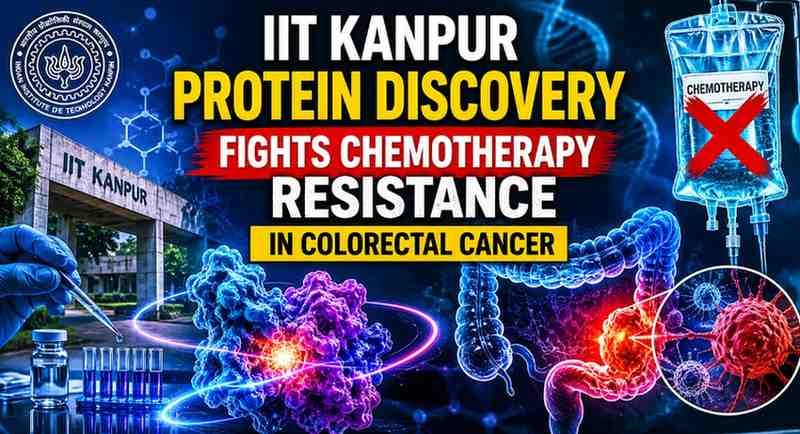
Who? Researchers from IIT Kanpur. What? Identification of a protein that enables colorectal cancer cells to survive chemotherapy. Where? India-based laboratory research with global clinical relevance. Why? Chemotherapy resistance is a major reason for cancer treatment failure. How? Through molecular biology experiments, protein analysis, and cell survival studies.
The Scientific Breakthrough Explained
In a significant advancement in cancer biology, researchers at IIT Kanpur have identified a specific protein that allows colorectal cancer cells to withstand the effects of chemotherapy. This discovery helps explain why some patients respond poorly to treatment despite aggressive therapy.
Chemotherapy is designed to kill rapidly dividing cells. However, cancer cells often develop resistance mechanisms, allowing them to survive and continue growing. The newly identified protein appears to play a key role in activating such survival pathways.
What Is Colorectal Cancer and Why Resistance Matters?
Colorectal cancer is one of the most common cancers worldwide. Standard treatment often includes chemotherapy drugs that target DNA replication or cell division.
Problem: Over time, many tumors become resistant, making treatment less effective.
Impact:
- Reduced survival rates
- Higher chances of relapse
- Limited treatment options in advanced stages
Mechanism: How the Protein Enables Survival
According to the research findings, the protein appears to regulate cellular stress responses and repair mechanisms. When chemotherapy damages cancer cells, this protein helps:
- Repair DNA damage caused by drugs
- Prevent programmed cell death (apoptosis)
- Maintain cellular energy balance under stress
Scientific Insight: This aligns with known resistance pathways such as enhanced DNA repair, anti apoptotic signaling, and metabolic adaptation.
Experimental Evidence and Research Methods
The discovery is backed by a combination of advanced laboratory techniques:
- Cell Culture Experiments: Cancer cells were exposed to chemotherapy drugs to observe survival rates.
- Protein Expression Analysis: Researchers measured increased levels of the identified protein in resistant cells.
- Gene Silencing Studies: When the protein was suppressed, cancer cells became more sensitive to chemotherapy.
- Comparative Analysis: Resistant vs non resistant cell lines showed clear differences in protein activity.
Conclusion from experiments: The protein is not just associated with resistance it actively contributes to it.
Global Research Context
This discovery fits into a broader scientific effort to understand chemotherapy resistance. Similar studies worldwide have identified mechanisms involving:
- Drug efflux pumps (cells pushing drugs out)
- Genetic mutations altering drug targets
- Tumor microenvironment protecting cancer cells
However, the IIT Kanpur study adds a new dimension by pinpointing a specific protein that could serve as a therapeutic target.
Why This Discovery Is Important
1. Targeted Drug Development
If drugs can be designed to block this protein, chemotherapy may become more effective.
2. Personalized Medicine
Patients could be tested for this protein to predict treatment response.
3. Reduced Treatment Failure
Understanding resistance mechanisms helps doctors adjust therapy earlier.
Future Applications and Clinical Potential
While the research is currently at a laboratory stage, it opens several possibilities:
- Development of combination therapies (chemotherapy + protein inhibitor)
- Biomarker-based diagnosis to identify resistant tumors
- Clinical trials to test targeted interventions
Expert Perspective: Translating lab findings into clinical treatment may take years, but such discoveries form the foundation of next generation cancer therapies.
Comparison: Sensitive vs Resistant Cancer Cells
| Feature | Sensitive Cells | Resistant Cells |
|---|---|---|
| Response to Chemotherapy | High cell death | Survival and regrowth |
| Protein Activity | Low | High |
| DNA Repair | Limited | Enhanced |
| Apoptosis | Activated | Suppressed |
The Bigger Scientific Insight
This research reinforces a critical idea in oncology:
Cancer is not just about uncontrolled growth it’s about survival under attack.
By identifying how cancer cells adapt to stress, scientists can design smarter therapies that not only attack tumors but also block their defense systems.
Conclusion
The identification of this protein by IIT Kanpur researchers marks an important step toward solving one of the biggest challenges in cancer treatment chemotherapy resistance.
While more research and clinical validation are needed, the findings offer real hope for more effective and personalized cancer therapies in the future.
In simple terms: Understanding how cancer survives is the key to finally defeating it.
For breaking news and live news updates, like us on Facebook or follow us on Twitter and Instagram. Read more on Latest Health on thefoxdaily.com.




COMMENTS 0