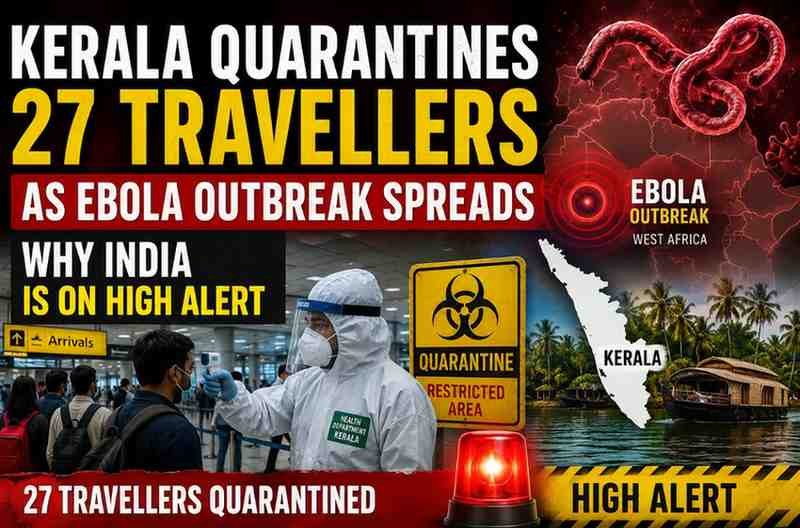
It is a number that might sound small just 27 people. But in public health, the significance of that figure lies not in its size but in its speed. Kerala’s Health Department has placed 27 individuals who recently arrived from Ebola affected nations under home quarantine as a precautionary measure, even as India has reported zero confirmed cases of the virus. No one is sick. No emergency has been declared. And yet the state is already watching, tracking, and monitoring exactly as it should be.
The move comes against the backdrop of one of the most alarming viral outbreaks in years. Since May 15, 2026, the Democratic Republic of the Congo (DRC) and Uganda have been fighting an outbreak of Ebola caused by the Bundibugyo strain a rare variant for which there is currently no approved vaccine or specific treatment. The World Health Organization (WHO) declared it a Public Health Emergency of International Concern (PHEIC) on May 17, 2026. As of June 2, 2026, the DRC alone had reported over 321 confirmed cases and 48 confirmed deaths, with the outbreak spreading across multiple provinces. Uganda’s capital Kampala had recorded 15 confirmed cases.
India, with its deep human ties to Africa through trade, the diaspora, and medical education, cannot afford complacency. Kerala, which sits at the centre of India’s international travel flows and has one of the highest concentrations of Non Resident Indians (NRIs) in the country, knows this better than anyone. The 27 people currently under home quarantine are not patients. They are a wall being built before the fire arrives.
Understanding the 2026 Ebola Outbreak: The Bundibugyo Threat
Not all Ebola outbreaks are created equal. The strain driving the 2026 crisis Bundibugyo virus is the rarest and least understood of the five known Ebola species. It was first identified during a 2007–2008 outbreak in Uganda’s Bundibugyo district. Unlike the Zaire strain that caused the catastrophic 2014 2016 West Africa outbreak, which killed over 11,300 people, the Bundibugyo strain has a lower case-fatality rate estimated at approximately 22–25% among suspected cases in the current outbreak but it carries a uniquely dangerous characteristic: there is no approved vaccine and no approved treatment for it.
The Zaire strain, which drove the 2014 West Africa disaster and the massive 2018–2020 DRC outbreak, had a clinical advantage in the eyes of public health responders: the rVSV ZEBOV vaccine (Ervebo) was developed and deployed, dramatically changing containment dynamics. For Bundibugyo, no such tool exists. Experimental antibody therapies are being explored in the 2026 outbreak, but as of early June, confirmed vaccine options remain unavailable. This is precisely why surveillance and early isolation exactly what Kerala is doing become the entire defense.
The outbreak’s geography adds another layer of complexity. Transmission is concentrated in Ituri Province in northeastern DRC, with spread into North Kivu and South Kivu regions already destabilized by ongoing conflict, armed militias, and mass displacement. Over 245,000 people had fled eastern DRC since January 2025 alone, creating population movements that make contact tracing extraordinarily difficult. Only around 7% of known contacts were being traced at the peak of the outbreak’s expansion. Uganda closed its border with DRC after reporting its first cases, but Kampala’s confirmed infections mostly with travel links to DRC demonstrated that urban spread was already a reality.
Why Kerala? The NRI Connection and the Travel Risk Profile
Kerala’s particular vulnerability to imported infectious diseases is not accidental it is structural. The state has one of the highest rates of international migration in India, with millions of Keralites working across the Gulf, Africa, Europe, and Southeast Asia. This diaspora creates a constant two-way flow of travelers between Kerala and some of the world’s most epidemiologically active regions.
Africa is a significant destination for Keralite professionals particularly in healthcare, engineering, and business. Students from Kerala attend medical institutions across sub-Saharan Africa, and Keralite traders, construction workers, and healthcare professionals have long established communities in East and Central African nations. The same human connectivity that makes Kerala’s economy vibrant makes its airports among the most epidemiologically sensitive entry points in the subcontinent.
Three international airports Thiruvananthapuram, Kochi (Cochin), and Kozhikode (Calicut) —l serve the state, all handling substantial volumes of passengers arriving from or transiting through African nations, often via Dubai, Doha, or Abu Dhabi. The Union Health Ministry’s June 2, 2026 advisory specifically noted a 21-day monitoring period for travellers from affected regions, reflecting Ebola’s maximum known incubation period. Kerala’s home quarantine of 27 individuals operates within exactly this framework.
India’s National Response: What Has Been Done
Kerala’s action is part of a coordinated national response that has been building since the WHO PHEIC declaration. On May 25, 2026, Union Health Minister Jagat Prakash Nadda chaired a high level review meeting to assess India’s preparedness. Key measures activated across the country include:
- Enhanced airport surveillance at all major international airports, with designated screening lanes for travellers arriving from or transiting through DRC, Uganda, and neighboring high risk nations.
- Standard Operating Procedures (SOPs) issued to all States and Union Territories covering traveller screening, quarantine protocols, clinical management, laboratory testing, and infection-control measures.
- Integrated Disease Surveillance Programme (IDSP) activated for enhanced monitoring, particularly for international travellers from affected countries.
- National Institute of Virology (NIV) Pune designated as the confirmatory testing facility for suspected Ebola samples, with NIV’s network being primed for sample routing from multiple states.
- Personal Protective Equipment (PPE) stockpiling and healthcare worker training in infection prevention protocols and sample handling.
The June 2 advisory from the Ministry of Health and Family Welfare was unambiguous: “As on June 2, 2026, there are no cases of Ebola disease reported in the country,” but anyone who had travelled through an Ebola affected country within the past 21 days was urged to closely monitor their health and report symptoms immediately.
| State | Key Measures Activated | Designated Isolation Facility |
|---|---|---|
| Kerala | State Rapid Response Team convened; airport surveillance strengthened; 27 travellers under home quarantine | Medical college hospitals; district hospitals (isolation wards being prepared) |
| Karnataka | Ebola alert issued; 21-day monitoring for travellers from Uganda and DRC; RRTs on alert; PPE training initiated | Rajiv Gandhi Institute of Chest Diseases (Bengaluru); Wenlock District Hospital (Mangaluru) |
| Gujarat | Screening and surveillance intensified at airports and hospitals | Designated government facilities under finalization |
| Bihar | Separate isolation wards planned at medical college and district hospitals | Medical college hospitals (under preparation) |
The Kerala Model: Why This State Is Especially Well-Positioned
Mention infectious disease preparedness in India and Kerala’s name invariably comes up first. This is not coincidence or flattery it is a track record earned through repeated crises managed with uncommon competence.
Between 2018 and 2023, Kerala successfully contained four separate outbreaks of the Nipah virus, one of the world’s most lethal zoonotic pathogens with a case fatality rate approaching 70 100% in some outbreaks. Each containment was achieved through the same core playbook: aggressive contact tracing within hours of a confirmed case, immediate isolation of contacts, transparent public communication, and tight coordination between state health officials, hospitals, laboratories, and the Union government.
The speed of response in the 2018 Nipah outbreak was particularly instructive. When the virus was identified in Kozhikode, Kerala health officials contacted the WHO, deployed Rapid Response Teams, established a 24-hour helpline, and activated community surveillance all within days. The outbreak was contained with 18 laboratory confirmed cases. Epidemiologists globally cited it as a model of how state level health infrastructure, when genuinely functional, can prevent a localized outbreak from becoming a catastrophe.
COVID-19 further demonstrated Kerala’s surveillance capability. The state reported India’s first three COVID-19 cases in early 2020 all students returning from Wuhan and its response of immediate testing, contact tracing, and home quarantine became the national template. The same Integrated Disease Surveillance Programme infrastructure is now being deployed for Ebola monitoring.
The 27 individuals currently under home quarantine represent this institutional muscle memory in action. They were identified, tracked, and placed under observation not because they are symptomatic, but because Kerala’s health system knows that the incubation period is the most dangerous window the time when a person looks healthy but the virus could still emerge. Monitoring during that window is the entire point.
What Ebola Symptoms Look Like and Why the 21-Day Window Is Critical
Understanding why a 21-day home quarantine period is the international standard requires understanding Ebola’s clinical timeline. After exposure to the Bundibugyo virus, the incubation period the time between infection and the appearance of symptoms ranges from 2 to 21 days, with most cases developing symptoms between 4 and 10 days post-exposure. During this entire window, the infected person typically feels well and, crucially, is not contagious. Ebola does not spread before symptoms appear.
This is one critical difference between Ebola and COVID-19. COVID-19’s pre-symptomatic transmission made containment extraordinarily difficult. Ebola’s transmission requires direct contact with the bodily fluids blood, saliva, vomit, urine, stool of a person who is already visibly ill. This makes standard surveillance, isolation, and contact tracing more effective as containment tools, but it also means that vigilance during the incubation period is essential. A person who develops symptoms and is not immediately isolated can expose caregivers, family members, and healthcare workers to the virus at the moment of peak biological risk.
Early symptoms of Ebola infection are non-specific fever, fatigue, muscle pain, headache, and sore throat indistinguishable from malaria, typhoid, or influenza. This clinical ambiguity is one reason why the home quarantine and monitoring protocol for Ebola-region travellers focuses on daily health checks and symptom reporting rather than blanket hospital admission. A traveller showing no symptoms represents no transmission risk. But if symptoms develop, the protocol requires immediate escalation to an isolation facility with a confirmed diagnostic pathway.
The Bundibugyo Strain: The Unique Challenge No One Is Talking About Enough
Most media coverage of this outbreak focuses on the case counts and deaths. What receives insufficient attention is the strategic disadvantage posed by the Bundibugyo strain specifically: the absence of an approved vaccine fundamentally changes the risk calculus for any country where the virus arrives.
During the 2018–2020 DRC Ebola outbreak which ultimately became the second-largest in history with over 3,400 cases the deployment of the Ervebo (rVSV-ZEBOV) vaccine was a game-changer. Ring vaccination of contacts and contacts-of-contacts created a biological firewall around confirmed cases. It was imperfect in an active conflict zone, but it demonstrably slowed transmission.
For the 2026 Bundibugyo outbreak, no equivalent exists. Experimental antibody treatments are being explored, including a US-backed antibody therapy that was reportedly under consideration for introduction in DRC, but these are not standard-of-care tools. This makes the classic non-pharmaceutical interventions isolation, contact tracing, quarantine, infection prevention, safe burial practices, and community education the only genuine toolkit available. It also means that if the virus were to arrive in India, the containment response would depend entirely on the speed and quality of the public health system, with no pharmaceutical backup. Kerala’s current surveillance posture is therefore not merely cautious it is the entire strategy.
India’s Zero-Case Status: Reassuring, But Not a Reason to Relax
India has reported zero Ebola cases in the 2026 outbreak, and public health officials across all states have consistently emphasized that the risk to the general population is low. This is accurate and important to communicate clearly. Panic is itself a public health problem it drives people to avoid hospitals, creates stigma around travellers from African nations, and undermines compliance with monitoring protocols.
However, the phrase “risk is low” deserves context. The risk is low because the preparedness measures currently in place are functioning. Airport screening, IDSP surveillance, the 21-day monitoring protocol, and Kerala’s home quarantine of returning travellers are all risk-reduction activities. The moment those activities are abandoned on the assumption that the low risk makes them unnecessary the risk profile changes. This is the public health equivalent of saying “my smoke alarm has never gone off, so I’ll remove the battery.”
India’s geographic and demographic exposure to this outbreak is also real. The country has large communities in both DRC and Uganda including Indian peacekeepers deployed through the United Nations, business communities, and healthcare workers. Nepal, which has nearly 1,000 peacekeepers in DRC, implemented mandatory 21-day isolation for returning troops. India’s equivalent populations require equivalent vigilance.
The Global Picture: How Other Nations Are Responding
India’s response sits within a rapidly evolving global posture. As of early June 2026, multiple countries had implemented significant travel-related measures in response to the Bundibugyo outbreak.
| Country/Region | Measure Taken |
|---|---|
| Uganda | Closed borders with DRC; mandatory 21-day isolation for all entrants from DRC |
| United States | Travel ban for non-citizens from DRC/Uganda; quarantine facility established in Kenya for exposed Americans |
| Canada | 90-day entry ban for residents of DRC, Uganda, and South Sudan |
| Thailand & Vietnam | 21-day quarantine orders for travellers from DRC and Uganda (effective May 26, 2026) |
| Germany | Evacuated a US doctor who tested positive for Ebola; confirmed low transmission risk in Europe |
| Malaysia | Active monitoring of travellers from Uganda and DRC, including transit passengers |
| Singapore | Health advisories issued; 21-day self-monitoring recommended for travellers from affected regions |
India’s approach aligns with the middle ground: not imposing blanket travel bans, but activating robust monitoring and quarantine for those identified as potentially exposed. This is consistent with WHO guidance, which has not recommended travel bans to DRC or Uganda, but has called for enhanced surveillance at points of entry.
Conclusion: 27 People, One System, One Lesson
The 27 individuals under home quarantine in Kerala are not a news item to be consumed and discarded. They represent something more significant: the visible evidence that India’s public health early warning system is operational, that the lessons of Nipah, COVID-19, and decades of epidemic response have been institutionalized into reflexes that activate faster than symptoms can develop.
The 2026 Bundibugyo Ebola outbreak is genuinely serious. With over 321 confirmed cases, 48 confirmed deaths, and geographic spread across multiple DRC provinces and into Uganda’s capital, with no approved vaccine and contact tracing reaching only a fraction of known exposures, the outbreak is not under control. The WHO PHEIC designation reflects exactly that assessment.
India’s zero-case status is not luck. It is the product of surveillance infrastructure, interstate coordination, institutional memory, and the willingness of state health departments like Kerala’s to act preemptively rather than reactively. Home quarantine for 27 people who show no symptoms is not alarmism. It is the science of outbreak prevention executed correctly quiet, methodical, and invisible precisely because it is working.
The outbreak will continue to evolve. Case counts will rise before they fall. The virus, unable to fly but carried by humans who can, will keep testing border health systems worldwide. India is watching. Kerala is watching. And for now, that watchfulness is the most powerful weapon available.
Key Takeaways
- Kerala has placed 27 people from Ebola-affected nations under precautionary home quarantine; no cases of Ebola have been confirmed in India as of June 2026.
- The 2026 outbreak is caused by the Bundibugyo strain — a rare Ebola variant with no approved vaccine or treatment, making surveillance and isolation the primary containment tools.
- As of June 2, 2026, the DRC reported 321 confirmed cases and 48 confirmed deaths; Uganda reported 15 confirmed cases, mostly linked to Kampala.
- WHO declared the outbreak a Public Health Emergency of International Concern (PHEIC) on May 17, 2026.
- Ebola’s 21-day incubation period is the basis for the home quarantine duration; crucially, the virus does not spread before symptoms appear.
- Kerala’s preparedness draws on its track record of containing four Nipah outbreaks through aggressive contact tracing, IDSP surveillance, and Rapid Response Teams.
- India’s airports have activated enhanced screening; NIV Pune is designated for confirmatory Ebola testing of suspected samples.
- Multiple countries including Canada, Thailand, Vietnam, Uganda, and the US have imposed quarantine or entry restrictions for travellers from DRC and Uganda.
For breaking news and live news updates, like us on Facebook or follow us on Twitter and Instagram. Read more on Latest Health on thefoxdaily.com.





COMMENTS 0