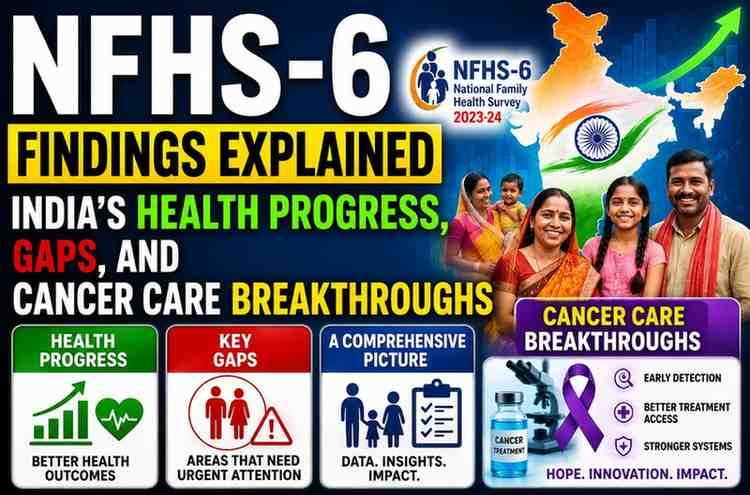
India’s health story is never a simple one. It is a country where world-class oncology centers operate within miles of villages where children still go to bed malnourished. Where fertility rates have dropped below replacement level in many states while maternal mortality remains a stubborn challenge in others. Where cancer research is advancing at a global pace while awareness and early detection infrastructure lag decades behind. This week’s Health Wrap, hosted by Ramya Kannan, Health Editor at The Hindu, and Senior Assistant Editor Zubeda Hamid, brought together two of the biggest stories in Indian public health the release of NFHS-6 findings and a series of significant advances in cancer care and examined what they mean for the country’s 1.4 billion people.
Whether you are a policy watcher, a healthcare professional, a patient, or simply a citizen trying to make sense of where India stands on its health journey, this breakdown covers the essential findings, the analysis that goes beyond the headlines, and the implications that will shape public health priorities for the next decade.
What Is NFHS-6 and Why Does It Matter?
The National Family Health Survey, or NFHS, is India’s most comprehensive household health survey. Conducted by the Ministry of Health and Family Welfare and implemented through the International Institute for Population Sciences (IIPS), it collects data on fertility, mortality, family planning, nutrition, child health, women’s empowerment, domestic violence, and a wide range of other health and development indicators across all Indian states and union territories.
NFHS-6 is the sixth round of this landmark survey, following NFHS-5 which was conducted in 2019–21. Each new round is not just a data collection exercise it is a national health audit. It tells policymakers what is working, what is not, which states are pulling ahead, and which are falling dangerously behind on indicators that determine whether people live healthy, productive lives or die preventable deaths.
The survey’s findings carry enormous weight. They influence budget allocations under the National Health Mission, shape maternal and child health priorities, determine where nutrition interventions are intensified, and inform India’s reporting to international bodies including the WHO and UNICEF on progress toward Sustainable Development Goals.
Key Findings of NFHS-6: What the Data Actually Shows
The headline numbers from NFHS-6 paint a picture of genuine, if uneven, progress across India’s health indicators. Several trends stand out as particularly significant for understanding where the country is and where it is headed.
Fertility and Population Dynamics
India’s Total Fertility Rate (TFR) the average number of children a woman is expected to have in her lifetime has continued its sustained decline. At the national level, TFR has fallen below the replacement rate of 2.1 in most states, a milestone that demographers and public health experts consider a turning point in a country’s development trajectory.
This is significant not just as a population statistic but as a proxy for women’s health, education, and empowerment. Falling fertility rates in India have historically tracked closely with rising female literacy, increased contraceptive use, delayed marriage age, and greater female participation in economic life. The NFHS-6 data reinforces this correlation states with better female education outcomes continue to report the sharpest fertility declines.
However, the inter-state disparity remains stark. Southern states have been at replacement-level or below for years. Several northern states — particularly in the high-focus BIMARU grouping — still show TFR numbers that indicate population growth will continue for decades even after the national average falls further. This demographic divergence has major implications for health infrastructure planning, resource allocation, and the political economy of health spending.
Child Nutrition: Progress With Persistent Gaps
Child malnutrition remains one of India’s most deeply rooted and internationally scrutinized public health challenges. NFHS data on stunting (low height for age), wasting (low weight for height), and underweight children has historically made for uncomfortable reading India has carried one of the world’s largest absolute burdens of child undernutrition despite decades of economic growth.
NFHS-6 shows measurable improvement in stunting and underweight rates compared to NFHS-5, continuing a trend of gradual decline that reflects the cumulative impact of programs including the Integrated Child Development Services (ICDS), the PM POSHAN mid-day meal scheme, and POSHAN Abhiyaan. The improvement is real and should be acknowledged.
But the numbers still represent a crisis by any international standard. Millions of Indian children continue to experience stunting that permanently affects cognitive development, immune function, educational attainment, and adult productivity. The gap between India’s economic growth trajectory and its child nutrition outcomes a gap that researchers have labeled the “Asian Enigma” has not closed as rapidly as comparable income gains would predict in other regions.
Open defecation, dietary diversity, maternal nutrition during pregnancy, and household income remain the four most powerful predictors of child nutritional status in Indian data. NFHS-6 findings on all four of these upstream determinants are essential context for interpreting the nutrition numbers themselves.
Anaemia: The Persistent National Emergency
If there is one indicator where NFHS data consistently delivers uncomfortable findings despite policy attention, it is anaemia. India has among the highest anaemia prevalence rates in the world across all age and gender groups children, adolescent girls, women of reproductive age, and pregnant women are all affected at rates that represent a major public health emergency.
NFHS-6 data on anaemia will be scrutinized closely by nutritionists and public health advocates. Previous rounds showed that anaemia rates had either stagnated or, in some analyses, increased even as other indicators improved a troubling paradox that points to the limits of iron supplementation programs alone in addressing what is fundamentally a dietary diversity and food systems problem.
Institutional Deliveries and Maternal Health
One of India’s genuine public health success stories visible in successive NFHS rounds is the dramatic rise in institutional deliveries births that take place in health facilities rather than at home without skilled attendance. This shift, driven by programs including the Janani Suraksha Yojana cash transfer scheme, has been associated with measurable reductions in maternal and neonatal mortality.
NFHS-6 is expected to show continued high institutional delivery rates, likely exceeding 90% nationally. The policy challenge has shifted from getting women to deliver in facilities to ensuring the quality of care within those facilities a harder, less measurable, but ultimately more consequential goal.
Cancer Care Advances: Pancreatic and Breast Cancer in Focus
Alongside the NFHS-6 discussion, this week’s Health Wrap devoted significant attention to recent advances in cancer treatment specifically developments in pancreatic and breast cancer that carry implications for Indian patients and healthcare systems.
Pancreatic Cancer: Why Any Progress Is Significant
Pancreatic cancer occupies a particularly grim corner of oncology. With a five-year survival rate that has historically hovered around 10-12%, it is among the most lethal of all cancers. The reasons are well established: the pancreas is anatomically positioned in a way that produces no early symptoms, meaning most cases are diagnosed at an advanced, surgically unresectable stage. Early detection tools are essentially non-existent for population-level screening. And the tumor microenvironment of pancreatic cancer is particularly hostile to conventional chemotherapy and immunotherapy approaches.
Recent research has focused on several fronts that represent genuine incremental progress. Advances in neoadjuvant chemotherapy treatment given before surgery to shrink tumors and potentially convert inoperable cases into operable ones have extended the pool of patients who can benefit from curative surgical resection. Targeted therapies for the subset of pancreatic cancer patients with BRCA mutations and other specific genetic alterations have produced meaningful response rates in populations that previously had no targeted options.
For India specifically, pancreatic cancer is rising as a concern against a backdrop of increasing rates of type 2 diabetes itself a known risk factor and an aging population that is increasingly surviving other diseases long enough to develop cancers that previously never appeared in survival statistics.
Breast Cancer: Where Innovation Is Happening Fastest
Breast cancer is the most commonly diagnosed cancer in Indian women, having overtaken cervical cancer in incidence over the past decade. It is also the cancer where treatment innovation is currently most rapid globally, creating a complex situation where cutting-edge therapies exist but accessibility and affordability remain major barriers in the Indian context.
Antibody-drug conjugates (ADCs) represent perhaps the most significant recent class of innovation in breast cancer treatment. These engineered molecules combine the targeting precision of antibodies with the cancer-killing potency of chemotherapy, delivering toxic payloads directly to cancer cells while sparing surrounding healthy tissue. Several ADCs have now received regulatory approvals for specific breast cancer subtypes particularly HER2-low breast cancer, a classification that barely existed in clinical vocabulary five years ago dramatically expanding the population of patients who can benefit from targeted therapy.
CDK4/6 inhibitors have transformed the treatment of hormone receptor-positive, HER2-negative metastatic breast cancer, converting what was previously a rapidly progressive disease into one where many patients can achieve years of disease control with manageable side effects. The challenge in India is that these drugs remain expensive, with limited coverage under government insurance schemes, creating a two-tier treatment reality where patients with private insurance or substantial personal wealth access them while others do not.
| Cancer Type | Key Recent Advance | India-Specific Challenge | Five-Year Survival (Approximate) |
|---|---|---|---|
| Pancreatic Cancer | Improved neoadjuvant chemotherapy, BRCA-targeted therapy | Late-stage diagnosis, limited oncology infrastructure in Tier 2/3 cities | 10–12% |
| Breast Cancer (HER2+) | Antibody-drug conjugates (ADCs), trastuzumab biosimilars | High drug costs, low screening rates, delayed diagnosis | 70–90% (early stage) |
| Breast Cancer (HR+/HER2-) | CDK4/6 inhibitors for metastatic disease | Affordability, insurance coverage gaps | 80–90% (early stage) |
| Triple-Negative Breast Cancer | Immunotherapy combinations, PARP inhibitors for BRCA carriers | Genetic testing access, biomarker testing infrastructure | 40–60% (varies by stage) |
The Intersection: What NFHS-6 and Cancer Data Tell Us Together
Reading NFHS-6 findings and cancer care advances in the same frame reveals a structural tension at the heart of India’s health system. The NFHS data tracks population-level outcomes driven primarily by primary healthcare, nutrition, maternal health, and basic disease prevention. Cancer care advances, by contrast, operate in the domain of tertiary medicine sophisticated, expensive, specialist-led interventions that reach a relatively small fraction of the population.
India’s challenge is that it needs to win on both fronts simultaneously. It must continue improving the basic indicators that NFHS measures child nutrition, anaemia, maternal mortality, vaccination coverage while simultaneously building the oncology infrastructure needed to catch and treat the growing cancer burden that comes with an aging, urbanizing population.
These are not competing priorities, but they do compete for resources. And the NFHS-6 data is a reminder that for hundreds of millions of Indians, the most impactful health intervention is not a new antibody-drug conjugate but a reliable supply of iron tablets, a skilled birth attendant, or a toilet.
Public Health Stories Worth Watching
Beyond NFHS-6 and cancer, this week’s Health Wrap flagged several other public health developments that deserve attention. Antimicrobial resistance continues to be an undercovered crisis in Indian public health discourse, with NFHS-adjacent data on antibiotic use patterns suggesting that irrational prescription practices and over-the-counter antibiotic availability are sustaining resistance rates that will become a catastrophic problem within a generation.
Mental health indicators, now more systematically captured in health surveys than in previous decades, continue to reveal a treatment gap of staggering proportions a majority of Indians with diagnosable mental health conditions receive no treatment whatsoever, a situation that carries enormous economic and human consequences that NFHS data is only beginning to quantify.
Conclusion: Reading India’s Health Data With Both Eyes Open
NFHS-6 is, in many ways, a document of hope and frustration simultaneously. It shows a country that has made genuine, measurable progress on some of the most fundamental health indicators infant mortality, institutional deliveries, contraceptive use, vaccination coverage. And it shows a country that still has vast distances to travel on child nutrition, anaemia, mental health, and the upstream social determinants that drive all of these outcomes.
The cancer advances discussed alongside the NFHS findings are a reminder that India’s health system operates across an extraordinary range of complexity from village 9level primary care to cutting-edge molecular oncology and that progress at one level does not automatically translate to progress at another.
The Health Wrap conversation between Ramya Kannan and Zubeda Hamid captures something important about how to engage with this complexity: with rigor, with context, and with an honest accounting of both what India has achieved and what it still owes its citizens in health. That accounting, uncomfortable as it sometimes is, is the essential foundation for the policy choices that will determine what the next NFHS round shows.
For breaking news and live news updates, like us on Facebook or follow us on Twitter and Instagram. Read more on Latest Health on thefoxdaily.com.






COMMENTS 0