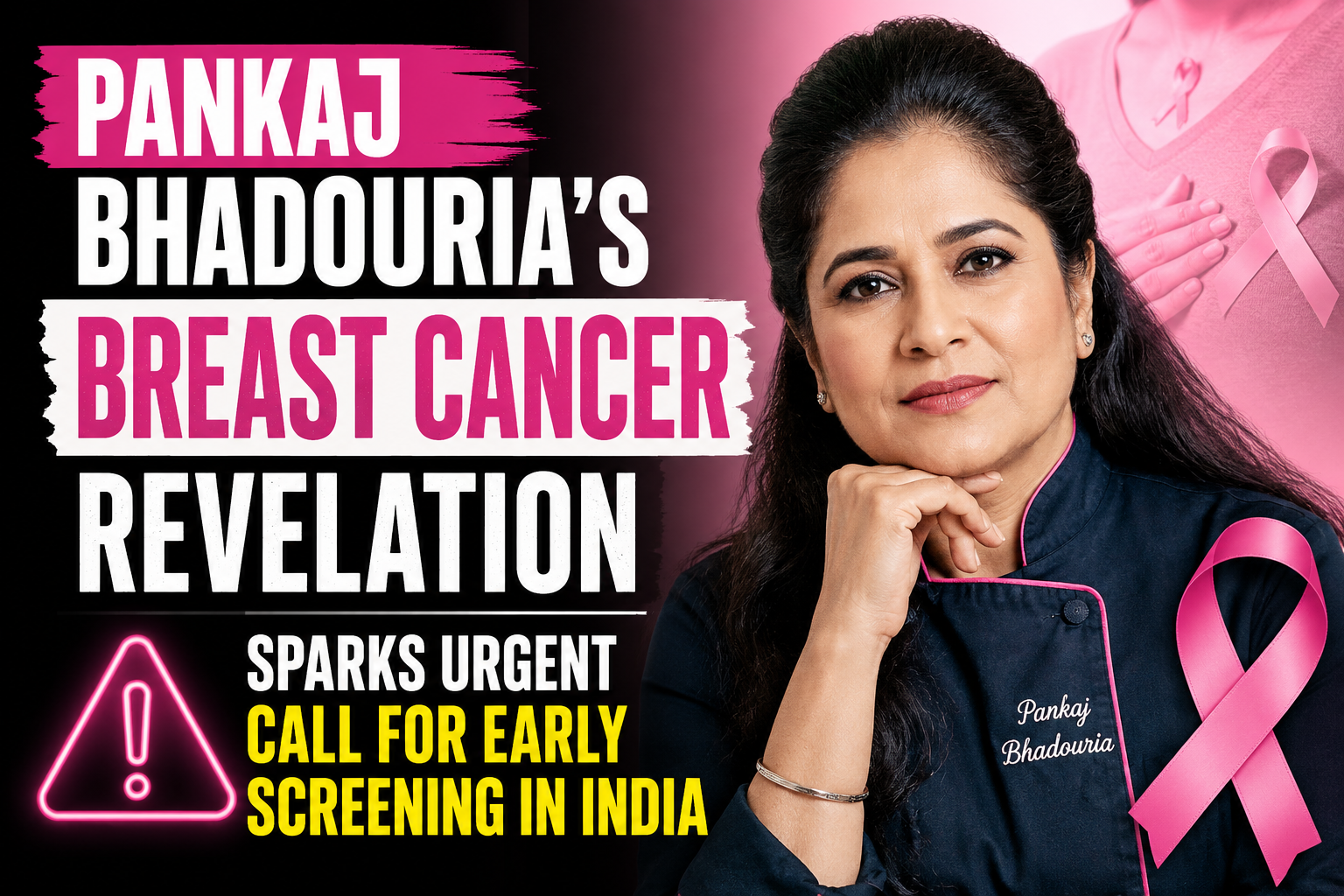
When one of India’s most beloved celebrity chefs steps in front of a camera not to demonstrate a recipe but to share that she just came out of cancer surgery, the nation pauses. On June 2, 2025, Pankaj Bhadouria winner of the first season of MasterChef India and a household name across millions of Indian kitchens did exactly that. In a heartfelt video message shared on social media, she revealed that she had been diagnosed with breast cancer, undergone surgery, and was now on the road to recovery. But more importantly, she turned her personal health crisis into a public health appeal: urging women, especially those over 40, to stop delaying breast cancer screenings.
Her timing, her courage, and the statistic she shared that 1 in every 20 Indian women is susceptible to breast cancer have sparked a conversation that India desperately needs to have, openly and urgently. This article goes beyond the headline to explain why Bhadouria’s story matters, what the data actually says about breast cancer in India, and what every woman reading this should do before the week is out.
Who Is Pankaj Bhadouria, and Why Does Her Voice Matter?
Pankaj Bhadouria is not just a reality television personality. She is a former English teacher who became a culinary icon after winning MasterChef India Season 1 in 2010, inspiring an entire generation of home cooks particularly women to take their passion for food seriously. Her social media following spans millions, and her audience skews heavily toward women in their 30s, 40s, and 50s: precisely the demographic most at risk for breast cancer.
That demographic reach is exactly why her decision to speak publicly about her diagnosis is so significant. Unlike formal health campaigns run by hospitals or government bodies, celebrity disclosures carry a different kind of weight. They feel personal. They dismantle the dangerous illusion that serious illness is something that happens to “other people.” When Pankaj Bhadouria says, “Ham sabko lagta hai ki shayad ye hamare sath nahi hoga” (“We all think this won’t happen to us”), she is naming the single biggest psychological barrier to early cancer detection in India.
What Happened: The Timeline of Her Diagnosis and Recovery
A few weeks before her public video message, Bhadouria’s team first disclosed on social media that she had been diagnosed with breast cancer. The announcement came as a shock to fans who knew her primarily through her vibrant, food forward public persona. The team reassured followers that her surgery had been completed successfully.
In her follow-up video in early June, Bhadouria confirmed the good news: her cancer had been caught at a very early stage, her surgery had gone well, and she was recovering. She was transparent about the role that timing played in her outcome. “I was fortunate that my cancer was detected at a very early stage. That is why I could recover,” she said, without minimizing the gravity of the situation. She thanked fans for their overwhelming support and pivoted immediately to a larger message: early detection is not luck it is a choice you can make through regular screening.
The Shocking Reality of Breast Cancer in India
Bhadouria’s doctors told her that one in every 20 Indian women is susceptible to breast cancer. That figure sounds manageable in isolation until you place it inside the actual scale of India’s population. India now reports approximately 2.2 lakh new cases of breast cancer every year, making it the most common cancer among Indian women. Between 2019 and 2023, cases rose steadily from roughly 200,000 to over 221,000 annually, with deaths climbing from 74,000 to over 82,000 in the same period.
Those mortality figures point to a problem that goes far beyond incidence: late stage diagnosis. Nearly 57–60% of breast cancers in India are detected at Stage III or Stage IV when the disease has already spread, treatment is far more aggressive, outcomes are far worse, and survival is dramatically reduced. Compare this to developed nations, where more than 60% of cases are caught early. India’s current early detection rate sits at around just 30%.
The survival gap that results from this is stark.
| Stage at Diagnosis | 5-Year Survival Rate (India) | What It Means |
|---|---|---|
| Stage I (Early) | ~93% | Nearly all women survive with timely treatment |
| Stage II | ~75–80% | Good outcomes with surgery + treatment |
| Stage III | ~50–60% | More complex treatment, lower survival odds |
| Stage IV (Advanced) | ~24.5% | Disease has spread; treatment is palliative |
| India’s Overall 5-Year Survival | ~66% | Significantly lower than US/UK (~90%) |
The data is unambiguous. A woman whose breast cancer is found at Stage I has roughly a 93% chance of surviving five years. A woman whose cancer is found at Stage IV has less than a 25% chance. The disease does not become more lethal as it progresses the treatment just becomes less effective. That gap between 93% and 24.5% is not a medical mystery. It is a detection failure.
Why Indian Women Are Diagnosed So Late: The Real Barriers
Understanding why late diagnosis is so common in India requires looking at several interconnected barriers that are rarely discussed together in mainstream coverage.
1. The Stigma of Breast Health Conversations
In many parts of India, discussing breast health openly even with a doctor remains socially uncomfortable, particularly for older women raised in conservative households. The breast is not just a medical organ in the cultural imagination; it carries layers of femininity, modesty, and shame that make routine self-examination or a clinical check up feel transgressive. This silence costs lives.
2. The “It Won’t Happen to Me” Fallacy
Pankaj Bhadouria identified this barrier herself, and it is perhaps the most universal. Psychological research consistently shows that people systematically underestimate their personal risk of illness while correctly estimating risk for the general population. This “optimism bias” is particularly dangerous in cancer, where early action is so critical. Hearing a familiar face say “I thought this wouldn’t happen to me either” is one of the most effective ways to break that bias.
3. Access and Affordability
For women in rural India, tier-2 and tier-3 cities, or lower-income urban households, accessing a mammogram is not straightforward. Machines are concentrated in major metropolitan areas, costs can be prohibitive without insurance, and awareness of government-run screening programs remains low. The government’s Ayushman Bharat scheme has conducted breast cancer screenings for over 150 million women a remarkable achievement but coverage remains uneven, and the scale of unmet need is still enormous.
4. Busy Lives and Deferred Self-Care
Indian women particularly those juggling careers, households, children, and ageing parents simultaneously tend to place their own health at the bottom of an impossibly long priority list. Annual health check-ups that are standard in corporate environments for men are often skipped or delayed by women. Symptoms get rationalized (“it’s probably nothing”), and by the time something is taken seriously, precious time has been lost.
What Screening Actually Looks Like: A Practical Guide
One reason awareness campaigns often fail to translate into action is that they remain abstract. Here is what breast cancer screening actually involves for Indian women, broken down by age and risk:
For Women Under 40 (Average Risk)
Monthly breast self-examination (BSE) is the cornerstone. Ideally performed about a week after your period ends (when breasts are less tender), BSE involves checking for any new lumps, skin changes, nipple discharge, or changes in shape or size. It takes five minutes. It costs nothing. Any new finding should be reported to a doctor promptly not in three months, not “when things calm down.”
For Women 40 and Above (General Population)
Annual clinical breast examination (CBE) by a trained healthcare professional, combined with a mammogram every 1–2 years, is the standard recommendation. Mammography can detect tumors up to two years before they are large enough to be felt by hand making it the single most powerful early detection tool available.
For High-Risk Women (Family History, BRCA Gene Mutations)
Women with a firstdegree relative (mother, sister, daughter) who had breast cancer, or those with known BRCA1/BRCA2 gene mutations, should begin screening earlier potentially from age 30 and may require MRI scans in addition to mammography. A genetics counselor referral is advisable.
| Age Group | Recommended Screening | Frequency |
|---|---|---|
| 20–39 (Average Risk) | Breast Self Examination (BSE) | Monthly |
| 40–49 | BSE + Clinical Breast Exam + Mammogram | Annually |
| 50 and above | Mammogram + Clinical Breast Exam | Every 1–2 years |
| High Risk (any age) | Mammogram + MRI + Genetic Counseling | As advised by specialist |
The Celebrity Effect: Does Public Disclosure Actually Change Behavior?
There is compelling evidence that it does. After Angelina Jolie published her 2013 op-ed about her preventive double mastectomy following a positive BRCA gene test, researchers documented a measurable surge in genetic testing referrals and breast cancer screening consultations globally a phenomenon now formally known as the “Angelina Jolie effect” in medical literature. In the US, mammography rates among women aged 40 50 rose significantly in the months following her announcement.
India has seen similar, if more localized, patterns. When public figures discuss health conditions candidly, it removes the social taboo that many women need removed before they will take action. It also makes the topic conversational suddenly, women are talking to their mothers, sisters, and friends about screenings in a way that a government poster or hospital pamphlet never achieves.
Pankaj Bhadouria’s reach and the relatability of her persona gives her disclosure the potential to trigger exactly this kind of behavioral shift. She is not a Western celebrity speaking to a distant cultural context. She is someone millions of Indian women have watched cook in a kitchen that looks like theirs, speak in a language they grew up with, and navigate a life that mirrors theirs in countless ways.
The Gap Between Awareness and Action: What Needs to Change
Individual celebrity campaigns are powerful but insufficient. India’s breast cancer burden demands structural solutions running in parallel with personal awareness efforts.
First, mammography infrastructure needs aggressive expansion beyond metropolitan centers. Mobile mammography units already piloted in some states need to become a national standard, reaching rural and semi-urban women who currently have no viable access to screening.
Second, workplace wellness programs need to include mandatory breast health screening for women employees above 40, the same way many corporates now include blood pressure and diabetes checks. Employers in India have enormous untapped potential to normalize women’s preventive health.
Third, the conversation about breast health needs to be embedded into school and college health education from a young age not in a clinical or alarming way, but matter of factly, the way dental hygiene is taught. Young women who learn to conduct breast self-examinations at 20 will not forget at 45.
Fourth, India’s government screening programs under Ayushman Bharat and the National Programme for Prevention and Control of NCDs have already trained over 1.4 million primary healthcare providers in early detection by May 2024 but ground-level uptake needs monitoring, accountability, and local community engagement to translate training into actual screenings.
A Prediction Worth Making
Within the next decade, India’s breast cancer story will be written by two competing forces: the continued rise in incidence driven by urbanization, lifestyle changes, later age of first pregnancy, and reduced breastfeeding and the potential for dramatically improved outcomes if early detection infrastructure is scaled and normalized. The women diagnosed in 2035 will either benefit from a healthcare culture that treats breast cancer screening as routine as a blood test, or they will face the same late stage diagnoses that are costing so many women their lives today.
Which version of that future materializes depends, in significant part, on how many moments like Pankaj Bhadouria’s video are created, amplified, and followed through with concrete action both by individuals and by the systems meant to serve them.
Conclusion: Fortuitous, Not Lucky
Pankaj Bhadouria called herself “fortunate” that her cancer was caught early. But fortune had less to do with it than choice the choice to get checked, the choice to not dismiss a symptom, the choice to prioritize her own health. That distinction matters because fortune is passive and choice is active. Every woman reading this has access to the same active choice.
India reports over 2.2 lakh breast cancer cases every year, and more than half are found too late. The surgery that Bhadouria recovered from with relative ease becomes a far more brutal fight and sometimes an unwinnable one when the diagnosis comes at Stage III or Stage IV. The information to prevent that is not hidden. The technology to screen for it is not experimental. What has been missing, for too many women, is the permission to take their own health seriously.
Pankaj Bhadouria has just given them that permission. The next step is theirs to take and it starts with scheduling a screening appointment before closing this tab.
Key Takeaways at a Glance
- Pankaj Bhadouria, MasterChef India Season 1 winner, was diagnosed with breast cancer at an early stage and underwent successful surgery in 2025.
- She is urging women over 40 to get regular mammograms and to practice monthly breast self examination.
- 1 in 20 Indian women is susceptible to breast cancer, with over 2.2 lakh new cases reported annually.
- Nearly 57–60% of breast cancers in India are diagnosed at advanced stages compared to under 40% in developed countries.
- Stage I survival rates touch 93%; Stage IV survival rates fall below 25% a gap bridged almost entirely by early detection.
- Government programs have screened 150 million women under Ayushman Bharat, but access gaps remain serious, especially in rural India.
- Celebrity disclosures are clinically documented to increase screening uptake Bhadouria’s voice has the potential to do real public health good.
For breaking news and live news updates, like us on Facebook or follow us on Twitter and Instagram. Read more on Latest Health on thefoxdaily.com.






COMMENTS 0