To understand why this surveillance launch matters, it helps to understand the scale of the problem it is targeting. Antimicrobial resistance occurs when microorganisms mutate or acquire resistance genes that allow them to survive exposure to medicines that would otherwise kill them. Overuse and misuse of antibiotics in human medicine, veterinary practice, and agriculture accelerates this process dramatically.
According to the Global Antimicrobial Resistance and Use Surveillance System (GLASS), drug-resistant infections directly caused approximately 1.27 million deaths globally in 2019 alone, with another 4.95 million deaths associated with AMR. India accounts for a disproportionate share of this burden. The country is the world’s largest consumer of antibiotics for human health, and antibiotics are routinely sold over the counter without prescription across much of the country a practice that turbocharges resistance development.
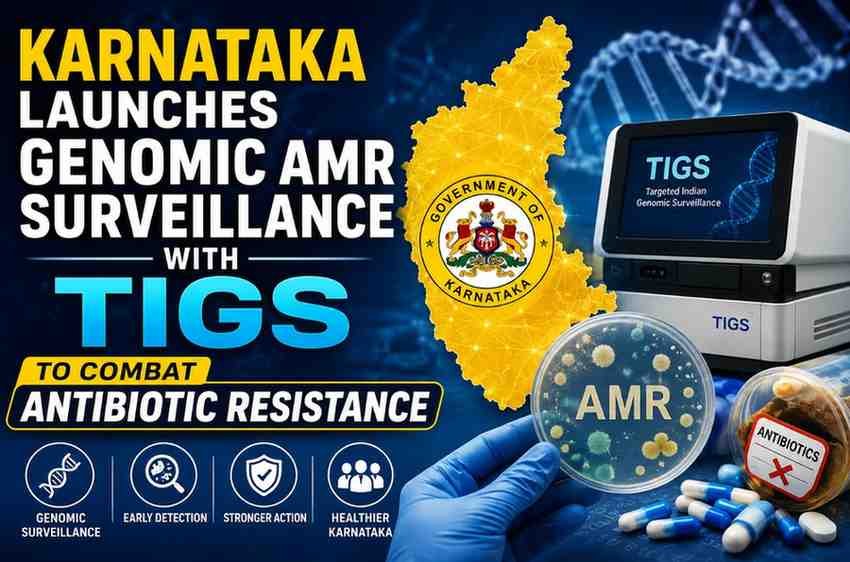
Karnataka‘s collaboration with TIGS an institute with deep expertise in genomics, biosafety, and infectious disease science represents the first structured, government-backed AMR surveillance framework in the state. It signals a shift from reactive outbreak management to proactive, data-driven resistance monitoring across multiple sectors simultaneously.
The Architecture of the Surveillance Programme: What Will Actually Be Monitored?
Effective AMR surveillance is not simply about testing patients in hospitals. Resistance genes travel through ecosystems from farms to food, from wastewater to drinking water, from animals to humans. Karnataka’s programme is designed with this interconnected reality in mind, drawing on the globally endorsed One Health approach that treats human, animal, and environmental health as inseparable.
The surveillance framework is expected to collect and analyse samples across three core domains:
- Human health settings: Tertiary care hospitals, district hospitals, and primary health centres will serve as sentinel sites, tracking resistant pathogens in clinical samples blood, urine, sputum, and wound cultures from patients.
- Animal and agricultural sectors: Poultry farms, dairy operations, and veterinary hospitals will be monitored for antibiotic-resistant bacteria that can transfer to humans through food chains or direct contact.
- Environmental samples: Water bodies, soil near agricultural zones, and hospital effluent will be screened for resistance genes, which are known to persist long after the antibiotic that triggered them has been discontinued.
TIGS brings genomic sequencing capabilities to the table, enabling the programme to go beyond culture-based resistance testing to whole-genome sequencing of resistant pathogens a method that can trace transmission networks, identify resistance gene families, and predict how resistance will spread. This is a considerable technological leap from the routine antibiotic sensitivity testing currently done in most Indian hospitals.
Karnataka and TIGS: A Partnership Built on Scientific Depth
The Tata Institute for Genetics and Society was established in 2017 with a mandate to address global health challenges through genetic and genomic science. Headquartered in Bengaluru, TIGS has built significant capacity in areas including gene drive research for malaria vector control and infectious disease genomics. Its institutional strength lies precisely where AMR surveillance needs depth: high-throughput genomic analysis, bioinformatics infrastructure, and the ability to translate laboratory data into Public Health policy recommendations.
The Karnataka government’s decision to partner with TIGS rather than rely solely on existing government laboratory networks reflects a pragmatic acknowledgement that combating AMR requires capabilities that public health infrastructure in India has not yet fully developed. By anchoring the programme in a research institution with international collaborations and cutting-edge sequencing technology, Karnataka is effectively future-proofing its surveillance architecture.
This public-private-research partnership model mirrors what has worked in countries like Denmark and the Netherlands, which are considered global leaders in AMR surveillance and have achieved measurable reductions in antibiotic-resistant infections through consistent, long-term monitoring paired with regulatory action.
The Unique Angle No Other Coverage Is Discussing: Genomic Surveillance as a Policy Lever
Most news coverage of AMR announcements focuses on the fact of the launch who, what, where. What is rarely examined is the downstream policy value of genomic surveillance data, and this is where Karnataka’s programme has the potential to be genuinely transformative.
When resistance patterns are tracked only through routine clinical microbiology, health authorities learn which drugs are no longer working after the resistance has already spread widely. Genomic surveillance, by contrast, can detect the emergence of a resistance gene before it has become clinically dominant and trace its geographic and institutional spread with precision. This transforms surveillance from a reporting tool into an early warning system.
Consider the practical implications for Karnataka specifically. The state has a large and growing pharmaceutical manufacturing sector around Bengaluru, significant poultry farming activity in districts like Kolar and Tumkur, and river systems including the Cauvery basin that flow through both agricultural and urban zones. Each of these represents a potential AMR hotspot. Genomic mapping of resistance across these geographies could allow the state government to target antibiotic stewardship interventions restricting certain antibiotics, mandating prescription requirements, improving hospital infection control at exactly the locations and pathogen types where they will have the greatest impact.
This is the difference between public health policy guided by intuition and public health policy guided by evidence. The data infrastructure Karnataka is building now will, over time, become one of its most valuable health assets.
India’s AMR Problem in Numbers: The Context Behind the Urgency
| Indicator | India / Karnataka Context | Global Benchmark |
|---|---|---|
| Antibiotic consumption (human) | Largest consumer globally by volume | WHO recommends access antibiotics only; India still overuses watch/reserve categories |
| OTC antibiotic sales | Widespread despite Schedule H regulations | Prescription-only in EU, US, Australia |
| AMR-attributable deaths (2019) | ~300,000+ estimated in India | ~1.27 million globally (direct attribution) |
| Carbapenem-resistant Enterobacteriaceae (CRE) | Rising rapidly in Indian ICUs | Classified as critical priority pathogen by WHO |
| ESKAPE pathogens resistance rates | Among highest in South Asia | Major cause of hospital-acquired infections globally |
| National AMR action plan | India adopted in 2017; implementation uneven | WHO calls for fully funded, implemented national plans by all member states |
The table above underscores a fundamental tension: India has the policy intent but has historically struggled with the implementation infrastructure to back it up. State-level programmes like Karnataka’s are therefore not supplementary to the national effort they are, in many ways, the national effort finding practical expression.
What Makes This Different From Previous AMR Initiatives in India?
India has had AMR-related programmes before. The Chennai Declaration of 2012 was a watershed moment, bringing together medical associations to commit to responsible antibiotic use. The National Action Plan on AMR was launched in 2017. ICMR has maintained AMR surveillance networks at select hospitals for over a decade.
So what distinguishes the Karnataka-TIGS programme from what came before?
Three things stand out. First, the integration of genomic sequencing at a state government level is new. Previous surveillance relied primarily on phenotypic testing observing whether bacteria grow in the presence of an antibiotic which gives limited information about the genetic mechanisms driving resistance. Second, the One Health framing that includes agricultural and environmental sampling alongside clinical data is a meaningful expansion of scope. Third, the institutional partnership with TIGS introduces research-grade analytical capacity into what has historically been a routine public health monitoring exercise.
Together, these elements suggest that Karnataka is not building another data collection programme that quietly generates reports read by few. It is building a system designed to generate actionable intelligence.
Challenges Ahead: What Could Go Wrong?
Intellectual honesty demands acknowledging the challenges that lie between programme launch and genuine impact. AMR surveillance at scale is technically demanding, resource-intensive, and politically complex.
Sample collection from private hospitals which handle the majority of clinical cases in urban Karnataka requires buy-in that regulatory mandates alone cannot guarantee. Agricultural sector compliance, particularly from small-scale poultry and dairy farmers, will require sustained outreach and incentive structures, not just notification. And perhaps most critically, the data generated must be translated into regulatory decisions quickly enough to matter a challenge in any bureaucratic system.
There is also the question of data sharing. AMR surveillance generates sensitive information about resistance patterns in specific institutions and geographies. Balancing transparency with the risk of stigmatisation which could discourage participation will require careful governance from the outset.
None of these challenges are insurmountable. But acknowledging them is part of what makes this initiative credible rather than ceremonial.
The Broader Vision: Can Karnataka’s Model Go National?
If Karnataka’s AMR surveillance programme delivers on its promise generating granular, genomics-informed resistance data across human, animal, and environmental domains it will have created something of immense replicable value. India’s federal health structure means that state-level innovations often become the templates for national policy. Tamil Nadu’s drug procurement model, Kerala’s community health infrastructure, and Rajasthan’s right-to-health legislation all began as state experiments before influencing the national discourse.
Karnataka has a credible shot at doing the same for AMR. A well-designed, well-executed state surveillance programme that demonstrably improves antibiotic stewardship, reduces resistant infection rates, and produces publishable scientific data will be impossible to ignore at the central level.
The WHO’s Global Action Plan on AMR explicitly calls for country-level surveillance systems that feed into the global GLASS database. If Karnataka’s programme is designed with interoperability in mind generating data in formats compatible with international reporting standards it could simultaneously serve state needs and contribute to India’s global AMR reporting obligations.
Conclusion: A Small Launch With Large Stakes
Karnataka’s antimicrobial resistance surveillance programme, launched in collaboration with TIGS, may not have generated the headlines of a vaccine approval or a disease eradication announcement. But in the long arc of public health history, surveillance infrastructure is where battles are won or lost before they are ever fought in the clinic.
The pathogens that do not respond to last-resort antibiotics are already circulating in Indian hospitals, farms, and waterways. The question is not whether resistance will worsen without intervention, the data strongly suggest it will. The question is whether India’s health systems will have the intelligence infrastructure to detect, track, and contain that worsening before it reaches crisis proportions.
Karnataka, in partnership with TIGS, has just invested in that intelligence infrastructure. The genomic surveillance data it begins collecting today may, within a decade, be credited with saving thousands of lives not through a dramatic cure, but through the unglamorous, indispensable work of knowing where the threat is, how it is moving, and where to act.
In a public health landscape prone to prioritising the visible over the vital, that is not a small thing. It is, in fact, exactly the right thing.
For breaking news and live news updates, like us on Facebook or follow us on Twitter and Instagram. Read more on Latest Health on thefoxdaily.com.






COMMENTS 0