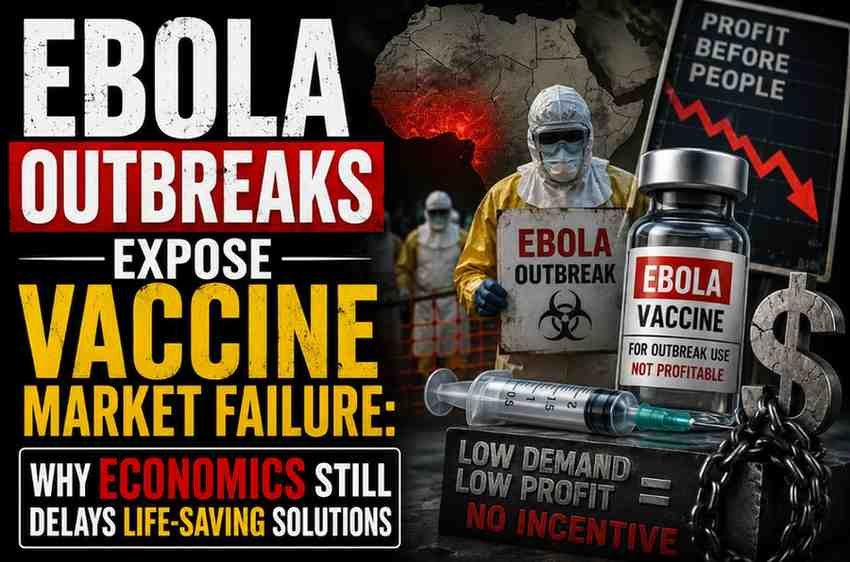
A disease with a known cure pathway keeps killing people not because science failed, but because the economics of drug development were never designed to save the poor.
Global Health · Vaccine Economics · Infectious Disease Policy
Every few years, a village in Central or West Africa erupts in fear. Hemorrhagic fever spreads fast. Health workers fall. Borders close. The world watches, horrified and then, almost as reliably as the outbreak itself, experts appear on television to explain that a vaccine exists, or nearly exists, or could exist if only someone had funded it properly. The cycle repeats. The graves multiply. And the root cause a profound, structural market failure in global vaccine development remains largely unaddressed.
The latest Ebola outbreak is not a scientific failure. It is an economic one. Understanding why requires pulling back the lens from virology and looking at how the pharmaceutical industry actually decides which diseases deserve cures and which ones do not.
What Is a “Market Failure” And Why Does It Keep Killing People?
In economics, a market failure occurs when private markets, left to their own devices, produce an outcome that is socially suboptimal. In the context of vaccines for diseases like Ebola, Marburg, Nipah, or Lassa fever, the failure is almost textbook: the people most at risk cannot pay the prices required to make drug development profitable, and so the private sector quietly deprioritizes them.
This isn’t a conspiracy. It’s arithmetic. A pharmaceutical company investing $800 million to $1.2 billion in vaccine development needs a return. When the target population lives on less than $2 a day in rural Democratic Republic of Congo, Guinea, or Sierra Leone, the math simply does not work under a purely commercial model. The disease is real. The science is tractable. The market is not.
The current system doesn’t ask “Can we cure this disease?” It asks “Can we profit from curing this disease?” For Ebola, the answer has historically been no and thousands of people have paid for that answer with their lives.
The Neglected Tropical Disease Problem at Scale
Ebola is often grouped with what global health researchers call neglected tropical diseases (NTDs) a category of infections that disproportionately burden low-income countries and receive a fraction of the global R&D investment relative to their disease burden. What makes Ebola distinct, and in some ways more alarming, is that it is not “neglected” because it’s rare or scientifically obscure. It’s neglected because its victims are poor and its outbreaks are episodic a combination that makes sustained commercial investment almost impossible to justify to a board of shareholders.
A Timeline of Missed Opportunities: Ebola’s Long Road to (Partial) Vaccination
- 1976 Ebola first identified in what is now the DRC. Initial outbreak kills 280 people. The scientific community takes note. Pharmaceutical investment does not follow.
- 1995–2012 Sporadic outbreaks in Central Africa. Researchers develop experimental vaccine candidates in academic and government labs. No pharmaceutical company moves them to large scale trials. The market signal is absent.
- 2014–2016 West Africa epidemic the largest in history. Over 28,600 cases, 11,325 deaths across Guinea, Liberia, and Sierra Leone. The world is shocked that no approved vaccine exists. Emergency funding pours in. The rVSV ZEBOV (Ervebo) vaccine enters accelerated trials.
- 2019 Ervebo (Merck) approved by the FDA and EMA the first licensed Ebola vaccine. This approval came 43 years after the disease was first identified. A second vaccine (Ad26.ZEBOV/MVA BN Filo, branded Zabdeno/Mvabea) gains approval for a two-dose regimen.
- 2021–2022 New strain, new problem. The Sudan strain of Ebola re-emerges in Uganda. Available vaccines were developed against the Zaire strain. The existing stockpiles are effectively useless for Sudan-strain outbreaks. The research gap is exposed again.
- 2025 2026 Current outbreak. Another outbreak reignites global attention, exposing persistent gaps in stockpile preparedness, cold chain logistics, and multi strain vaccine coverage. The cycle continues.
The Insight Competitors Are Missing
Most coverage frames Ebola vaccine delays as a funding problem. The deeper issue is a timing misalignment: money flows during outbreaks, when running clinical trials is ethically and logistically hardest. The scientific work that should happen between outbreaks strain coverage expansion, heat-stable formulations, stockpile maintenance is chronically underfunded precisely when the political pressure to fund it is lowest.
The Economics of Indifference: How Drug Pricing Determines Who Gets to Live
To understand why Ebola vaccines took four decades to arrive, you need to understand how the pharmaceutical industry allocates its R&D spending. Global pharmaceutical R&D expenditure exceeds $200 billion annually. The diseases that attract the most investment cardiovascular disease, oncology, diabetes, neurological conditions share a common characteristic: they affect large populations in wealthy countries where patients or their insurers can pay premium prices.
Ebola checks none of those boxes. Its victims are, almost without exception, in low-income Sub-Saharan African nations. Outbreaks are geographically concentrated and epidemiologically unpredictable. A vaccine developed at great cost might sit in a refrigerator for five years between outbreaks, generating no revenue. For a publicly traded company answering to shareholders, this is not an investment it is a charity project dressed in a lab coat.
The “Orphan Disease” Incentive Gap
The United States and European Union have created orphan drug designations that offer tax incentives, extended exclusivity periods, and expedited review for drugs targeting rare conditions. These mechanisms have genuinely stimulated R&D for rare genetic disorders predominantly affecting wealthy populations. But they were not designed for infectious disease outbreaks in low-income countries, and the incentives they offer are still insufficient to overcome the fundamental market gap that epidemic prone diseases represent.
| Disease | Primary Affected Population | Vaccine Status | Time from Discovery to Vaccine | Commercial Viability |
|---|---|---|---|---|
| COVID-19 | Global / wealthy nations heavily affected | Multiple approved vaccines in <1 year | <12 months | Extremely high |
| Ebola (Zaire) | Central / West Africa | Approved 2019 (Ervebo) | 43 years | Very low |
| Ebola (Sudan strain) | East / Central Africa | No approved vaccine as of 2026 | 50+ years and counting | Near zero |
| Marburg virus | Central Africa | Experimental candidates only | 59 years and counting | Near zero |
| Nipah virus | South / Southeast Asia | No approved vaccine | 28 years and counting | Very low |
| Influenza | Global | Annual vaccines, well-funded | Ongoing since 1940s | High |
The table above illustrates a brutal pattern: when a disease threatens wealthy nations, the pharmaceutical pipeline responds with remarkable speed. When it doesn’t, the world waits and waits and people die.
The COVID-19 Comparison: Proof That Speed Is Possible If the Incentives Are Right
The mRNA vaccine revolution demonstrated that vaccine development timelines are not fixed by science they are fixed by economics and political will. Within twelve months of SARS CoV 2 being identified, multiple highly effective vaccines were authorized for emergency use. The Pfizer-BioNTech mRNA vaccine was administered to its first recipients in December 2020, less than a year after the genome was published.
This was not magic. It was money, coordination, and risk-sharing. Governments pre-purchased billions of doses before efficacy was confirmed, absorbing the financial risk that would normally deter private investment. Regulatory processes ran in parallel rather than sequentially. Scientists shared data at unprecedented speed. The result was a compressed timeline that would have seemed impossible under the normal pharmaceutical development model.
The uncomfortable question this raises is painfully direct: if the same urgency and public investment had been applied to Ebola in 1976, or 1995, or 2012, how many of those 11,000 deaths in West Africa would not have happened? The answer is not zero manufacturing and distribution would still have been challenges. But it is certainly not “all of them would have died anyway.”
The Structural Solutions: What Actually Works
There is no shortage of proposed fixes to the Ebola vaccine market failure. The challenge is that most of them require sustained political commitment across election cycles something democracies struggle to deliver for crises that feel distant until they don’t.
Push Funding: Reducing the Cost of Discovery
Push mechanisms work by subsidizing the inputs of research grants, tax credits, public funding for early stage trials. Organizations like the Coalition for Epidemic Preparedness Innovations (CEPI), established after the 2014 16 Ebola epidemic, and the U.S. Biomedical Advanced Research and Development Authority (BARDA), provide this kind of upfront risk-sharing. CEPI has invested in Ebola Sudan vaccine candidates, and its 100 Days Mission aiming to develop a vaccine prototype within 100 days of a new pandemic threat being identified represents a meaningful institutional shift.
Pull Incentives: Guaranteeing a Market That Doesn’t Exist
Pull mechanisms work differently: they promise a reward if a product is successfully developed, creating commercial incentive where none previously existed. The most prominent example is the Advance Market Commitment (AMC), pioneered by economist Michael Kremer, which guarantees that donors will subsidize vaccine purchases at a viable price if a manufacturer produces a qualifying product. The pneumococcal vaccine AMC, launched in 2009, has been credited with accelerating access to vaccines for hundreds of millions of children in low-income countries.
Applying a similar mechanism specifically to outbreak-prone pathogens Ebola, Marburg, Nipah, Lassa remains under utilized and under funded. A credible, well capitalized AMC for filovirus vaccines could change the calculus for pharmaceutical R&D almost immediately.
Public Ownership of Pandemic-Critical Vaccines
A more radical and increasingly mainstream argument holds that vaccines against epidemic threat pathogens should be developed primarily by public institutions, with manufacturing licenses available to generic producers at cost. This model removes the profit motive entirely for a category of products where profit seeking has demonstrably failed. The mRNA Technology Transfer Programme, backed by the WHO, is attempting something like this for developing country manufacturing capacity, though full public ownership of vaccine intellectual property remains politically contested.
- CEPI’s 100 Days Mission targeting prototype vaccines within 100 days of new pathogen identification
- WHO Emergency Use Listing expedited approval pathways that reduce regulatory timelines for outbreak responses
- Stockpile pre positioning GAVI and partner organizations pre-positioning vaccine doses in high-risk regions before outbreaks occur
- Regional manufacturing hubs building vaccine production capacity within Africa to reduce supply chain dependency and response time
- Multi-strain R&D mandates requiring funded programs to cover all major Ebolavirus species, not just the commercially “easiest” Zaire strain
The Cold Chain Problem Nobody Wants to Talk About
Even when an Ebola vaccine exists, deploying it in the communities that need it most is a logistical nightmare that rarely makes international headlines. The approved Ervebo vaccine requires storage at -60°C to -80°C deep freeze conditions that are routine in hospital pharmacies in Paris or New York, but essentially impossible to maintain in remote villages of the DRC without extraordinary support infrastructure.
The 2018–2020 DRC outbreak in North Kivu the second largest Ebola outbreak in history, occurring while a vaccine was theoretically available illustrated this vividly. Distribution was hampered not only by active armed conflict but by the sheer cold chain logistics required to keep doses viable over rough terrain in equatorial heat. An approved vaccine that cannot reach patients at the point of need is, for those patients, effectively no vaccine at all.
This is why next generation Ebola vaccine research must prioritize thermostable formulations versions that remain effective at ambient temperatures alongside efficacy. The science of stabilization is less glamorous than the science of immunogenicity, but in a field outbreak, it is arguably more important.
Prediction: The Next Decade’s Turning Point
Within the next 10 years, one of two things will happen. Either a catastrophic outbreak one that spreads from an endemic zone into a major international hub before being contained will finally force the sustained policy shift that decades of smaller crises have failed to produce. Or, more optimistically, the convergence of mRNA platform technology, CEPI’s strengthened mandate, and growing African domestic vaccine manufacturing capacity will quietly close the gap without the galvanizing disaster. The second outcome is achievable. It is not, at the current pace of political commitment, probable.
Conclusion: A Curable Crisis of Political Will
The Ebola vaccine market failure is not a story about the limits of human ingenuity. It is a story about the limits of human solidarity and about an economic system that allocates the fruits of scientific progress according to purchasing power rather than need.
The good news is that the tools to fix this are well understood. Push funding, pull incentives, advance market commitments, public manufacturing capacity, and sustained between-outbreak investment are not theoretical proposals. They are proven mechanisms that work when properly resourced and politically committed to.
What this latest outbreak should make clear is that the cost of inaction is not just humanitarian. Pandemic preparedness is also an economic and security issue. The 2014 16 West Africa epidemic cost the regional economy an estimated $2.2 billion in GDP losses vastly more than fully funding a comprehensive Ebola vaccine program would have cost. Preparedness is not a charity expense. It is catastrophic risk insurance for a deeply interconnected world.
The future, if we choose it, looks like this:
- Vaccines developed for all major Ebolavirus strains, not just the commercially visible ones
- Thermostable formulations that can be deployed without ultra cold chain infrastructure
- Pre-positioned stockpiles in high risk regions, maintained continuously, not reactively
- Regional African manufacturing capacity that does not depend on European or North American supply chains
- A funded, standing AMC for filovirus vaccines that makes commercial development viable before the next outbreak begins
None of this is technically beyond reach. The only question is whether the world is willing to pay for it when the cameras are pointed elsewhere and whether it will take another catastrophe to find out.
For breaking news and live news updates, like us on Facebook or follow us on Twitter and Instagram. Read more on Latest Health on thefoxdaily.com.



COMMENTS 0