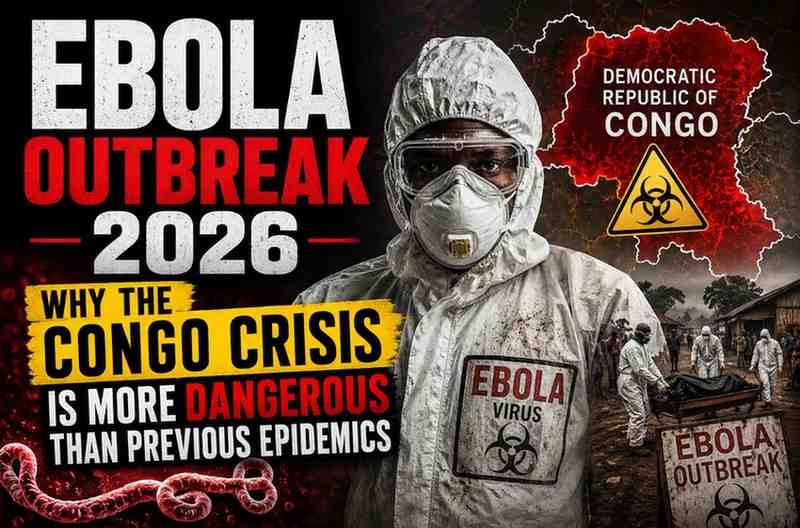
In a gold-mining town in northeastern Congo, health workers in full protective equipment are attempting the near-impossible: containing one of the world’s most feared viruses in an active conflict zone, where angry residents have attacked hospitals, burned down isolation tents, and where the sound of gunfire is a regular backdrop to emergency triage. This is the reality of the 2026 Ebola outbreak in the Democratic Republic of Congo and it is unfolding at a speed that has alarmed Global Health authorities and pushed the World Health Organization to take emergency action faster than it ever has before.
As of the latest WHO situation report, the outbreak has produced 550 confirmed cases and 101 confirmed deaths, with 19 recoveries. But those figures almost certainly undercount the true scale of the crisis. The outbreak was spreading for weeks possibly months before it was officially declared on May 15, 2026. Contact tracing coverage, a foundational tool of outbreak control, stands at just 64%. And the Bundibugyo strain of Ebola at the center of this outbreak is one for which no approved vaccine or targeted treatment currently exists.
The Outbreak at a Glance: Timeline and Current Status
The story of this outbreak begins not on May 15 but weeks earlier, in the health zones of Mongbwalu and Rwampara in Ituri Province. Throughout April 2026, Mongbwalu a congested gold-mining hub of roughly 130,000 people experienced a wave of unexplained deaths. Four health workers died within a single week. There were reports of widespread panic, with residents attributing the deaths to supernatural causes rather than infectious disease. It was not until May 5 that the WHO received a formal alert about an unknown high-mortality illness in the area. Laboratory analysis confirmed Bundibugyo virus in eight of thirteen blood samples on May 14. The DRC Ministry of Public Health officially declared the outbreak the following day.
The delay was consequential. By the time the formal declaration was made, the virus had already spread across multiple health zones in Ituri and had reached Uganda, where 19 confirmed cases have since been recorded, including cases in the capital Kampala. A confirmed case was also briefly reported in Goma a city of strategic importance in North Kivu Province under the control of the M23 armed group after an infected woman traveled there from Ituri.
| Key Milestone | Date | Details |
|---|---|---|
| Unexplained deaths begin in Mongbwalu | April 2026 | Including four health workers dead within one week |
| WHO alerted to high-mortality unknown illness | May 5, 2026 | Mongbwalu Health Zone, Ituri Province |
| Bundibugyo virus laboratory confirmed | May 14–15, 2026 | 8 of 13 samples positive at INRB Kinshasa |
| DRC officially declares Ebola outbreak | May 15, 2026 | 17th Ebola outbreak in DRC history |
| WHO declares Public Health Emergency of International Concern (PHEIC) | May 17, 2026 | First PHEIC declared before Emergency Committee convened |
| Uganda confirms cases including in Kampala | May–June 2026 | 19 confirmed cases in Uganda as of latest reports |
| Confirmed deaths exceed 100 in DRC | June 2026 | 550 confirmed cases; 101 deaths; 19 recoveries |
The Bundibugyo Problem: An Ebola Strain the World Is Not Ready For
Not all Ebola outbreaks are equal in their treatability. The strain responsible for the devastating 2018–2020 North Kivu epidemic the Zaire ebolavirus has an approved vaccine, Ervebo, and effective antibody treatments. That outbreak killed over 2,200 people but was eventually brought under control with the help of those medical tools. The 2026 outbreak is caused by a fundamentally different pathogen: the Bundibugyo virus, a species of Ebola first identified in Uganda’s Bundibugyo District in 2007.
There are no approved vaccines for Bundibugyo virus. There are no approved specific therapeutics. The WHO has explicitly recommended against using the Zaire Ebola vaccine (Ervebo) for this outbreak, citing low evidence of cross-protection. The Coalition for Epidemic Preparedness Innovations (CEPI) announced emergency funding in June 2026 for accelerated development of a Bundibugyo-specific vaccine candidate, but any such product is months or years from deployment at scale. In the meantime, clinicians are limited to supportive care fluids, fever management, treatment of secondary complications which can be lifesaving when delivered early but requires patients to reach treatment centers, which is precisely what the conflict is preventing.
Previous Bundibugyo outbreaks carry sobering statistics. The 2007 Uganda outbreak had a case fatality rate of around 25%. The 2012 DRC outbreak reached 50%. With confirmed deaths already at 101 out of 550 confirmed cases and with significant undercounting likely the current outbreak’s fatality trajectory falls within that range and may worsen as more seriously ill patients are counted.
Armed Conflict as a Disease Accelerant
Ituri Province is not simply a remote or underdeveloped area. It is an active conflict zone. Since late 2025, fighting has intensified across eastern DRC, with armed groups including the Allied Democratic Forces (ADF), CODECO, and the Rwanda-backed M23 movement operating throughout the region. In the months immediately preceding the outbreak, more than 100,000 people were newly displaced by violence in Ituri alone. The conflict-displacement nexus is, by design, an optimal environment for infectious disease transmission: dense, poorly-serviced displacement camps; disrupted healthcare infrastructure; terrified populations moving constantly across porous borders.
WHO Director-General Tedros Adhanom Ghebreyesus was direct in his characterization of the situation. “We cannot build community trust or isolate the sick while bombs are falling,” he said, describing the situation as a “catastrophic collision of disease and conflict.” The words are stark but accurate. Contact tracing the systematic identification and monitoring of everyone who may have been exposed to a confirmed case requires health workers to move freely, speak to people in their homes, and follow-up daily. In areas where armed groups control movement and where health workers are themselves targeted, this is not operationally feasible at the scale the outbreak demands.
Community Distrust: The Invisible Barrier
Beyond the bullets, another force is undermining the response: disbelief. In Mongbwalu, the epicenter of the outbreak, crowds attacked the town’s only hospital multiple times in the weeks after the declaration, attempting to retrieve bodies of Ebola victims for traditional burial — a practice that carries significant transmission risk given the high viral load in the bodies of the recently deceased. Attackers burned down one of the patient isolation tents hastily erected on the hospital grounds. Soldiers were required to fire warning shots to disperse them.
Dr. Richard Lokudi, the hospital director in Mongbwalu, described facing “serious resistance from the local community” from people who do not believe Ebola is real. This is not simply ignorance it is a product of decades of broken trust between Congolese communities and both their own government and international health authorities. During the 2018–2020 North Kivu Ebola outbreak, similar dynamics of community resistance contributed to the epidemic’s prolonged duration. The challenge in 2026 is the same, compounded by the fact that Bundibugyo virus, unlike the Zaire strain, is new to many of these communities and lacks the limited but present institutional memory that might lend it credibility.
Ebola’s burial protocols sealed coffins, no traditional washing of the body, rapid interment conflict directly with the mourning customs of many communities in eastern DRC. For families who have already lost loved ones to unexplained illness and who are being asked to surrender the body before traditional rites can be performed, the health workers arriving in head-to-toe protective equipment can feel less like helpers and more like agents of a threatening system. Building the trust that makes voluntary compliance possible is not a communication problem that can be solved with pamphlets. It requires sustained, community-led engagement which takes time that a fast-moving outbreak does not generously supply.
US Aid Cuts and the Funding Gap Behind the Crisis
The 2026 Ebola response is unfolding against a backdrop of dramatically reduced global health funding. Congo’s Health Minister Roger Kamba has publicly called on international donors to increase financial support, specifically citing US aid cuts as a complicating factor for the response. Congo is one of the five poorest countries in the world, where more than 80% of the population lives on $3 a day or less. Its public health system is structurally dependent on international funding for outbreak responses of this scale.
The WHO has deployed rapid response teams and is scaling up treatment centers, surveillance, and supply delivery. The International Rescue Committee is delivering personal protective equipment to frontline health workers. But the gap between what an effective response to this outbreak requires and what is currently funded is significant, and it is widening. A disease the world was already ill-equipped to fight pharmaceutically is now also being poorly-resourced financially a combination that creates conditions for a prolonged and more deadly outbreak than necessary.
The Regional Threat: Uganda, Cross-Border Spread, and What Comes Next
Ituri Province is not a geographic island. It is a commercial and migration hub, connected to Uganda, South Sudan, Rwanda, and through transit networks to the rest of Central and East Africa. The gold mining economy that drives Mongbwalu’s population draws workers from across the region. The region’s porous borders and high population mobility are a structural feature that no flight ban the DRC government banned most flights in and out of Ituri shortly after declaring the outbreak can fully address.
Uganda’s 19 confirmed cases and the brief appearance of a confirmed case in Kampala are the clearest demonstration that the outbreak has already crossed borders. Uganda has significant prior experience with Ebola and has responded rapidly. Kenya has not recorded cases. But the WHO’s assessment of risk as “high at the national and regional level” reflects a genuine concern about continued geographic spread as long as the DRC epicenter remains uncontrolled.
The WHO’s decision to declare a Public Health Emergency of International Concern on May 17 before the Emergency Committee had even formally convened, in an unprecedented procedural step reflects how seriously the organization judged the situation in those early days. The PHEIC designation unlocks international coordination mechanisms and is designed to mobilize faster resource deployment. Whether the response it triggers will match the speed of the virus remains the defining question of the coming weeks.
Why This Outbreak Is Harder to Stop Than Previous DRC Epidemics
The 2026 outbreak is, in several critical ways, more difficult to contain than any of the DRC’s previous sixteen Ebola events. The 2018–2020 North Kivu epidemic the largest in DRC history was fought with the Ervebo vaccine, experimental therapeutics, and a global health community that had both the tools and the institutional memory to respond. This outbreak has none of those pharmaceutical advantages. It started only five months after the end of the previous outbreak, meaning health system capacity had not fully recovered. It is caused by a strain so rarely encountered that even experienced Ebola responders have limited direct familiarity with its clinical presentation. And it is occurring in a political and security environment that has deteriorated significantly since late 2025.
The 64% contact tracing coverage rate is particularly concerning. In outbreak control, contact tracing is the mechanism by which transmission chains are identified and broken. A coverage rate below 80% is generally considered insufficient to control an exponentially spreading virus. Improving that rate in areas where armed groups restrict movement and where community trust has not been established is not simply a logistical challenge — it is a problem that requires political solutions, security guarantees, and community partnerships that take time to build.
Conclusion: A Race Against an Unforgiving Virus in an Unforgiving Environment
The 2026 Ebola outbreak in eastern DRC is a confluence of some of the worst possible conditions for infectious disease control: a highly lethal virus with no vaccine, an active conflict that makes systematic response nearly impossible, profound community distrust accumulated over decades, a funding environment weakened by global aid reductions, and a region already stretched beyond capacity by hunger and displacement.
The path to containment exists. It has been walked before in DRC the 2018–2020 epidemic was eventually brought under control despite extraordinary challenges. But that effort took nearly two years, cost over 2,200 lives, and relied on pharmaceutical tools this outbreak does not have. The global community faces a moment of decision: mobilize at the scale this outbreak demands, with the urgency that a declared Public Health Emergency of International Concern is meant to signal, or watch the numbers climb higher while the political will to act lags behind the virus.
Congo’s Health Minister put the essential truth plainly: “The virus knows no borders, it knows no race, it knows no tribe.” What happens in Ituri will not stay in Ituri. The question is whether the international response will prove that point before the outbreak does.
For breaking news and live news updates, like us on Facebook or follow us on Twitter and Instagram. Read more on Latest Health on thefoxdaily.com.




COMMENTS 0