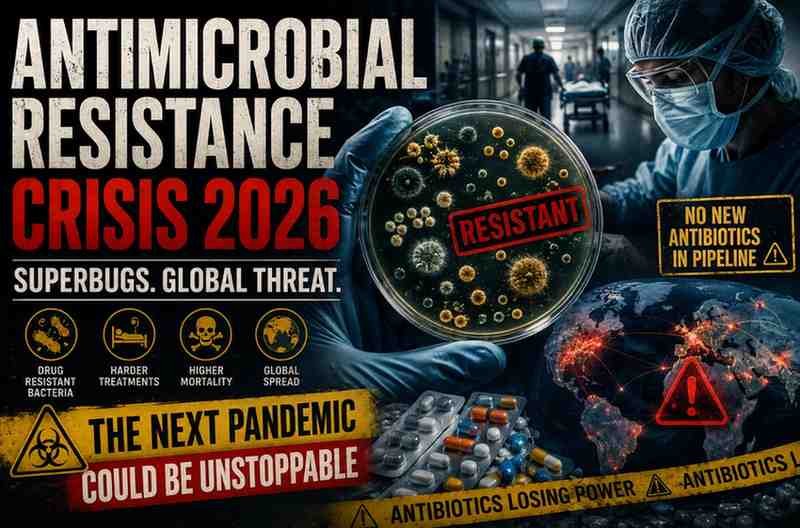
Primary Keyword: antimicrobial resistance crisis 2026
LSI Keywords: antibiotic resistance global threat, AMR causes and prevention, superbugs 2026, antibiotic misuse humans livestock, drug resistant infections, global health crisis AMR, antimicrobial resistance India, future of antibiotics
Introduction: The Silent Pandemic Already Here
While the world remains alert to viral outbreaks and emerging diseases, a far more dangerous and slow-moving crisis is unfolding antimicrobial resistance (AMR). Often called the “silent pandemic,” AMR is steadily making common infections harder, and sometimes impossible, to treat.
Who is affected? Everyone from patients and farmers to healthcare systems.
What is happening? Bacteria, viruses, and fungi are becoming resistant to existing drugs.
When is this becoming critical? The crisis has intensified sharply by 2026.
Where is it most visible? Globally, with severe impact in developing nations.
Why is it dangerous? It threatens to reverse decades of medical progress.
How did we get here? Through antibiotic overuse, poor sanitation, and environmental factors.
This is not a future problem it is already reshaping healthcare outcomes worldwide.
What Is Antimicrobial Resistance (AMR)?
Antimicrobial resistance occurs when microorganisms evolve and no longer respond to medicines designed to kill them. This includes resistance to:
- Antibiotics (bacteria)
- Antivirals (viruses)
- Antifungals (fungi)
- Antiparasitics
Simple explanation: The drugs still exist—but they no longer work effectively.
Why AMR Is Trending as the #1 Health Threat in 2026
1. Overuse of Antibiotics in Humans
Antibiotics are often prescribed unnecessarily for viral infections like colds and flu. Self-medication and incomplete courses further accelerate resistance.
2. Widespread Use in Livestock
Antibiotics are heavily used in agriculture to promote animal growth and prevent disease. This creates resistant bacteria that can spread to humans through food and environment.
3. Poor Sanitation and Hygiene
Inadequate sanitation systems allow resistant microbes to spread rapidly in communities.
4. Climate Change Is Making It Worse
Rising temperatures and extreme weather events are helping resistant bacteria survive longer and spread faster.
Insight: AMR is not just a medical issue it is deeply connected to environment, agriculture, and infrastructure.
Key Developments Driving the AMR Crisis
- Increase in “superbugs” resistant to multiple drugs
- Decline in new antibiotic development
- Growing hospital-acquired infections
- Global spread through travel and trade
Critical point: The pipeline for new antibiotics is dangerously limited compared to the speed of resistance.
Comparison: Antibiotics Then vs Now
| Aspect | Past (20th Century) | Present (2026) |
|---|---|---|
| Effectiveness | Highly effective | Declining rapidly |
| New Drug Development | Frequent breakthroughs | Very limited |
| Infection Outcomes | Easily treatable | Increasingly complicated |
| Global Awareness | Low | Growing but insufficient |
Real-World Impact: What AMR Means for You
1. Common Infections Becoming Dangerous
Diseases like urinary tract infections, pneumonia, and even minor wounds can become life-threatening.
2. Medical Procedures at Risk
Surgeries, chemotherapy, and organ transplants rely on effective antibiotics. Without them, these procedures become high-risk.
3. Rising Healthcare Costs
Longer hospital stays and complex treatments increase financial burden on patients and systems.
4. Increased Mortality
Drug-resistant infections are already responsible for a significant number of deaths globally.
Unique Insight: AMR as a “System Failure,” Not Just a Health Issue
Most discussions focus on antibiotic misuse—but that’s only part of the story.
New perspective: AMR reflects failures across multiple systems:
- Healthcare (overprescription)
- Agriculture (mass antibiotic use)
- Urban planning (poor sanitation)
- Climate policy (environmental changes)
This means solutions must be equally multidimensional.
What Can Be Done to Control AMR?
For Individuals
- Use antibiotics only when prescribed
- Complete the full course of medication
- Avoid self-medication
For Healthcare Systems
- Strengthen infection prevention
- Improve diagnostic accuracy
- Promote antibiotic stewardship programs
For Governments
- Regulate antibiotic use in agriculture
- Invest in new drug research
- Improve sanitation infrastructure
Challenges in Fighting AMR
- Lack of public awareness
- Limited financial incentives for new antibiotics
- Global coordination gaps
- Balancing access vs overuse
Reality Check: Even with awareness, behavior change remains a major hurdle.
Future Outlook: What Happens If We Don’t Act?
If left unchecked, AMR could lead to a “post-antibiotic era” where:
- Minor infections become fatal
- Routine surgeries become unsafe
- Life expectancy declines
Prediction: By the next decade, AMR could surpass many major diseases as a leading cause of death if action is delayed.
Conclusion: A Crisis That Demands Immediate Action
The antimicrobial resistance crisis 2026 is not a distant threat it is already impacting lives across the globe. Unlike sudden outbreaks, AMR grows quietly, making it harder to detect but far more dangerous over time.
Final Thought: Every antibiotic misuse today reduces its effectiveness tomorrow.
Future Outlook: With coordinated global action, innovation, and responsible behavior, it is still possible to slow down and potentially reverse this crisis. But the window to act is closing fast.
For breaking news and live news updates, like us on Facebook or follow us on Twitter and Instagram. Read more on Latest Health on thefoxdaily.com.




COMMENTS 0