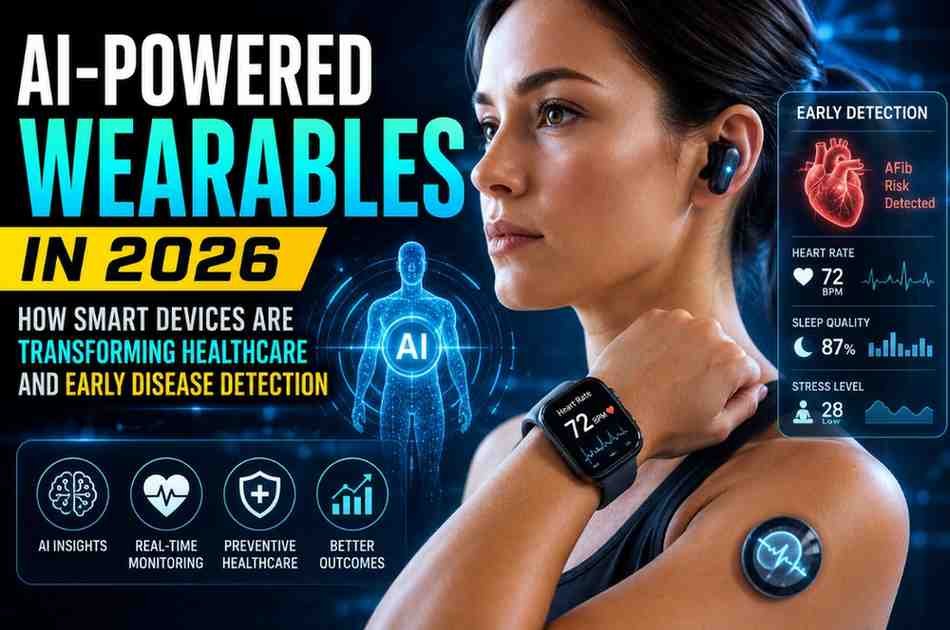
The consumer wearable market has undergone a transformation so rapid that the devices of five years ago are nearly unrecognisable by the standards of what sits on wrists today. What began as glorified pedometers counting steps and estimating calories with limited clinical credibility has evolved into a sophisticated category of continuous biosensor platforms capable of generating medically significant data streams 24 hours a day.
The Apple Watch Series 9, Samsung Galaxy Watch 6, Fitbit Sense 2, and Garmin’s medical-grade wearables now offer capabilities that would have required hospital-grade equipment a decade ago. These include photoplethysmography (PPG) for continuous heart rate and blood oxygen monitoring, electrical heart sensors enabling single-lead ECG recordings, skin temperature tracking, respiratory rate measurement, and advanced accelerometry capable of fall detection with automatic emergency response.
Heart Health Monitoring
Atrial fibrillation (AFib) a cardiac arrhythmia affecting an estimated 60 million people globally and a leading cause of stroke is perhaps the most clinically validated use case for consumer wearable technology. The Apple Heart Study, conducted across over 400,000 participants, demonstrated that irregular pulse notifications from the Apple Watch had a positive predictive value for AFib of approximately 84%. Subsequent FDA clearances for wearable AFib detection have opened a pathway where continuous consumer monitoring intercepts an otherwise silent condition before it precipitates a catastrophic neurological event.
Beyond arrhythmia detection, AI algorithms trained on wearable heart rate variability (HRV) data are being developed to predict hypertensive episodes, detect early signs of heart failure decompensation, and flag physiological patterns consistent with myocardial stress. The data density generated by continuous wearable monitoring thousands of data points per day per user creates a signal-to-noise ratio advantage that episodic clinical measurement simply cannot match.
Sleep Architecture and Metabolic Health
Sleep science has undergone a parallel revolution. Devices such as the Oura Ring Gen 4 and Whoop 4.0 use multi-parameter biometric tracking combining HRV, skin temperature, respiratory rate, and movement data to produce sleep staging analyses that correlate meaningfully with polysomnographic (clinical sleep study) findings. While wearable sleep staging is not a clinical-grade replacement for formal sleep studies, it provides longitudinal data that a one-night laboratory study cannot: months of nightly sleep architecture data revealing patterns in deep sleep deficits, REM disruption, and sleep efficiency that correlate with metabolic, cognitive, and cardiovascular outcomes.
Continuous glucose monitors (CGMs), once reserved for insulin-dependent diabetics, have entered the consumer wellness market through devices like the Stelo (Dexterity/Dexcom) and Abbott’s Lingo. Real-time glucose tracking provides individuals without diabetes a granular view of glycaemic response to diet, exercise, stress, and sleep enabling behavioural interventions that may prevent the progression from metabolic dysfunction to type 2 diabetes, one of the most consequential inflection points in chronic disease trajectories.
Early Disease Detection: The Emerging Frontier
The most ambitious and scientifically contested application of AI-powered wearables is early disease detection beyond cardiovascular conditions. Several research programmes are investigating whether continuous biometric data streams can identify pre-symptomatic signals for conditions including Parkinson’s disease (via gait analysis and fine motor tremor detection), COVID-19 and influenza (via resting heart rate elevation and HRV depression patterns), and even certain cancers through inflammatory biomarker proxies.
Fitbit’s pre-symptomatic illness detection research, conducted in collaboration with Stanford University, demonstrated that deviations in resting heart rate and HRV could identify potential illness onset 1–2 days before symptom awareness. While these findings require substantial clinical validation before they translate into actionable medical tools, they point toward a future in which wearable AI functions less as a fitness tracker and more as a continuous early-warning physiological monitoring system.
| Wearable Capability | Clinical Application | Leading Devices | Regulatory / Validation Status |
|---|---|---|---|
| Single-lead ECG | Atrial fibrillation detection | Apple Watch, Samsung Galaxy Watch, Withings ScanWatch | FDA Cleared |
| Blood Oxygen (SpO2) | Sleep apnoea screening, hypoxia monitoring | Apple Watch, Fitbit Sense 2, Garmin Venu 3 | FDA Cleared (Apple Watch Series 9 sleep apnoea, 2024) |
| Continuous Glucose Monitoring | Metabolic health, pre-diabetes prevention | Dexcom Stelo, Abbott Lingo | FDA Cleared (OTC, 2024) |
| HRV / Sleep Staging | Stress, recovery, metabolic health | Oura Ring Gen 4, Whoop 4.0, Garmin | Consumer wellness; validated against PSG |
| Skin Temperature | Ovulation tracking, illness onset detection | Oura Ring, Apple Watch Ultra 2 | Consumer wellness; FDA cleared for cycle tracking |
| Fall Detection / Gait Analysis | Elderly safety, Parkinson’s monitoring | Apple Watch Series 9, Garmin vívoactive | FDA Cleared (fall detection) |
| Blood Pressure Estimation | Hypertension management | Samsung Galaxy Watch 6 (select markets), Withings ScanWatch 2 | CE Marked; FDA pathway in progress |
AI in Hospital and Clinical Settings: Diagnosis, Automation, and Personalised Care
While consumer wearables represent AI’s most visible health footprint, the transformation occurring within clinical and hospital environments is arguably more structurally significant. Hospital systems globally are deploying AI across three broad domains: diagnostic support, operational automation, and personalised treatment planning.
AI-Powered Diagnostics
Medical imaging has emerged as AI’s most mature and clinically validated hospital application. Deep learning algorithms trained on millions of annotated images have achieved — and in several specific tasks, surpassed — radiologist-level accuracy in detecting pathology in chest X-rays, mammograms, retinal scans, and dermatological images. Google DeepMind’s LYNA (Lymph Node Assistant) demonstrated sensitivity for metastatic cancer in lymph node biopsies that exceeded pathologist performance. IDx-DR became the first FDA-authorised autonomous AI diagnostic system — capable of detecting diabetic retinopathy from retinal photographs without physician review.
In pathology, AI-assisted analysis of histological slides is accelerating diagnosis turnaround times and identifying morphological patterns that human pathologists may overlook at scale. In radiology, AI prioritisation systems are triaging imaging queues — flagging suspected pulmonary embolisms, intracranial haemorrhages, and pneumothoraces for immediate radiologist review, compressing time-to-diagnosis in conditions where minutes determine outcomes.
Clinical Automation and Administrative Intelligence
An estimated 30% of healthcare costs in developed economies are attributable to administrative overhead — billing, coding, documentation, scheduling, and prior authorisation workflows that consume physician and nursing time without directly contributing to patient care. AI is aggressively targeting this inefficiency. Ambient clinical intelligence tools — most notably Nuance DAX (acquired by Microsoft) and similar systems — use natural language processing to transcribe and structure clinical encounters in real time, generating draft clinical notes that physicians review and approve rather than dictate from scratch. Early deployments report documentation time reductions of 50–70%, with corresponding improvements in physician-reported burnout metrics.
In hospital operations, AI-driven patient flow management systems are predicting admission volumes, optimising bed allocation, anticipating discharge bottlenecks, and reducing emergency department wait times. Predictive sepsis algorithms — deployed in intensive care units across major US and European hospital networks — analyse continuous vital sign and laboratory data streams to identify sepsis onset hours before clinical teams would conventionally recognise it, enabling early intervention in a condition where each hour of delay increases mortality by approximately 7%.
Personalised Medicine and Genomic AI
The aspiration of personalised medicine — treatments designed for an individual’s specific biological profile rather than population averages — has been technologically constrained for decades by the computational demands of genomic analysis. AI is dissolving that constraint. AlphaFold, DeepMind’s protein structure prediction system, solved a 50-year grand challenge in biology and has since been used to model targets for drug discovery at a scale and speed previously impossible. Pharmaceutical companies including Novo Nordisk, Pfizer, and a wave of AI-native drug discovery startups are using large language models trained on genomic, proteomic, and clinical data to identify novel therapeutic targets, predict drug-drug interactions, and design clinical trials with adaptive enrichment strategies that would have required years to architect manually.
In oncology, AI-driven tumour genomic profiling is enabling oncologists to match patients to targeted therapies or clinical trials based on the specific mutational landscape of their cancer — a precision that population-based chemotherapy protocols cannot achieve. The FDA’s approval of multiple companion diagnostic AI systems reflects the regulatory system’s recognition that this modality is not experimental but clinically actionable.
The Convergence Layer: When Wearables Meet Clinical AI
The most transformative near-term development in health AI is not the continued improvement of wearables or hospital AI in isolation — it is their integration. Health systems are beginning to build architectures that incorporate continuous wearable data streams into clinical decision support: a patient’s resting heart rate trend from their Apple Watch informing their cardiologist’s assessment, a CGM’s glycaemic variability data feeding into an endocrinologist’s treatment algorithm, a smartwatch’s sleep disruption pattern alerting a psychiatrist to a potential mood episode before the patient reports symptoms.
This convergence creates what researchers are calling the “digital health twin” — a continuously updated computational model of an individual patient’s physiological state, trained on their personal longitudinal biometric data, against which deviations and anomalies can be detected with a sensitivity that population-based reference ranges cannot provide. The clinical value of knowing that this patient’s resting heart rate has increased 12 beats per minute over the past three weeks is qualitatively different from knowing their heart rate is within a normal reference range — and AI-powered personal baseline modelling makes that distinction actionable.
Challenges: Data Privacy, Algorithmic Bias, and the Equity Gap
No honest account of AI’s healthcare trajectory can omit its serious structural challenges. Data privacy represents perhaps the most immediate concern. Consumer wearables generate extraordinarily intimate data streams — sleep quality, heart rate during stress, menstrual cycle patterns, exercise avoidance, glucose response to alcohol — and the regulatory frameworks governing how this data is stored, sold, and accessed vary dramatically across jurisdictions. In the United States, HIPAA protections do not apply to data generated by consumer wellness devices not classified as medical equipment, creating a significant gap between the sensitivity of the data and the protections it receives.
Algorithmic bias presents a clinical safety concern that the field is only beginning to quantify systematically. AI diagnostic models trained predominantly on imaging and clinical data from specific demographic populations may perform with meaningfully lower accuracy in underrepresented groups. Pulse oximetry devices — the precursor to modern wearable SpO2 monitoring — were found to overestimate blood oxygen in patients with darker skin tones, leading to underdetection of hypoxia during the COVID-19 pandemic. As AI assumes larger roles in diagnostic and treatment pathways, ensuring algorithmic equity across race, ethnicity, age, sex, and socioeconomic status is not merely a DEI aspiration — it is a patient safety imperative.
The access gap compounds these concerns. Premium AI-powered wearables and the healthcare systems deploying advanced clinical AI are overwhelmingly concentrated in high-income countries and among higher-income demographic segments within those countries. The populations most vulnerable to the chronic diseases that AI health monitoring could prevent or intercept — including communities in South and Southeast Asia, sub-Saharan Africa, and low-income urban populations globally — are currently the least likely to benefit from these technologies. Solving this equity gap requires deliberate policy intervention, not market forces alone.
Regulatory Evolution and the Path to Clinical Integration
Regulatory frameworks globally are straining to keep pace with the velocity of AI health technology development. The FDA’s Digital Health Center of Excellence has developed new premarket review pathways for AI/ML-based software as a medical device (SaMD), recognising that traditional device approval models — designed for static hardware — are poorly suited to adaptive algorithms that update continuously on new data. The EU’s Medical Device Regulation (MDR) and the AI Act are creating parallel frameworks in Europe that impose stricter conformity requirements on high-risk AI health applications.
The central regulatory challenge is validation: demonstrating that an AI health tool performs safely and effectively across the full diversity of patient populations in real-world conditions, not just in controlled trial environments. Post-market surveillance requirements for AI health devices are becoming more stringent globally — a development that will increase compliance costs but ultimately produce safer, better-validated tools.
The Future of AI Health: Predictions for the Coming Decade
By 2030, conservative projections suggest that AI will be integrated into the majority of clinical diagnostic workflows in high-income healthcare systems. More speculatively — but with increasingly credible evidence — continuous wearable monitoring combined with AI analysis may enable the detection of conditions including type 2 diabetes, cardiac disease, and certain cancers years before symptomatic presentation, fundamentally shifting treatment timing from reactive to preventive.
The physician of 2030 will likely practice in a fundamentally different cognitive environment: less time spent on pattern recognition in imaging and documentation, more time spent on the distinctly human dimensions of medicine — contextual clinical judgement, therapeutic relationships, ethical navigation of complex decisions, and the interpretation of AI-generated insights for patients navigating uncertainty. AI does not replace clinical medicine. It re-allocates it — toward the components that most require human presence.
Conclusion: Technology as the Democratisation of Health Intelligence
The convergence of AI and wearable health technology represents something more significant than an incremental improvement in medical tools. It represents a potential democratisation of health intelligence — the extension of continuous, personalised, predictive physiological awareness to populations that have historically accessed healthcare only at the point of illness. Whether that democratisation is realised or whether it deepens existing health inequities will depend on decisions made now: in regulatory frameworks, in pricing models, in data governance policy, and in the deliberate design of AI systems that perform equitably across the full spectrum of human diversity.
The technology, increasingly, is ready. The question is whether the systems surrounding it — political, economic, and ethical — will rise to meet the moment.
For breaking news and live news updates, like us on Facebook or follow us on Twitter and Instagram. Read more on Latest Health on thefoxdaily.com.






COMMENTS 0