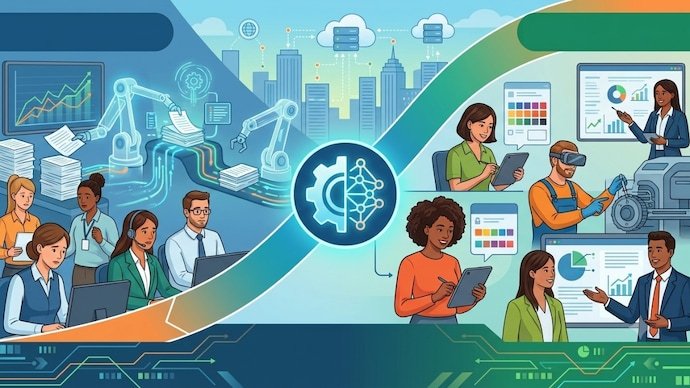
Artificial Intelligence is often portrayed as a threat to Employment, particularly in a country like India where millions of workers are employed in Technology services, customer support and business-process operations. But recent data offers a more complicated picture: AI is currently associated with substantially more hiring than job losses in India.
India recorded 83,100 AI-related hires compared with 31,921 layoffs and attrition linked to AI, according to a Nomura report first accessed by Bloomberg News. That works out to roughly 2.6 AI-related hires for every job lost or affected.
At first glance, that looks like reassuring news. But the headline numbers hide the most important part of the story. The jobs AI creates are often different from the jobs it replaces, and workers losing routine roles cannot necessarily move straight into highly specialised AI positions.
India is creating more AI jobs than it is losing
The Nomura figures suggest that India’s AI transition is not currently following the simplest version of the automation story, in which machines replace workers and employment steadily shrinks.
Instead, companies appear to be doing two things at once. They are reducing some roles where AI can automate repetitive tasks while increasing hiring for people who can develop, implement, manage or use AI systems.
That distinction matters because the overall employment balance can remain positive even while individual workers experience significant disruption.
Nomura economists Sonal Varma and Si Ying Toh examined 69 employment-related cases across Asia, mostly covering the period from 2022 through August 2026. Among the countries studied, India recorded the largest absolute impact from AI-related hiring and job losses.
The numbers are not a complete census of the Indian labour market. They are based on reported employment cases rather than every company and worker in the economy. They should therefore be read as evidence of an emerging pattern rather than proof that AI has already created a net employment boom across India.
Why India is a crucial test for AI and employment
India occupies a particularly important position in the global AI jobs debate because of the structure of its services economy.
For decades, India’s technology and business-process industries have relied on a large pool of educated workers who perform tasks for companies and customers around the world. Customer support, data processing, software testing and other routine services helped India build a major position in the global services market.
AI directly challenges parts of that model.
A chatbot can handle certain customer questions without a human agent. Software tools can automate parts of testing and coding. AI systems can process information that previously required teams of employees to review manually.
But the same technology creates demand for workers who can build and maintain these systems, integrate them into existing businesses, check their output and use them to improve productivity.
This is why Nomura describes India as “ground zero” for understanding AI’s employment impact. The country has both a large workforce exposed to automation and a substantial technology sector capable of creating new AI-related roles.
The catch: the new jobs are not necessarily for the displaced workers
This is the most important qualification behind India’s positive AI employment numbers.
Consider a simplified example. A company might reduce the size of a customer-support team after deploying an AI chatbot. At the same time, it could hire software engineers, data specialists or AI-focused technology workers to develop and operate the system.
Both events would appear in employment statistics as AI-related changes. But the person losing the customer-support job is not automatically qualified for the new technical position.
That creates what economists describe as a skills and transition problem.
AI can generate jobs without generating those jobs for the same people.
Nomura’s analysis specifically highlights this issue, noting that workers displaced by AI rarely move directly into AI engineering roles. The overall hiring figures can therefore look positive while particular groups of workers experience unemployment, retraining costs or slower Career progression.
Why entry-level workers could face the biggest challenge
The AI transition could be especially significant for young Indian Workers entering the labour market.
For many graduates, an entry-level job provides more than a salary. It is a way to gain practical experience, learn workplace systems and develop skills that eventually lead to specialised positions.
Some of those initial jobs are also the easiest for companies to automate because they involve repetitive, rules-based or highly standardised tasks.
If those opportunities shrink, graduates may face a different entry barrier. Instead of joining a company with limited experience and learning on the job, they may increasingly be expected to arrive with knowledge of AI tools, data systems, software development or specialised business processes.
That could produce a two-tier labour market.
On one side would be experienced workers who understand both AI and the industries where it is being deployed. Their productivity and bargaining power could rise as companies compete for specialised talent.
On the other side could be workers with limited experience who find that some traditional routes into professional Careers are disappearing.
AI is changing the meaning of a technology job
Another reason the employment numbers can be misleading is that the boundary between an “AI job” and an ordinary job is becoming less clear.
A company does not necessarily need thousands of employees whose job titles contain the word “AI”. Instead, AI may become part of ordinary software development, marketing, customer service, finance, research or operations.
That means some of the most important employment effects may not appear in simple counts of AI-specific hiring.
A Software Engineer who uses AI coding tools may become more productive without changing job titles. A customer-service worker might supervise AI-generated responses rather than answering every question manually. A financial analyst could use AI to process documents while spending more time on higher-level decisions.
In these cases, AI does not necessarily eliminate the occupation. It changes what the worker does during the working day.
India’s experience reflects a wider Asian shift
The pattern identified by Nomura is not unique to India. Across Asia, the economists identified 1,30,758 AI-related hires compared with 60,654 job losses.
More than 90% of the hiring cases were in technology, while roughly 60% of the job-loss cases were in financial services.
The impact is also visible in countries with large business-process outsourcing industries, including India, China and the Philippines. These economies have built major employment bases around services that are increasingly exposed to automation.
The significance of AI therefore goes beyond the technology industry itself. It could affect the competitive advantage of countries that have traditionally relied on large pools of relatively lower-cost skilled workers.
Why AI could still be good news for India’s workforce
The negative side of automation should not obscure the potential economic benefits.
If AI allows Indian companies to complete work faster and at lower cost, businesses could potentially serve more customers without increasing their workforce at the same rate. Higher productivity can also allow companies to take on more complex work and compete for higher-value global contracts.
That could create opportunities in areas such as AI implementation, software development, Cybersecurity, data management, system oversight and specialised business services.
AI could also change existing jobs rather than simply eliminate them. A worker equipped with effective AI tools may be able to perform tasks that previously required a larger team.
The economic outcome will therefore depend partly on what companies do with the productivity gains. If higher productivity translates into business expansion and new services, employment opportunities could grow. If companies mainly use AI to reduce headcount and costs, the benefits could be distributed more narrowly.
The biggest challenge is reskilling at scale
For India, the central policy challenge may not be preventing AI adoption. It may be helping workers adapt quickly enough to it.
A worker displaced from a routine role needs a realistic path into the next opportunity. That can require technical training, industry knowledge, practical experience and access to employers willing to hire people who are transitioning between occupations.
The problem becomes more difficult when the new jobs require substantially higher skills than the old ones.
A short course cannot necessarily turn a customer-support employee into an AI engineer. But training can still help workers move into adjacent roles, particularly where AI is being introduced into existing business functions.
That makes the design of training programs important. Preparing workers only to use generic AI tools may not be enough. Training needs to connect technology skills with actual workplace requirements.
What Indian graduates should take from the numbers
The data does not suggest that students should abandon traditional computer science fundamentals and chase every new AI trend.
Instead, the changing labour market makes a combination of skills increasingly valuable.
Strong programming and problem-solving abilities remain useful, but workers also need to understand how modern AI systems are applied in real businesses. Communication, debugging, system design, data handling and the ability to evaluate AI-generated output can all become important alongside technical knowledge.
The broader lesson is that learning a single tool is unlikely to provide long-term protection from technological change.
AI tools themselves will continue to change. Skills that allow workers to understand problems, evaluate solutions and adapt to new systems are more durable than familiarity with one particular application.
The numbers are encouraging, but they need context
It would be tempting to interpret the 83,100 AI-related hires versus 31,921 AI-linked layoffs and attrition as proof that AI is already a net job creator in India.
That conclusion would go further than the available evidence allows.
Nomura’s analysis is based on 69 employment-related cases across Asia rather than a comprehensive survey of every employer. The figures capture reported cases and therefore cannot represent every AI-driven hiring decision, restructuring exercise or worker transition.
There is another limitation: job counts do not measure job quality. One highly skilled AI position and several lower-paid routine jobs are not economically interchangeable simply because they can be counted in the same employment statistics.
Wages, working conditions, career progression and geographical distribution also matter when assessing whether workers are genuinely benefiting from technological change.
India may be facing a job transformation, not a jobless future
The most useful way to understand India’s AI employment story may be to stop viewing it as a simple contest between jobs created and jobs destroyed.
The more important question is whether workers can move from declining occupations into growing ones quickly enough.
So far, the numbers provide an encouraging signal. India recorded far more AI-related hiring than AI-linked job losses in the cases examined by Nomura. That suggests the technology is generating significant demand for new skills rather than simply eliminating work.
But the transition will not be painless. Workers whose roles are automated may not possess the skills required for the jobs being created. Young graduates could also find that some traditional entry-level positions are disappearing just as they enter the workforce.
India’s long-term outcome will depend on how effectively businesses, educational institutions and workers respond to that gap.
AI may therefore create more jobs than it cuts, but that does not mean every worker will be better off automatically. The real test will be whether India’s workforce can make the journey from the jobs being replaced to the jobs being created.
That is where the country’s AI story gets much more complicated than a simple jobs tally.
For breaking news and live news updates, like us on Facebook or follow us on Twitter and Instagram. Read more on Latest Business on thefoxdaily.com.






COMMENTS 0