For years, the debate around Artificial Intelligence has revolved around one pressing question: Will AI replace human jobs? A new study by Cognizant and Pearson suggests the answer is more nuanced than many expected.
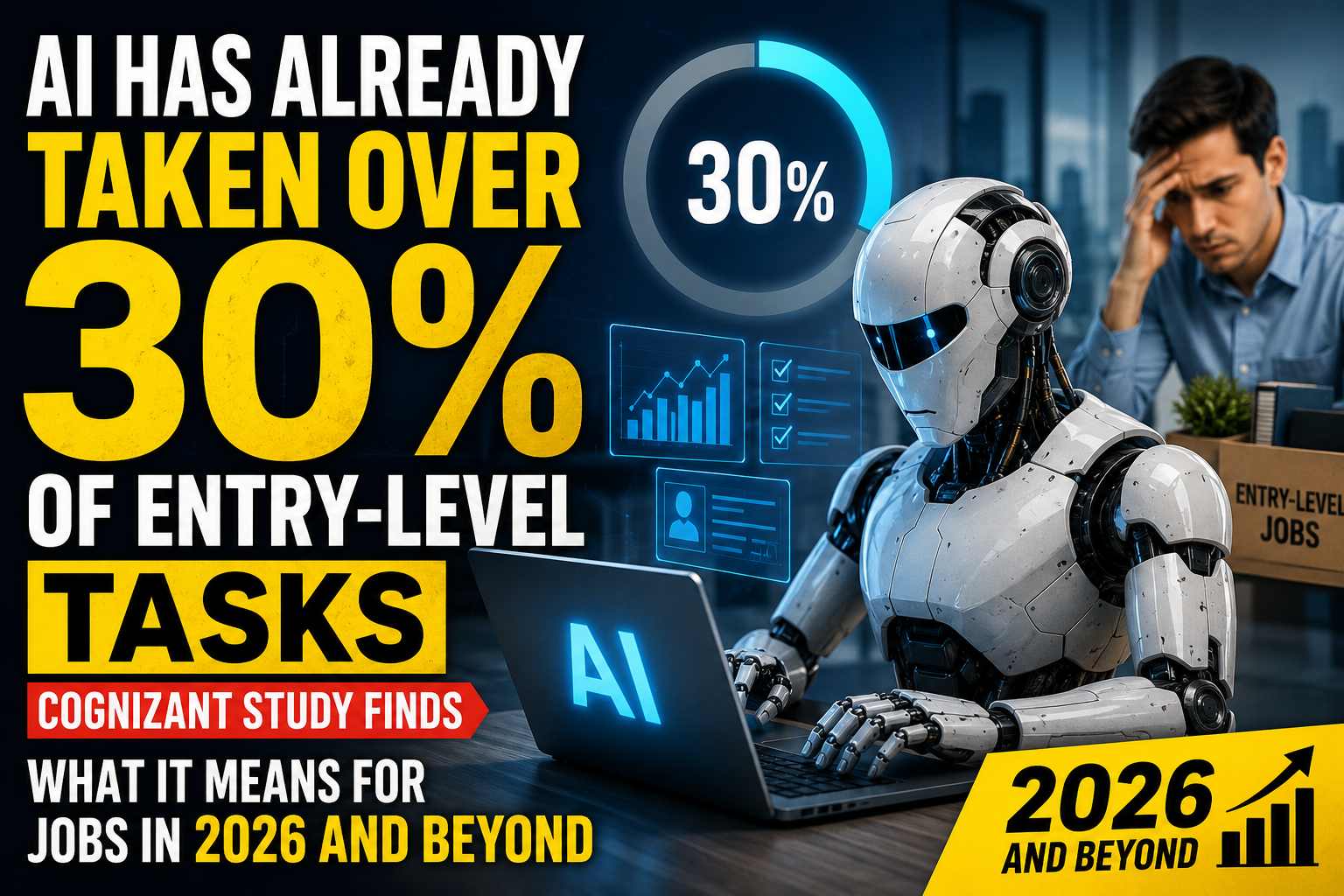
According to the report, AI is already performing 33% of entry-level tasks globally, with the figure rising to 37% in India. The findings indicate that AI is no longer a future disruption—it is actively reshaping workplaces today.
As businesses integrate generative AI tools into everyday operations, the nature of entry-level employment is evolving rapidly. Rather than eliminating jobs outright, companies appear to be redesigning roles around human-AI collaboration.
The shift raises critical questions for students, recent graduates, employers, and policymakers: Which jobs are most vulnerable? What skills will remain valuable? And how can workers prepare for an AI-driven economy?
Key Findings From the Cognizant-Pearson AI Workforce Study
The study surveyed 750 HR leaders across India, the United Kingdom, and the United States to understand how artificial intelligence is changing workforce strategies.
The results reveal that AI adoption is accelerating faster than many experts anticipated.
| Key Metric | Global Average | India |
|---|---|---|
| Entry-level tasks handled by AI | 33% | 37% |
| HR leaders saying AI manages half or more of entry-level work | — | 18% |
| Organisations valuing AI skills for non-technical roles | — | 91% |
| Companies reporting increased demand for AI training | — | 91% |
| Organisations proactively providing AI upskilling | — | 54% |
| HR leaders expecting new AI-driven entry-level roles | 94% | — |
| HR leaders expecting roles to evolve into AI supervision jobs | 96% | — |
The data suggests that businesses are moving beyond experimentation and embedding AI into core workflows.
Why Entry-Level Jobs Are Being Transformed First
Entry-level roles often involve repetitive, rules-based tasks that follow predictable patterns—precisely the kind of work AI systems excel at.
These tasks include:
- Data entry and document processing
- Basic customer support interactions
- Scheduling and administrative tasks
- Content summarisation and reporting
- Market research and information gathering
- Code generation and debugging assistance
- Email drafting and communication support
Modern AI tools can complete many of these activities faster and at a lower cost than traditional workflows.
However, experts caution against interpreting these changes as a direct replacement of entire jobs.
In most cases, AI is automating specific tasks within a role, not replacing the role itself.
From Job Replacement to Job Redesign
The biggest misconception about AI is that it eliminates positions overnight.
History shows that technological revolutions typically reshape jobs rather than erase them completely.
The introduction of computers reduced demand for certain clerical tasks but created entirely new professions in software development, cybersecurity, digital marketing, and data analytics.
AI appears to be following a similar pattern.
Nearly all HR leaders surveyed believe entry-level roles will evolve into positions where employees supervise, manage, or collaborate with AI systems.
Instead of manually producing reports, employees may validate AI-generated insights. Rather than writing code from scratch, developers could focus on reviewing and improving AI-generated code.
The value of human workers is shifting from execution to judgment.
India’s Rapid AI Adoption: Opportunity and Challenge
India’s higher AI adoption rate reflects the country’s growing digital infrastructure, large technology workforce, and increasing investment in automation.
Indian companies are embracing AI across sectors including information technology, healthcare, financial services, education, retail, and customer support.
At the same time, India faces a unique challenge.
Every year, millions of graduates enter the workforce seeking entry-level opportunities. If traditional pathways into employment change rapidly, educational institutions and employers must adapt quickly.
The study found that 61% of organisations struggle to find candidates with the right skills for an AI-driven workplace.
This mismatch highlights a widening gap between academic education and industry expectations.
The Skills That Will Matter Most in the AI Era
Perhaps the most surprising finding from the study is that the rise of AI is increasing the value of human skills.
An overwhelming 97% of respondents said soft skills are becoming more important than ever.
These include:
- Critical thinking
- Communication
- Creativity
- Emotional intelligence
- Problem-solving
- Adaptability
- Collaboration
- Leadership
As AI becomes more capable of handling technical and repetitive tasks, uniquely human abilities become more valuable.
Interestingly, 67% of organisations said they now place greater value on liberal arts degrees than they did previously.
This shift reflects a growing understanding that future employees need broad thinking skills alongside technical expertise.
AI Skills Are No Longer Optional
One of the clearest messages from the report is that AI literacy is becoming essential—even for non-technical roles.
In India, 91% of organisations now place greater importance on AI skills when hiring for positions outside traditional technology functions.
Basic AI competency increasingly includes:
- Understanding how AI tools work
- Writing effective prompts
- Evaluating AI-generated outputs
- Identifying bias and inaccuracies
- Using AI responsibly and ethically
- Integrating AI into everyday workflows
Much like digital literacy became a baseline requirement over the past two decades, AI literacy is emerging as a fundamental workplace skill.
Are Companies Hiring Less Because of AI?
The timing of the report coincides with hiring slowdowns and restructuring efforts across major global companies.
Several technology firms have reduced recruitment or reorganised teams as they integrate AI into operations.
However, industry leaders argue that AI adoption and hiring growth are not mutually exclusive.
Many companies implementing AI are simultaneously creating new roles in areas such as AI governance, prompt engineering, workflow design, data quality management, and AI training.
The challenge lies in the transition period.
Workers whose skills align with outdated job requirements may face difficulties, while those who embrace continuous learning could benefit significantly.
What Students and Early-Career Professionals Should Do Now
For students and job seekers, the message is clear: focus on becoming AI-augmented rather than AI-resistant.
Experts recommend taking the following steps:
- Learn to use popular AI tools effectively
- Build strong communication and analytical skills
- Develop domain expertise in a specific industry
- Create a portfolio demonstrating AI-assisted work
- Stay updated on emerging workplace technologies
- Invest in continuous learning and certifications
The most successful professionals in the coming decade are unlikely to be those competing against AI—but those who know how to work alongside it.
Conclusion: The Future of Work Is Human Plus AI
The Cognizant-Pearson study offers a clear signal that the future of work has already arrived.
With AI now handling more than one-third of entry-level tasks in India, businesses are redesigning roles, educational institutions are rethinking curricula, and workers are adapting to new expectations.
While concerns about job displacement remain valid, the evidence suggests that AI is creating a transformation rather than a collapse of employment opportunities.
The real risk is not that AI will replace workers—it is that workers who fail to develop AI skills may be replaced by those who do.
In an increasingly automated world, human qualities such as creativity, empathy, judgment, and adaptability will become the ultimate competitive advantage.
For breaking news and live news updates, like us on Facebook or follow us on Twitter and Instagram. Read more on Latest Careers on thefoxdaily.com.






COMMENTS 0