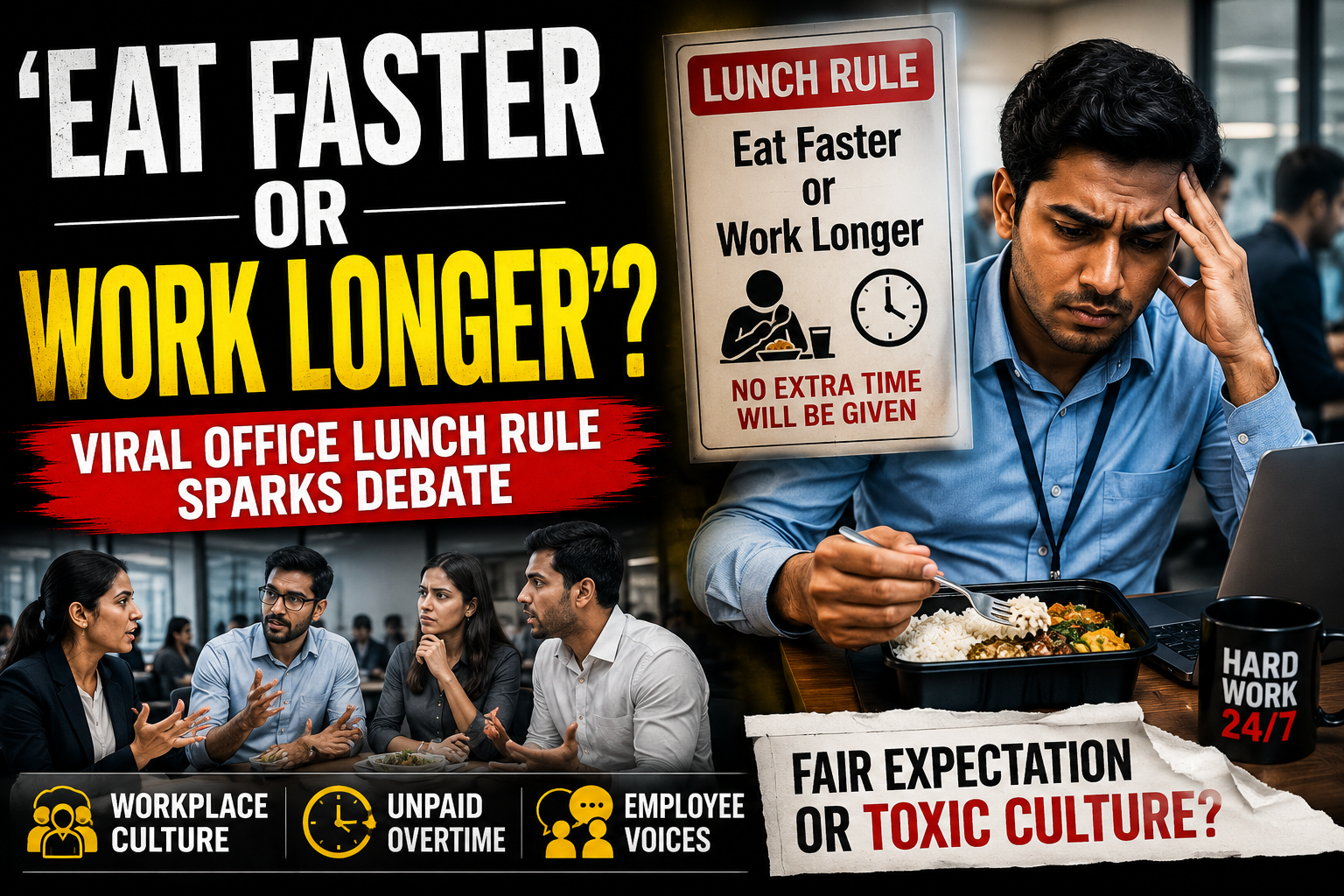
Workplace culture has entered a new era where employees increasingly value flexibility, trust, and performance over rigid time monitoring. That is why a viral office notice reportedly warning employees to “eat faster” or face additional unpaid work triggered immediate backlash online.
The controversial notice claimed that staff members exceeding a 30-minute lunch break would need to remain in the office beyond working hours—with every extra minute translating into one additional hour of unpaid work.
Although the authenticity of the notice remains unclear and no company was publicly identified, the reaction across social platforms revealed something much larger than one policy: employees are becoming less willing to accept management practices they perceive as unfair, excessive, or disconnected from modern work expectations.
What the Viral Lunch Break Notice Claimed
The reported policy outlined an unusually strict workplace rule:
- Employees receive a fixed 30-minute lunch break
- Any extra minute spent beyond the limit results in overtime
- The overtime would reportedly be unpaid
- The purpose appeared to enforce strict punctuality
Even without confirmation of its origin, the notice spread rapidly because many workers felt it reflected real frustrations they experience in office environments.
Why the Reaction Became Bigger Than the Notice Itself
The strongest criticism was not necessarily about lunch.
The backlash centred on proportionality.
Many employees questioned whether a one-minute delay should realistically lead to a sixty-minute penalty.
Critics argued that such approaches create an environment where time becomes more important than outcomes.
Supporters of stricter discipline, however, argued that maintaining structure and punctuality is necessary for operational efficiency.
The divide exposed an ongoing tension inside modern workplaces:
Should employees be measured by attendance and control—or by performance and results?
Why Policies Like This Trigger Strong Employee Responses
Employee sentiment around work has evolved dramatically.
Workers increasingly expect:
- Clear expectations
- Reasonable flexibility
- Respect for personal time
- Transparent policies
- Fair treatment across teams
Rules perceived as punitive often create emotional reactions because they affect more than schedules—they influence trust.
The Hidden Cost of Excessive Workplace Control
Management systems designed around surveillance and strict enforcement can sometimes produce unintended outcomes.
| Short-Term Goal | Possible Long-Term Effect |
|---|---|
| Improve punctuality | Lower employee morale |
| Increase compliance | Reduced engagement |
| Control attendance | Higher employee turnover |
| Reduce idle time | Lower creativity and trust |
| Enforce discipline | Stronger resignation intent |
Employees who feel overly monitored may spend more energy avoiding mistakes than producing meaningful work.
Does Longer Time at Work Mean Higher Productivity?
One of the biggest assumptions behind rigid office rules is that more time automatically creates better results.
Research and workplace experience often suggest otherwise.
Productivity is influenced by:
- Focus quality
- Energy levels
- Clear priorities
- Work environment
- Leadership quality
- Recovery and breaks
Short breaks frequently help employees reset attention and maintain output across longer work periods.
How Workplace Expectations Are Changing
The popularity of hybrid and remote work models has shifted employee expectations globally.
Workers increasingly value:
- Output-based evaluation
- Flexible scheduling
- Autonomy
- Better work-life integration
- Mutual accountability
That does not mean discipline disappears.
Instead, companies are experimenting with systems that combine accountability with flexibility.
A Better Alternative: Outcome-Based Management
Many modern organisations are moving toward measuring outcomes instead of minutes.
| Traditional Management | Outcome-Based Management |
|---|---|
| Track attendance | Track results |
| Measure office hours | Measure deliverables |
| Strict monitoring | Shared accountability |
| Fixed schedules | Flexible execution |
| Control-first approach | Trust-first approach |
Companies adopting this model often focus more on goals, communication, and measurable impact rather than rigid minute-by-minute supervision.
What Employers Can Learn From Viral Workplace Moments
Whether genuine or not, viral workplace stories often spread because they connect with broader employee experiences.
Management policies are increasingly judged not only by operational intent but by perceived fairness.
Employees may accept strict standards when expectations feel reasonable and consistent.
When rules appear disproportionate, the conversation quickly shifts from productivity to culture.
What Employees Can Learn Too
Workplace flexibility works best when paired with accountability.
Respecting schedules, communicating delays, and maintaining professional standards remain important.
The strongest workplace cultures usually balance employee freedom with clear expectations rather than relying entirely on strict enforcement.
Conclusion
The viral “eat faster” office notice became popular not because of lunch—but because it touched a deeper concern about how employees want to be managed.
Modern workforces increasingly expect trust, fairness, and recognition of outcomes over rigid control of time.
Whether organisations operate from offices, remote environments, or hybrid systems, the message becoming clearer is this: sustainable productivity is built through engagement—not fear of the clock.
For breaking news and live news updates, like us on Facebook or follow us on Twitter and Instagram. Read more on Latest Careers on thefoxdaily.com.

COMMENTS 0