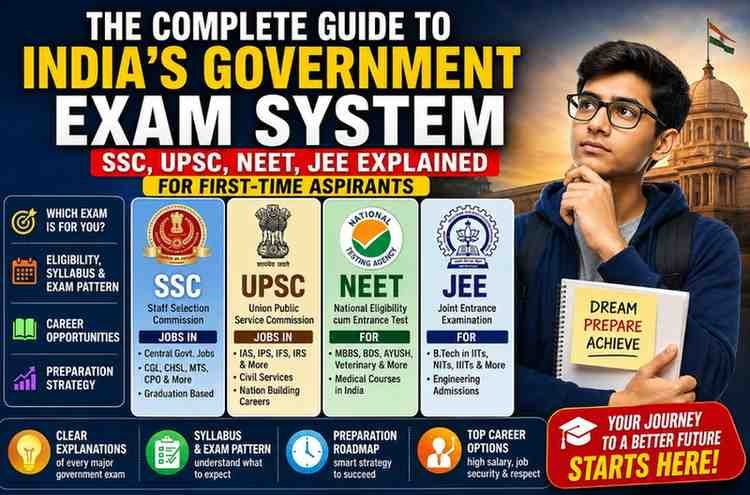
For first-time aspirants, India‘s competitive exam landscape can feel overwhelming a maze of acronyms, eligibility rules, and overlapping exam cycles. This guide breaks down the major national-level exams, what they lead to, WHO should consider each one, and how they differ in difficulty, structure, and Career outcome.
UPSC (Union Public Service Commission): Civil Services
The UPSC Civil Services Examination is widely considered one of the most Competitive Exams in the country, leading to roles like IAS, IPS, and IFS officers.
- Structure: Three stages Preliminary (objective), Main (written, descriptive), and Interview (personality test).
- Eligibility: Graduates from any discipline, within a specified age range, with a limited number of permitted attempts (varying by category).
- Who it suits: Aspirants with strong general awareness, analytical writing skills, and the endurance for a preparation cycle that typically spans 1-3 years.
- Career outcome: Administrative and policy-making roles across central and state government, considered among the most prestigious government career paths in India.
SSC (Staff Selection Commission): Central Government Jobs
SSC conducts multiple exams for group B and C posts in central government ministries and departments the most well-known being SSC CGL (Combined Graduate Level) and SSC CHSL (Combined Higher Secondary Level).
- Structure: Typically a multi-tier format combining objective tests, descriptive papers, and skill/typing tests depending on the specific post.
- Eligibility: Varies by exam CGL requires a graduate degree, while CHSL requires a 12th-pass qualification.
- Who it suits: Aspirants seeking a faster route into government service compared to UPSC’s longer preparation cycle, with a wide range of departments and posting options.
- Career outcome: Roles in departments like Income Tax, Central Excise, CBI, and various ministries.
NEET (National Eligibility cum Entrance Test): Medical Admissions
NEET is the single national-level entrance exam for admission to MBBS, BDS, and other medical/dental undergraduate courses across government and private colleges in India.
- Structure: A single objective-type exam covering Physics, Chemistry, and Biology, conducted once a year by the National Testing Agency (NTA), with re-exams occasionally scheduled in exceptional circumstances.
- Eligibility: Candidates must have completed or be appearing in class 12 with Physics, Chemistry, and Biology as core subjects.
- Who it suits: Aspirants pursuing a career in medicine or dentistry NEET is mandatory for admission to any medical college in India, government or private.
- Career outcome: Admission into MBBS, BDS, AYUSH courses, and other medical/paramedical programs.
JEE (Joint Entrance Examination): Engineering Admissions
JEE is the gateway exam for admission into engineering programs, including the prestigious IITs, NITs, and other centrally funded technical institutions.
- Structure: Two levels JEE Main (for NITs, IIITs, and as a qualifier for JEE Advanced) and JEE Advanced (specifically for admission to the IITs), both testing Physics, Chemistry, and Mathematics.
- Eligibility: Class 12 pass or appearing candidates with Physics, Chemistry, and Mathematics as core subjects; JEE Advanced additionally requires a qualifying rank in JEE Main.
- Who it suits: Aspirants aiming for a career in engineering, particularly those targeting IITs, which require clearing both JEE Main and Advanced.
- Career outcome: Undergraduate engineering degrees (B.Tech) from India’s top technical institutions.
| Exam | Conducted By | Purpose | Eligibility |
|---|---|---|---|
| UPSC CSE | Union Public Service Commission | Civil services (IAS, IPS, IFS) | Graduate, age limit applies |
| SSC CGL/CHSL | Staff Selection Commission | Central govt Group B/C posts | Graduate (CGL) / 12th pass (CHSL) |
| NEET | National Testing Agency | Medical/dental admissions | 12th pass with PCB |
| JEE Main/Advanced | National Testing Agency / IITs | Engineering admissions | 12th pass with PCM |
How to Choose the Right Exam Path
- If you’re still in school (before class 12): Your subject choice matters most. PCM (Physics, Chemistry, Mathematics) opens the JEE path; PCB (Physics, Chemistry, Biology) opens the NEET path. Both require early, structured preparation, often starting in class 11.
- If you’re a graduate deciding between UPSC and SSC: UPSC demands a longer, broader preparation timeline with a focus on analytical and writing skills, while SSC offers a comparatively faster entry into government service with more objective-focused preparation.
- If you’re unsure about long-term commitment: SSC and state-level PSC exams generally have shorter preparation cycles and more frequent exam attempts compared to UPSC, making them a lower-commitment entry point into government service.
Common Mistakes First-Time Aspirants Make
- Preparing for multiple large exams simultaneously without a clear primary focus, which spreads preparation too thin.
- Ignoring the official notification and eligibility criteria before starting preparation, leading to wasted effort on exams they may not qualify for.
- Underestimating the role of previous years’ papers and mock tests in understanding actual exam difficulty and pattern, relying instead only on theoretical study.
- Not tracking official exam calendars (UPSC, NTA, SSC each release annual calendars) which can lead to missed application windows.
For breaking news and live news updates, like us on Facebook or follow us on Twitter and Instagram. Read more on Latest Careers on thefoxdaily.com.






COMMENTS 0