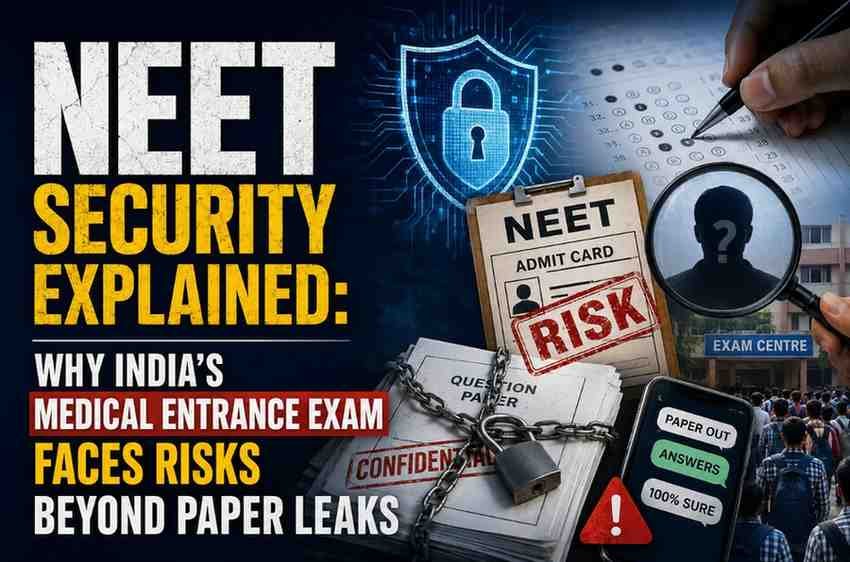
Every time a controversy erupts around the National Eligibility cum Entrance Test (NEET), public attention immediately turns to one question: Was the question paper leaked? While paper leaks dominate headlines, experts argue they represent only one part of a much larger challenge. The real vulnerabilities facing India’s largest medical entrance examination extend far beyond the printing press or sealed transport boxes.
Recent discussions surrounding NEET have highlighted a broader concern: even the strongest physical security measures cannot fully protect an examination system if institutional blind spots, insider networks, weak governance mechanisms, and commercial incentives remain unaddressed.
With millions of aspirants competing for limited medical seats every year, ensuring the credibility of NEET is not merely an examination issue—it is a matter of public trust, educational fairness, and healthcare quality for future generations.
Why NEET Matters More Than Ever
NEET serves as the single entrance examination for undergraduate medical admissions across most medical institutions in India. Every year, lakhs of students spend months or even years preparing for the examination, making it one of the country’s most competitive academic tests.
Because admission opportunities are limited while demand continues to rise, even the perception of unfairness can significantly affect public confidence. Every security lapse therefore carries consequences that extend beyond one examination cycle.
The integrity of NEET directly influences the credibility of India’s medical Education system.
Paper Leaks Are Only One Type of Risk
Printed question papers are protected through multiple layers of security, including confidential printing, sealed packaging, secure transportation, controlled storage, and monitored distribution. These measures make unauthorized access increasingly difficult.
However, examination experts caution that focusing exclusively on paper leaks risks overlooking other vulnerabilities that may be equally damaging.
Modern examination security requires safeguarding not only physical documents but also digital systems, administrative processes, human decision-making, and institutional accountability.
Understanding the Broader Security Ecosystem
A nationwide examination involves thousands of people, multiple organizations, technology platforms, logistics partners, examination centres, and administrative personnel.
Every stage creates opportunities where errors, misconduct, or security weaknesses could emerge if oversight is inadequate.
| Stage | Potential Area of Vulnerability |
|---|---|
| Question Development | Confidentiality and access control |
| Printing & Packaging | Secure handling procedures |
| Transportation | Chain-of-custody monitoring |
| Examination Centres | Operational compliance and supervision |
| Evaluation & Administration | Data integrity and governance |
Security is only as strong as the weakest point in this chain.
The Challenge of Insider Risks
Cybersecurity professionals often describe insiders as one of the most difficult risks to eliminate. Unlike external attackers, insiders may already possess legitimate access to sensitive systems or information.
This does not imply widespread wrongdoing, but it highlights why strong internal controls, role-based access, continuous monitoring, and independent audits are essential components of examination security.
Experts argue that preventing insider misuse requires governance systems rather than reliance on trust alone.
Institutional Blind Spots Can Create Unexpected Weaknesses
Large examination systems frequently develop blind spots—not because of intentional misconduct, but because complex organizations sometimes overlook vulnerabilities that fall between departments or responsibilities.
Examples may include inconsistent procedures, delayed reporting mechanisms, inadequate documentation, or insufficient coordination between agencies.
Identifying these institutional gaps requires continuous review rather than reacting only after controversies arise.
The Commercial Ecosystem Around Competitive Exams
India’s highly competitive examination environment has given rise to an extensive coaching industry, educational technology platforms, test preparation services, and consultancy businesses.
Most operate legitimately and play an important role in helping students prepare. However, experts note that whenever extremely high financial stakes exist, regulators must remain vigilant against unethical practices by any individuals or organizations seeking unfair advantage.
The focus therefore extends beyond examination halls to the broader ecosystem surrounding competitive admissions.
Technology Strengthens Security—but Also Introduces New Challenges
Digital technologies have significantly improved examination management through biometric verification, encrypted communication, surveillance systems, and computerized data management.
At the same time, greater reliance on digital infrastructure creates new responsibilities related to cybersecurity, access management, software security, and data protection.
Modern examination integrity increasingly depends on both physical security and digital resilience.
Why Transparency Builds Public Trust
One of the strongest safeguards against misinformation and speculation is transparency. When examination authorities communicate clearly about security protocols, investigation procedures, and corrective actions, public confidence improves.
Transparency does not require revealing confidential security details. Instead, it involves demonstrating that robust oversight, accountability, and independent review mechanisms exist.
Students and parents are more likely to trust systems they understand.
The Human Cost of Examination Controversies
For students, uncertainty surrounding examination fairness can be emotionally exhausting. Months or years of preparation often culminate in a single examination day, making confidence in the process just as important as the examination itself.
Repeated controversies may increase anxiety, reduce morale, and create doubts even among candidates who performed honestly.
Protecting examination integrity therefore also protects student well-being.
| Strong Examination System | Benefits |
|---|---|
| Transparent Processes | Greater public confidence |
| Independent Oversight | Improved accountability |
| Robust Digital Security | Reduced cyber risks |
| Clear Governance | Consistent implementation |
| Regular Audits | Early identification of vulnerabilities |
Learning From High-Security Systems
Globally, organizations responsible for high-stakes assessments increasingly rely on layered security rather than single-point protection. This includes continuous risk assessments, independent audits, controlled access systems, digital monitoring, incident reporting frameworks, and periodic policy reviews.
The principle is straightforward: no individual safeguard is sufficient on its own. Multiple overlapping protections create stronger resilience.
Such approaches recognize that threats evolve over time and security systems must evolve alongside them.
The Bigger Picture: Trust Is the Most Valuable Asset
The credibility of a national entrance examination depends not only on preventing misconduct but also on ensuring that every candidate believes the process is fair.
Even isolated incidents can have disproportionate effects because they influence public perception. Building trust therefore requires consistent governance, transparent communication, and continuous improvement—not just stronger locks on question paper containers.
Ultimately, examination security is about protecting opportunity itself.
What Could Strengthen NEET in the Future?
Education experts believe future reforms may increasingly focus on integrated security frameworks combining technology, governance, and institutional accountability.
- Regular independent security audits
- Enhanced cybersecurity monitoring
For breaking news and live news updates, like us on Facebook or follow us on Twitter and Instagram. Read more on Latest Health on thefoxdaily.com.






COMMENTS 0