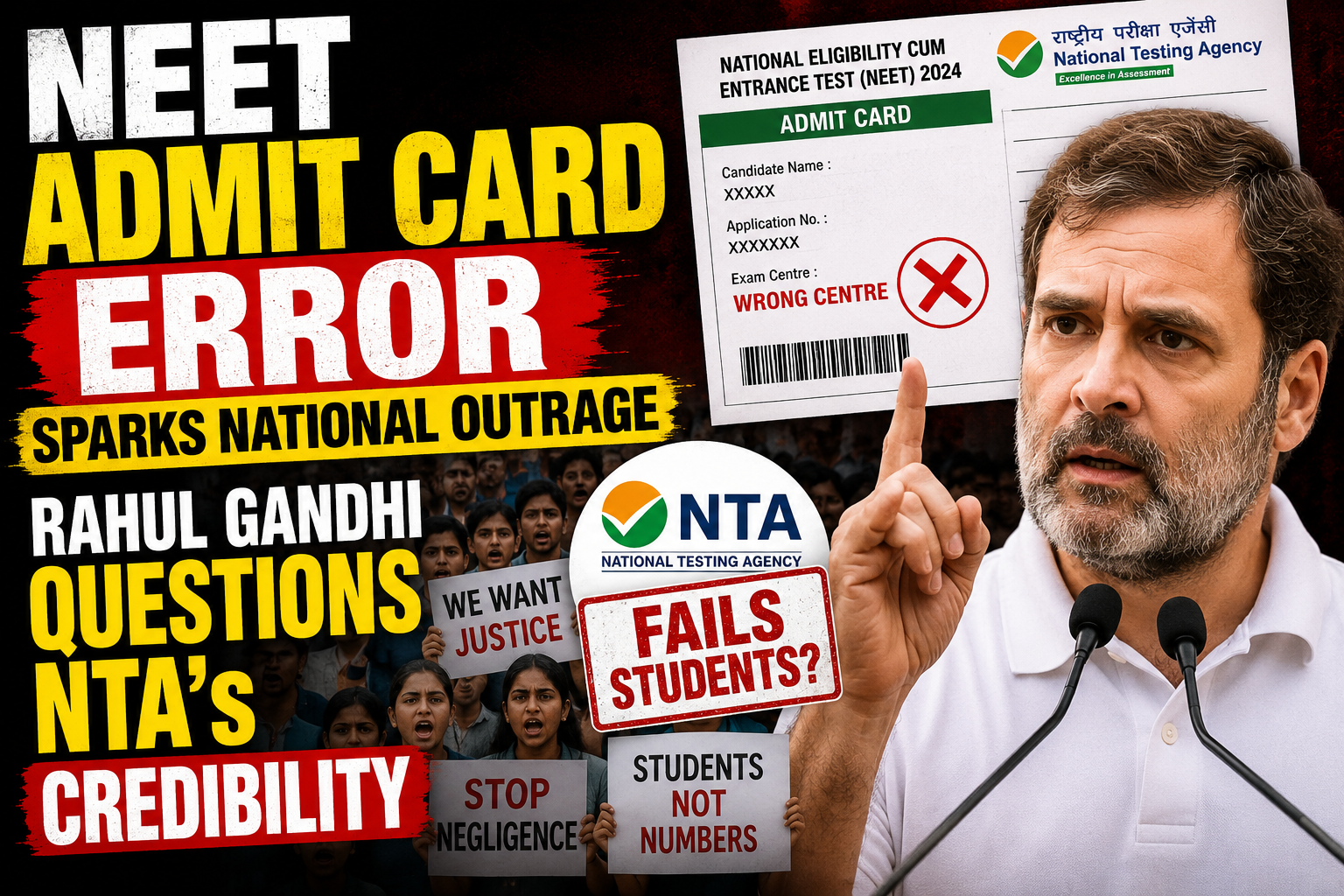
India’s highly competitive entrance examination ecosystem is once again under scrutiny after a shocking administrative error involving the National Eligibility cum Entrance Test (NEET) UG re-examination. A student from Nagpur reportedly received an admit card showing his examination centre in Abu Dhabi, United Arab Emirates, despite being registered to appear for the test in India.
The incident quickly escalated into a national controversy, drawing reactions from political leaders, Education experts, parents, and students. Beyond the technical mistake itself, the episode has highlighted a deeper issue facing India’s examination system: the growing trust deficit between students and examination authorities.
As the National Testing Agency (NTA) moved to correct the error, questions emerged about how such a significant oversight could occur in one of the country’s most important entrance examinations and what it reveals about the broader challenges facing educational administration.
What Exactly Happened?
The controversy began when a Nagpur-based student preparing for the NEET UG re-examination discovered that his admit card listed Abu Dhabi as his designated examination centre.
The student and his family were reportedly stunned by the allocation. According to accounts shared publicly, the family neither possessed passports nor had the financial means or logistical capability to arrange international travel on extremely short notice.
What should have been the final stage of exam preparation instead became an urgent battle to secure clarification from authorities.
For students preparing for highly competitive examinations, even minor disruptions can create significant emotional pressure. An error of this magnitude naturally amplified concerns and uncertainty.
Why NEET Matters More Than Most Examinations
NEET is not simply another academic test. It serves as the primary gateway to undergraduate medical and dental education across India.
Every year, millions of aspirants compete for a limited number of seats in government and private institutions. Success or failure can influence career paths, financial planning, and years of academic effort.
Because of these high stakes, students expect an examination process that is:
- Accurate and transparent.
- Technologically reliable.
- Operationally efficient.
- Responsive to grievances.
- Focused on student welfare.
When administrative mistakes occur, they often trigger reactions that extend far beyond the individual case involved.
Rahul Gandhi’s Criticism Adds Political Weight
The incident gained further attention after senior opposition leader Rahul Gandhi publicly criticized the situation.
Using social media, he questioned how a student preparing for a crucial examination could suddenly discover that his test centre had been allocated outside the country.
His comments focused on the psychological burden placed on students and families when errors occur in systems responsible for managing high-pressure examinations.
The criticism also reflected a broader political debate surrounding educational administration, examination reforms, and institutional accountability.
By highlighting the student’s emotional distress, the issue shifted from being viewed solely as a technical error to becoming part of a larger discussion about student welfare and governance.
The Mental Health Impact Often Overlooked in Exam Controversies
One aspect frequently overlooked during examination controversies is the psychological toll on students.
Medical entrance examinations are among the most demanding academic challenges in India. Many candidates spend years preparing through coaching programs, self-study, mock tests, and intensive revision schedules.
The emotional investment is enormous.
When unexpected administrative complications arise, students can experience:
- Heightened anxiety.
- Loss of confidence.
- Sleep disruption.
- Difficulty concentrating.
- Fear of missing opportunities.
- Stress affecting performance.
Educational psychologists increasingly emphasize that examination authorities must consider not only logistical efficiency but also the mental well-being of candidates.
NTA’s Response and the Technical Error Explanation
Following public attention and media coverage, the National Testing Agency acknowledged the issue and attributed it to a technical malfunction.
According to the agency, corrective action was initiated immediately, and the affected student’s admit card was scheduled to be revised with the appropriate examination centre details.
The response helped prevent the situation from escalating further for the individual candidate. However, it also raised important questions about quality-control mechanisms within large-scale examination systems.
Critics argue that while correcting mistakes is necessary, preventing them should remain the primary objective.
How Examination Systems Handle Millions of Candidates
Administering a nationwide examination involves enormous operational complexity.
Authorities must process applications, allocate centres, generate admit cards, manage logistics, coordinate invigilators, and ensure fairness across thousands of locations.
Despite advances in digital technology, large-scale systems remain vulnerable to occasional failures.
Common administrative challenges include:
- Database integration errors.
- Incorrect location mapping.
- Software configuration issues.
- Communication failures.
- Human oversight mistakes.
- Incomplete verification procedures.
The larger the examination, the greater the importance of robust validation systems capable of identifying unusual allocations before candidates receive official documents.
Why Public Trust Is Becoming a Key Issue
The controversy comes at a time when public confidence in examination management has become increasingly important.
Students and parents expect examination authorities to function with precision because the consequences of errors can be life-changing.
Trust is built not only through successful examinations but also through consistent reliability over time.
Each administrative controversy contributes to a broader perception of how effectively institutions perform their responsibilities.
Even isolated incidents can have a disproportionate impact on public confidence when they involve examinations that influence educational and professional futures.
The Larger Problem: Student Experience Versus System Efficiency
Modern examination systems often prioritize operational scale and efficiency. While these goals are important, they can sometimes overshadow the candidate experience.
From a technical perspective, an admit card error may appear manageable if corrected quickly.
From a student’s perspective, however, the experience can feel overwhelming.
This difference in perspective helps explain why controversies like this generate strong reactions.
Students evaluate systems based on certainty, fairness, and reliability. Institutions often evaluate them based on operational outcomes and correction mechanisms.
The challenge lies in balancing both priorities.
Comparison: What Students Expect vs. What Creates Anxiety
| Student Expectations | Issues That Trigger Concern |
|---|---|
| Correct exam centre allocation | Unexpected location errors |
| Clear communication | Last-minute corrections |
| Reliable technology | Technical malfunctions |
| Quick problem resolution | Uncertainty before exams |
| Transparent procedures | Limited explanations |
The gap between these expectations and occasional administrative failures often becomes the source of public frustration.
Lessons for India’s Examination Ecosystem
This incident offers valuable lessons for examination authorities across the country.
As educational assessments become increasingly digitized, agencies must invest not only in automation but also in oversight.
Potential improvements include:
- Enhanced pre-release verification systems.
- Automated anomaly detection tools.
- Real-time candidate support mechanisms.
- Multiple-stage centre allocation audits.
- Improved crisis communication protocols.
- Greater transparency during corrective actions.
Such measures could reduce errors while improving public confidence in the examination process.
The Future of Student-Centric Examination Management
The most successful examination systems are likely to be those that place students at the centre of decision-making.
Technology should simplify processes and reduce stress, not create additional uncertainty.
As competition for educational opportunities continues to intensify, candidates increasingly expect systems that are accurate, accountable, and responsive.
Educational institutions and examination agencies that prioritize these values will be better positioned to earn long-term trust.
Conclusion
The NEET UG re-examination admit card controversy involving a Nagpur student assigned an examination centre in Abu Dhabi has become a symbol of larger concerns surrounding examination administration in India.
While the National Testing Agency acknowledged the mistake and moved to correct it, the incident has sparked important conversations about technological reliability, institutional accountability, student mental health, and public trust.
For millions of students preparing for competitive examinations, reliability is not a luxury—it is a necessity. The episode serves as a reminder that examination systems must be judged not only by their ability to conduct tests but also by their ability to protect the confidence, time, and aspirations of the students they serve.
As India’s education landscape continues to evolve, ensuring a more transparent, efficient, and student-focused examination framework will remain essential for restoring and strengthening trust in the system.
For breaking news and live news updates, like us on Facebook or follow us on Twitter and Instagram. Read more on Latest Careers on thefoxdaily.com.






COMMENTS 0