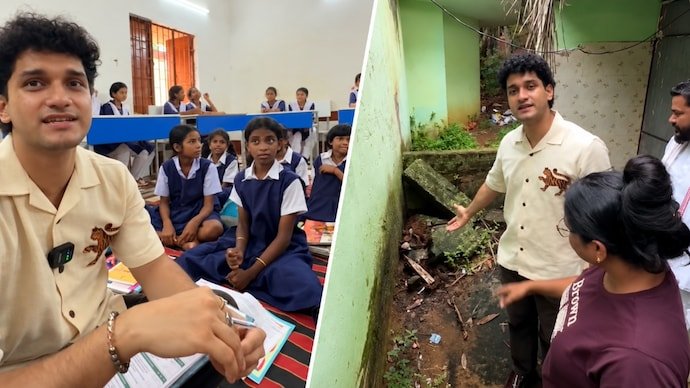
The Cockroach Janta Party (CJP) has extended its “School Thik Karo” campaign to Odisha, with co-convenor Saurav Das joining an ongoing student-led protest over errors in government school textbooks and demanding accountability from School and Mass Education Minister Nityananda Gond.
Das reached Bhubaneswar on Monday and met protesters associated with the Navnirman Yuva Chhatra Sangathan (NYCS), which has been campaigning over mistakes in textbooks for Classes I to VIII. He also visited government schools in and around the city, including an SC/ST Ashram school, and raised concerns about hygiene and the condition of some school infrastructure.
The intervention came as the Odisha textbook controversy entered another phase. The state government has acknowledged a large number of errors in the books and has begun distributing revised textbooks after incorporating corrections. At the same time, the NYCS and opposition groups have continued to demand accountability and the resignation of Gond.
The controversy has also acquired a political dimension, with the BJP-led Odisha government facing criticism from opposition parties and the CJP over the textbook preparation and review process.
What is the Odisha textbook controversy?
The controversy began after numerous errors were identified in newly introduced textbooks for students in Classes I to VIII. According to figures reported by Odisha authorities, 1,678 errors were detected across the textbooks.
The mistakes included factual inaccuracies, spelling and typographical errors, incorrect photographs and illustrations, and problems in educational content. Class VIII textbooks accounted for the largest number of identified errors, with 705 reported mistakes.
Some of the examples highlighted in reports were particularly striking. A reference described Sir Isaac Newton incorrectly, while images and geographical references were also reported to have been mixed up. Scientific and conceptual mistakes were identified in some lessons as well.
The discovery of such errors raised questions about the system used to prepare, review and approve textbooks before they were distributed to students.
The Odisha government subsequently ordered an inquiry and announced corrective measures. The administration has also begun distributing revised textbooks containing corrections.
CJP enters the Odisha education row
Saurav Das’s visit represents a new intervention by the CJP in a BJP-ruled state. The organisation has been conducting its “School Thik Karo” campaign across government schools, focusing on infrastructure, sanitation and other conditions affecting students.
In Odisha, Das combined the school inspections with support for the NYCS protest over textbook errors.
Das said the CJP supported the activists who were demanding Education Reforms and accountability for the textbook mistakes. He also called for Gond to resign, arguing that responsibility should be fixed for what he described as the large-scale errors in the books.
“The government has spent Rs 380 crore for printing textbooks for schoolchildren, but they were found to have multiple mistakes,” Das said, according to reports. He argued that accountability should be established and repeated the demand for the minister’s resignation.
The Rs 380-crore figure has become a major part of the political dispute. The opposition Biju Janata Dal has alleged irregularities in the textbook publication process and has sought a Central Bureau of Investigation probe. Those allegations are political claims and do not, by themselves, establish wrongdoing.
Saurav Das inspects government schools in Odisha
Das’s Odisha visit was not limited to the protest site. He was accompanied by CJP Joint Secretary (Organisation) Balkrishna Shukla and members of the party’s Odisha unit as he visited government schools.
In a social media post, Das said he visited three schools, including an SC/ST Ashram school in Bhubaneswar. He alleged that the schools had poor hygiene conditions and that some structures within school complexes were in a dilapidated state.
He also linked school sanitation to broader concerns about student retention, particularly among teenage girls, although that connection was presented as his argument rather than an independently established finding from the inspections.
The inspections are part of the CJP’s wider “School Thik Karo” campaign, which has taken the organisation into government schools in several states.
The campaign has previously focused on issues such as toilets, school buildings and other basic infrastructure. Its expansion into Odisha has now brought the organisation into an ongoing political dispute over the quality and review of school textbooks.
NYCS protest enters a crucial phase
The CJP’s intervention came as the Navnirman Yuva Chhatra Sangathan intensified its agitation in Odisha.
The NYCS, the youth and student wing of the Odisha-based Naba Nirman Krushak Sangathan, has been protesting over the textbook errors and demanding education reforms and accountability.
The organisation’s satyagraha began on August 20. By September 21, protesters had been demonstrating for more than a month.
Naba Nirman Krushak Sangathan convenor Akshaya Kumar began an indefinite hunger strike on September 5. By the time Das joined the protest, Kumar had been fasting for more than two weeks.
The protesters have also announced plans to gherao the Odisha Assembly as the Monsoon Session begins. The demonstration is intended to increase pressure on the state government over the textbook issue and other education-related demands.
Das appealed to students and young people to participate in the planned peaceful protest, arguing that the government had not adequately addressed their concerns.
Odisha government acknowledges errors and starts corrective action
The BJP-led Odisha government has not denied the existence of serious errors in the textbooks. Instead, authorities have initiated a series of measures intended to correct the mistakes and change the review process.
Chief Minister Mohan Charan Majhi ordered a high-level inquiry after the extent of the errors became known. The government subsequently announced action against officials connected with the textbook preparation process.
Four officials were suspended, including a former director associated with the Teachers Training and State Council of Educational Research and Training. Disciplinary proceedings were also initiated against six other officials.
The government accepted recommendations aimed at strengthening the textbook review mechanism. These included a four-stage proofreading system and the creation of a Textbook Quality Assurance Cell.
Officials have also said corrected textbooks for Classes I to VIII are being distributed. The School and Mass Education Department said the distribution had begun in Cuttack and other districts and would be completed soon.
Minister Nityananda Gond has said the government is taking steps to ensure that textbooks supplied to students are free of errors and that proofreading and checks are being conducted at different stages of preparation.
Why the textbook errors have become a political issue
School textbooks are directly linked to the education of millions of children, making errors in officially approved material more consequential than ordinary printing mistakes.
Teachers rely on textbooks as teaching resources, while students use them to prepare for examinations and understand core subjects. Factual or conceptual errors can therefore create confusion if they are not identified and corrected quickly.
The controversy has also raised questions about institutional responsibility. The central issue for protesters is not simply that mistakes occurred, but how so many errors passed through the preparation, proofreading and approval process before the books reached schools.
The government’s disciplinary measures indicate that officials have recognised shortcomings in the process. The continuing demand for ministerial accountability, however, goes further and places political responsibility on the department’s leadership.
Whether responsibility should extend to the minister is a political question on which the government, opposition parties and protest groups have taken different positions.
BJP rejects CJP’s allegations
The Odisha BJP has rejected the CJP’s criticism and characterised its intervention as politically motivated.
BJP spokesperson Anil Biswal accused the CJP of acting as a “B-Team” of congress and the Aam Aadmi Party. He argued that the organisation was focusing on BJP-ruled states while ignoring issues in states governed by other parties.
Biswal also questioned the CJP’s broader record and described its allegations against the Odisha government as political in nature.
The BJP’s response highlights the wider political context surrounding the school campaign. While the textbook errors themselves have been acknowledged by the Odisha government, the question of political responsibility and the demand for Gond’s resignation remain contested.
Opposition parties also target the Odisha government
The CJP is not the only political organisation pressing the Odisha government over the textbook controversy.
The Biju Janata Dal, which governed Odisha for 24 years before the BJP came to power in June 2024, has also criticised the government over the issue. BJD leaders have raised the textbook errors in their criticism of the Majhi administration and demanded accountability.
The BJD’s youth and student wings have announced a two-day Assembly gherao beginning September 22, adding to the pressure on the government during the legislative session.
The convergence of student protests, opposition criticism and the CJP campaign has made the textbook controversy a broader political issue rather than a dispute confined to the education department.
Odisha’s BJP government faces pressure over education governance
The textbook controversy comes as the BJP government of Mohan Charan Majhi continues to establish itself after ending the BJD’s long period in power.
Since taking office in 2024, the government has faced scrutiny over governance, law and order and the functioning of various departments. The textbook controversy has added education administration to the list of issues drawing political attention.
For the government, the immediate challenge is to ensure that corrected books reach students and that the revised quality-control system prevents similar errors from recurring.
For protesters and opposition parties, the issue has become a test of accountability. Their argument is that corrective action should be accompanied by responsibility for the process that allowed the mistakes to occur.
What happens next in the Odisha textbook row?
The distribution of corrected textbooks could reduce the immediate academic impact of the controversy, but it is unlikely by itself to resolve the political dispute.
The NYCS has continued its agitation and has planned an Assembly demonstration. The BJD has also indicated that it will raise the issue during the legislative session.
Meanwhile, the government has begun implementing corrective measures and disciplinary proceedings against officials involved in the textbook process.
The effectiveness of those measures will depend on whether students receive accurate textbooks promptly and whether the new quality-assurance system can prevent similar failures in future editions.
CJP expands its school campaign into Odisha
Saurav Das’s intervention has given the Odisha textbook controversy a new national political dimension. By joining the NYCS protest and conducting school inspections, the CJP has combined its “School Thik Karo” campaign with a demand for accountability from a BJP-led state government.
The organisation’s involvement follows similar school-focused interventions in other states, where it has highlighted infrastructure and sanitation concerns in government schools.
In Odisha, however, the campaign has intersected with an already established student agitation over textbook quality. The result is a broader debate involving school infrastructure, textbook accuracy, administrative responsibility and political accountability.
The Odisha government has acknowledged the textbook errors and started distributing corrected books, while protesters continue to demand further action, including the resignation of Nityananda Gond. With the Assembly session underway, the dispute is set to remain a prominent education and political issue in the state.
For breaking news and live news updates, like us on Facebook or follow us on Twitter and Instagram. Read more on Latest India on thefoxdaily.com.





COMMENTS 0