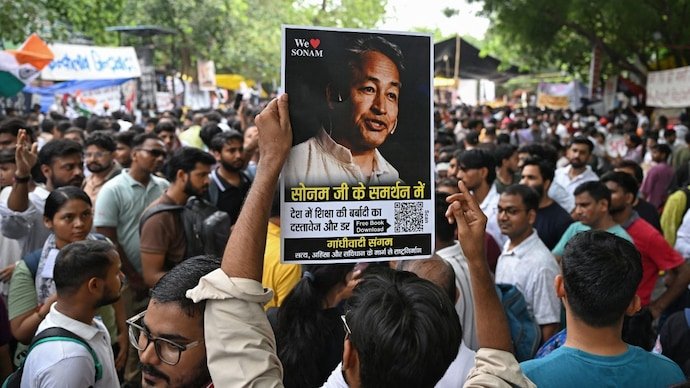
The nationwide protests over alleged examination paper leaks and demands for education reforms may be entering a new chapter after activist Sonam Wangchuk indicated he is willing to end his indefinite hunger strike under a revised set of conditions. His latest statement has attracted significant political attention because it appears to place greater emphasis on student welfare and institutional reforms than on the earlier demand for the resignation of Union Education Minister Dharmendra Pradhan.
For weeks, Wangchuk’s hunger strike had become the moral centre of the protest movement. Thousands of students, activists, and civil society members rallied around his campaign, making his health and demands central to the national conversation. His latest position has therefore raised an important political question: Is this a tactical compromise to protect students, or does it offer the government an opportunity to de-escalate one of the biggest youth-led protests in recent years?
While no final resolution has yet emerged, the developments highlight how protest movements often evolve as negotiations begin and political stakeholders search for common ground.
What Changed in Sonam Wangchuk’s Position?
When the movement gained momentum, one of its most visible demands was political accountability through the resignation of the Education Minister. Supporters argued that leadership accountability would demonstrate the government’s commitment to addressing alleged failures in the examination system.
However, Wangchuk’s latest statement placed greater emphasis on three broader concerns:
- Protection of students who participated in the protests.
- Support for families affected by the examination controversy.
- A meaningful parliamentary discussion on education reforms and accountability.
Notably, his statement referred to consideration of ministerial accountability rather than making resignation an immediate precondition for ending his fast.
This subtle but important shift has reshaped the political debate.
Why Sonam Wangchuk Became the Face of the Movement
Although several organizations and student groups participated in the demonstrations, Wangchuk’s hunger strike gave the protests a powerful moral dimension.
His decision to undertake an indefinite fast transformed public perception of the movement, attracting wider national attention beyond students directly affected by examination controversies.
Several factors contributed to his influence:
- His long-standing reputation as an education reform advocate.
- Public recognition for grassroots innovation in Ladakh.
- A non-partisan public image.
- The symbolic impact of an extended hunger strike.
- Growing concern over his health.
As media coverage increased, so did public interest in the broader issues surrounding examination integrity.
Timeline of Key Developments
| Period | Development |
|---|---|
| Early June | Student protests over alleged examination irregularities begin. |
| Late June | Sonam Wangchuk begins an indefinite hunger strike. |
| Following Weeks | Public participation and national attention increase significantly. |
| Recent Days | Police action and confrontations intensify political attention. |
| Latest Development | Wangchuk announces revised conditions for ending his fast. |
Why the Hunger Strike Became So Influential
Throughout India’s democratic history, hunger strikes have often served as peaceful tools to draw public attention toward issues that protesters believe require urgent political action.
Unlike conventional demonstrations, an indefinite fast places personal well-being at the centre of public debate, often increasing pressure on governments to engage in dialogue.
In Wangchuk’s case, concern over his deteriorating health helped sustain national attention on examination reforms even as political narratives shifted.
Government’s Response
Government representatives have maintained that they are committed to protecting students’ interests while ensuring that examination-related concerns are addressed through institutional mechanisms.
Recent discussions between senior ministers and Wangchuk suggested that dialogue remains open.
According to public statements, topics discussed reportedly included:
- Support for affected families.
- Parliamentary discussion on examination reforms.
- Protection of peaceful protesters.
- Long-term improvements in education governance.
These discussions have been interpreted by some observers as an effort to reduce tensions while avoiding prolonged political confrontation.
Why the Shift in Demands Matters Politically
Political movements often evolve as negotiations begin.
Initial demands may serve to mobilize supporters, while later discussions frequently focus on practical outcomes that can realistically be implemented.
Wangchuk’s revised position appears to shift emphasis from an immediate political demand toward broader institutional concerns affecting students.
Whether this represents a strategic compromise or simply a phased approach remains a matter of political interpretation.
Role of the Opposition
Opposition parties have continued criticizing the government’s handling of the examination controversy and have argued that accountability should extend beyond administrative reforms.
Several opposition leaders have maintained that:
- Political responsibility remains necessary.
- Students deserve greater transparency.
- Examination agencies require structural reforms.
- Parliament should thoroughly debate the issue.
The evolving protest strategy may therefore influence how opposition parties continue framing the issue in Parliament and public campaigns.
Why Students Remain the Central Issue
Despite growing political debate, the underlying concern remains the experience of students preparing for competitive examinations.
Repeated allegations of paper leaks and examination irregularities can create uncertainty for candidates who invest years preparing for highly competitive tests.
Students continue seeking:
- Fair examinations.
- Transparent recruitment.
- Timely investigations.
- Institutional accountability.
- Confidence in examination systems.
These concerns remain largely unchanged regardless of political developments.
Comparison: Earlier vs Revised Protest Priorities
| Earlier Focus | Current Emphasis |
|---|---|
| Minister’s resignation | Protection of protesting students |
| Immediate political accountability | Parliamentary discussion on reforms |
| Administrative responsibility | Institutional improvements |
| Political symbolism | Practical outcomes for affected students |
Expert Insight: Why Protest Movements Often Change Direction
Political analysts frequently observe that large protest movements evolve as negotiations progress.
Early stages typically focus on attracting public attention through symbolic demands, while later phases often prioritize achievable policy commitments that can deliver tangible benefits.
Successful negotiations usually involve balancing public expectations, political realities, and humanitarian concerns particularly when a prolonged hunger strike raises serious health issues.
The Bigger Question: Can This Lead to Education Reform?
Beyond the immediate political debate, the protests have reignited discussion about broader reforms within India’s examination system.
Policy experts have suggested improvements such as:
- Enhanced cybersecurity for examination papers.
- Independent oversight mechanisms.
- Greater transparency in recruitment processes.
- Faster grievance redressal systems.
- Stronger penalties for organized examination fraud.
Regardless of how the current protests conclude, these structural issues are expected to remain part of future education policy discussions.
What Happens Next?
The next phase will depend largely on whether discussions between protest representatives and the government produce concrete outcomes.
Key developments to watch include:
- Whether Wangchuk formally ends his hunger strike.
- Government announcements regarding student protections.
- Parliamentary debate on examination reforms.
- Future action by student organizations.
- Implementation of long-term institutional reforms.
The direction of the movement may increasingly depend on policy responses rather than symbolic political demands alone.
Future Outlook
Even if Wangchuk ends his fast, the broader debate over examination transparency, recruitment integrity, and education governance is unlikely to disappear. Public attention has expanded beyond individual incidents to include wider questions about institutional credibility and accountability.
If meaningful reforms emerge through legislative discussion and administrative action, the protests could ultimately influence long-term changes in India’s examination system. If not, student concerns may continue to shape political discourse in the months ahead.
Conclusion
Sonam Wangchuk’s revised conditions for ending his hunger strike represent a significant turning point in the ongoing student protests. By placing greater emphasis on protecting protesters, supporting affected families, and pursuing parliamentary discussion, the movement appears to be shifting from symbolic confrontation toward potential negotiation.
Whether this provides the government with a political off-ramp or marks the beginning of substantive education reforms remains uncertain. What is clear, however, is that the larger conversation about examination integrity, institutional accountability, and the future of India’s education system has moved well beyond a single protest. The coming weeks will determine whether dialogue translates into durable policy changes capable of restoring confidence among millions of students.
For breaking news and live news updates, like us on Facebook or follow us on Twitter and Instagram. Read more on Latest India on thefoxdaily.com.






COMMENTS 0