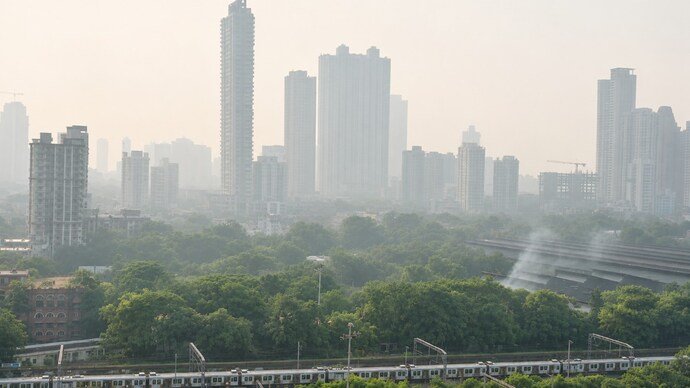
The Bombay High Court on Wednesday criticised Brihanmumbai Municipal Corporation (BMC) officials for failing to ensure compliance with noise and air pollution regulations at construction sites across Mumbai. The court said enforcing pollution-control rules was a statutory responsibility of public authorities, not an act of charity, and directed officials to ensure that prescribed norms were followed without violations.
A bench comprising Chief Justice MC Tripathi and Justice Advait M Sethna made the observations while hearing a petition filed by Mahim resident Dr Ashok Pathare, who complained of persistent construction noise at a site adjoining his residence.
“They are not doing charity. They have to ensure that the norms are followed in toto,” the bench said, emphasising that pollution monitoring must be carried out routinely across the city rather than being limited to action against individual builders.
The court made it clear that action against one construction developer would not be sufficient. Civic authorities and other responsible departments must ensure that construction sites in every locality comply with noise and air pollution standards.
Bombay High Court says pollution rules must be monitored across Mumbai
During the hearing, the bench stressed that compliance with pollution regulations should be a regular part of the authorities’ responsibilities. It said officials must monitor construction activities throughout Mumbai instead of responding only when residents approach the authorities with complaints.
“In every area, the noise pollution norms have to be followed. Action against one builder will not suffice. This has to be monitored in every area,” the bench observed.
The judges also questioned the effectiveness of granting construction permissions if the authorities failed to ensure that developers followed the conditions attached to those permissions.
“When you give permission there should not be noise or air pollution. The rules have to be adhered to. We are asking all the officials to monitor these things. They should do it on a routine basis. We are not against one individual builder. The officers who are responsible have to ensure that norms are followed,” the court said.
The observations underline the distinction between granting permission for construction and ensuring that work is carried out in accordance with environmental and public safety requirements. The court said the responsibility rested with the officials tasked with monitoring compliance.
Mahim resident says complaints went unanswered for more than 60 days
The petition was filed by Dr Ashok Pathare, a resident of Mahim who alleged that construction work at a site next to his home had caused persistent noise pollution.
Pathare told the court that noise was not his only concern. He said he had spent more than 60 days approaching different departments and government authorities, but instead of resolving the problem, the departments repeatedly passed responsibility between themselves.
According to the petitioner, the BMC had imposed conditions requiring construction sites to prevent public nuisance, take precautions during piling work and comply with applicable noise pollution regulations. Despite these conditions, he alleged that violations continued at the site.
The case raised questions about the gap between pollution-control requirements imposed on construction projects and their implementation on the ground.
Pathare also argued that the authorities’ response had failed to provide effective relief despite repeated complaints. His petition highlighted the difficulties residents can face when responsibility for monitoring and enforcement is spread across multiple departments.
Noise levels allegedly crossed 100 decibels
To support his allegations, Pathare referred to police panchnamas, which he said recorded noise levels exceeding 100 decibels at the construction site.
He compared these readings with the permissible daytime noise limit of 55 decibels for residential areas, arguing that the construction activity was significantly exceeding the prescribed standard.
The petitioner alleged that pollution-control requirements remained largely confined to official documents, with little effective enforcement at the site despite complaints and conditions imposed by the civic body.
He also described the impact of the construction activity on his family. Pathare submitted that he had suffered permanent partial hearing loss, while his son, who has autism spectrum disorder, experienced severe distress because of the noise.
The petition further alleged that the developer and contractor continued construction despite complaints and used influential connections to discourage him from pursuing the matter.
These submissions brought the personal consequences of prolonged construction noise into focus during the hearing, alongside the broader question of whether civic authorities were fulfilling their responsibility to protect residents from pollution.
High Court flags absence of builder’s assurance
During the proceedings, the Bombay High Court noted that the builder concerned had not filed an affidavit assuring the court that there would be no further violations of noise and air pollution regulations.
The absence of such an assurance was noted as the court examined the allegations and the responsibilities of the authorities involved in monitoring construction activity.
The bench emphasised that its observations were intended to remind civic and other government officials of duties already placed upon them under the law. It said public authorities had an obligation to protect residents from pollution and prevent unnecessary inconvenience.
“We are only informing all officials that there is a duty cast. There is a mandate of the High Court. In every area this is to be monitored, no inconvenience is to be caused to the public at large,” the judges said.
The court’s remarks made clear that pollution control cannot depend solely on individual residents filing complaints against construction companies. Authorities must also carry out regular inspections and ensure that applicable standards are followed across different parts of the city.
Bombay HC also raises concern over light pollution
While focusing primarily on noise and air pollution, the bench also highlighted light pollution as an issue requiring attention.
The judges called for substantial reductions in both noise and air pollution and urged citizens to report violations supported by first-hand information.
“There should be substantial reduction in air pollution and noise pollution. The light pollution is also an issue,” the bench observed.
The court also encouraged residents to bring specific instances of non-compliance to its attention, indicating that information from people directly witnessing violations could help identify problems requiring intervention.
“We also make a request that if you get first-hand information and there is a violation, then please indicate. Do not hesitate. We will look into it,” the bench said.
What the court’s observations mean for construction sites in Mumbai
The hearing has brought attention to the responsibilities of the BMC and other authorities in enforcing pollution-control requirements at construction projects. The court’s emphasis was not limited to the particular site in Mahim but extended to routine monitoring across Mumbai.
For residents living near construction projects, the issue concerns more than compliance with paperwork. Noise from piling and other construction activities, along with dust and air pollution, can affect daily life, particularly when complaints do not lead to timely action.
The court’s observations also place responsibility on officials who approve and monitor construction activities. Granting permission for a project does not remove the obligation to ensure that developers follow the conditions imposed on them.
The central message from the bench was that pollution-control norms must be enforced consistently, rather than relying on occasional action against individual builders after residents raise complaints.
By reminding officials of their statutory duties and encouraging citizens to report violations, the Bombay High Court has highlighted the importance of regular oversight in protecting the public from construction-related pollution.
For breaking news and live news updates, like us on Facebook or follow us on Twitter and Instagram. Read more on Latest India on thefoxdaily.com.






COMMENTS 0