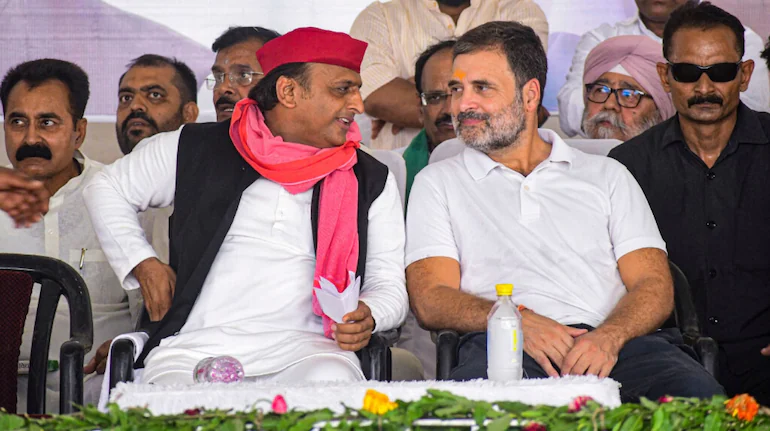
The Congress and the Samajwadi Party (SP) have entered a difficult round of negotiations over seat-sharing for the 2027 Uttar Pradesh Assembly elections. Although both parties have repeatedly said their objective is to defeat the Bharatiya Janata Party (BJP), they remain far apart on how many constituencies each should contest and which seats should go to Congress.
Congress has reportedly reduced its original demand of 181 seats to approximately 130 in a revised proposal. However, the reduction does not mean the party is prepared to compromise equally across all constituencies. It has divided its wishlist into three categories, identifying 68–70 seats as its highest priority and keeping around 60 additional constituencies open for discussion.
The Samajwadi Party’s response has been considerably more limited. SP leaders have confirmed an offer of 26 constituencies, including seats where Congress has previously won or finished second, as well as constituencies where the SP believes its own electoral performance gives it a stronger claim.
The disagreement is not simply about the number of seats. It reflects competing assessments of political strength, organisational reach and electoral winnability. Congress wants its improved performance in the 2024 Lok Sabha elections to translate into a larger role in Uttar Pradesh, while the SP is seeking an arrangement that reflects its stronger Assembly-level position.
What do Category A, B and C mean in Congress’s seat-sharing formula?
Congress’s three-category approach is designed to separate constituencies it considers essential from those where it is prepared to negotiate. Instead of presenting one undifferentiated list, the party has reportedly ranked seats according to its electoral history, recent performance and assessment of its local strength.
Category A: 68–70 priority constituencies
Category A contains the seats Congress wants the SP to concede as a central part of the alliance agreement. The party reportedly considers these constituencies non-negotiable, although the exact number and final list have not been publicly established through a signed agreement.
Most of these priority seats are understood to fall within the six Lok Sabha constituencies Congress won in the 2024 general election: Saharanpur, Sitapur, Rae Bareli, Amethi, Allahabad and Barabanki. Congress believes its performance in these parliamentary constituencies gives it a strong basis for seeking a substantial share of the Assembly segments located within them.
The parliamentary results provide the party with an argument for protecting these areas. Congress won the six Lok Sabha seats while contesting as part of the INDIA bloc arrangement with the SP. It wants the Assembly-level distribution to recognise that performance rather than leave the constituencies entirely to its regional ally.
However, winning a Lok Sabha constituency does not automatically establish that Congress is the strongest party in every Assembly segment within it. Parliamentary and Assembly elections involve different candidates, local issues and voting calculations. The SP may therefore assess individual constituencies differently, particularly where it has sitting MLAs or a stronger booth-level organisation.
Categories B and C: Around 60 constituencies open to negotiation
The remaining seats in Congress’s reported proposal have been placed in Categories B and C. These constituencies are not being treated with the same level of rigidity as Category A, leaving room for discussions over which party should contest them.
Congress reportedly believes it has a reasonable claim to several of these seats because it finished second in previous elections or has maintained a political presence in the area. The party’s broader objective is to expand its Assembly footprint across Uttar Pradesh instead of limiting its presence to a few traditional strongholds.
The distinction between the categories gives Congress negotiating flexibility. It can defend its highest-priority seats while potentially making concessions elsewhere to reach an agreement. For the SP, however, the central question remains whether Congress’s assessment of its own strength is supported by constituency-level evidence.
Why Congress is demanding a larger share of the 403 seats
Congress is using its performance in the 2024 Lok Sabha elections as the main basis for seeking a larger share of Assembly constituencies. The party contested 17 parliamentary seats in Uttar Pradesh as part of the INDIA bloc arrangement and won six. The SP won 37 seats, while the BJP secured 33, a substantial reduction from its 62-seat tally in 2019.
Together, the SP and Congress won 43 of Uttar Pradesh’s 80 Lok Sabha constituencies. The result demonstrated that the two parties could combine their support bases in a statewide election, giving Congress an argument that it should receive a meaningful share of the Assembly seats in 2027.
The party also wants to strengthen its organisation beyond its established areas. A larger number of Assembly constituencies would give it more opportunities to field candidates, build local networks and maintain a presence between elections.
Congress’s argument is also connected to its national position within the INDIA bloc. The party does not want its role in the alliance to be determined solely by the number of Assembly seats it won in 2022, when it contested independently. It believes the 2024 result provides a more recent indication of its ability to contribute to a joint electoral campaign.
However, the two elections cannot be compared directly. In 2024, Congress benefited from a broader opposition arrangement with the SP, whereas in 2022 it contested almost the entire Assembly election on its own. The regional party is likely to argue that the parliamentary performance should not be treated as proof that Congress can independently win a similar number of Assembly constituencies.
Why the Samajwadi Party has offered only 26 seats
The SP’s 26-seat proposal is based on a different assessment of electoral strength. Rather than accepting Congress’s broader demand, the regional party has identified constituencies where it believes the national party has a reasonable claim, while also including seats where the SP itself has performed strongly in previous elections.
SP general secretary Ram Gopal Yadav explained the reasoning behind the offer on November 24. According to him, the proposed list includes two constituencies previously won by Congress, four where it finished second and 20 where the SP had secured between 60,000 and 70,000 votes in the previous election, compared with approximately 2,000 votes for Congress.
The two seats Congress previously won are Rampur Khas and Farenda. The four constituencies where it finished second are Mathura, Kheragarh, Jagdishpur and Kidwai Nagar.
The other 20 constituencies in the SP’s reported offer are:
- Baghpat
- Modinagar
- Hapur
- Jewar
- Syana
- Khurja
- Khair
- Iglas
- Mant
- Agra North
- Fatehpur Sikri
- Bilgram-Mallanwan
- Govind Nagar
- Nanpara
- Gorakhpur City
- Khajani
- Padrauna
- Fazilnagar
- Pindra
- Varanasi Cantt
Yadav’s explanation makes the SP’s position clear: it wants seat allocation to reflect the votes each party has previously secured in individual constituencies. From the SP’s perspective, offering seats where Congress has a limited recent vote base is already a concession.
SP MP Rajeev Rai also confirmed that the party had offered Congress 26 constituencies. Both leaders indicated that negotiations would continue rather than presenting the proposal as a final agreement. :chatgpt-content-reference{index=”0″}
The biggest disagreement: Political influence versus constituency-level winnability
The difference between Congress’s demand and the SP’s offer reflects two distinct approaches to alliance negotiations.
Congress is placing greater emphasis on its improved parliamentary performance, its traditional areas of influence and the need to rebuild its organisation across the state. It wants the alliance to recognise its contribution to the INDIA bloc’s 2024 result and provide enough constituencies to make a meaningful independent political impact.
The SP is placing greater emphasis on individual constituency performance. Its leaders have argued that the parties should examine where each organisation has a realistic chance of winning instead of deciding the distribution through a fixed numerical formula.
This disagreement is important because a seat-sharing arrangement is not simply a division of constituencies between two party headquarters. Each seat has its own caste composition, local leadership, candidate networks, historical voting patterns and relationship with the state-level political environment.
A constituency where Congress finished second in one election may have a different political situation by 2027. Similarly, an SP candidate who received a large number of votes in a previous contest may not necessarily retain the same level of support if local circumstances change.
The two parties therefore need to assess more than their previous vote totals. Candidate credibility, organisational strength, alliance coordination and the possibility of vote transfer between supporters will all matter when deciding which party should contest a particular seat.
What the 2022 Assembly election tells us about the negotiations
The SP’s reluctance to accept a demand for around 130 seats is partly rooted in Congress’s weak performance in the 2022 Uttar Pradesh Assembly election.
Congress contested 399 of the state’s 403 constituencies independently but won only two seats. The SP, by comparison, won 111 seats and emerged as the principal opposition party in the Assembly.
The previous alliance between the two parties in 2017 also provides a reference point. Congress contested 107 constituencies while the SP fought the remaining seats under their seat-sharing arrangement. Congress won seven seats, while the SP secured 54.
These results strengthen the SP’s argument that it should retain a substantially larger share of constituencies. Its leadership can point to its much stronger Assembly-level record as a reason to avoid giving Congress a large number of seats without evidence that the party has developed sufficient local strength.
Congress, however, can counter that the 2022 result came when it contested without the SP. The 2024 parliamentary election showed that the opposition parties could perform differently when they coordinated their campaigns and combined their support bases.
The challenge is to determine how much of that parliamentary success can be translated into Assembly-level support. The SP and Congress must establish whether voters who supported the alliance in the Lok Sabha election will also back candidates from either party in individual Assembly constituencies.
How the 2024 Lok Sabha result changed Congress’s bargaining position
The 2024 general election gave Congress a stronger argument in Uttar Pradesh than its Assembly performance in 2022 would suggest. The party won six of the 17 parliamentary seats it contested, while the SP secured 37 of the state’s 80 seats.
The BJP won 33 constituencies, down from 62 in the 2019 general election. The combined INDIA bloc tally of 43 seats demonstrated the impact of opposition coordination in a state that sends the largest number of MPs to the Lok Sabha.
For Congress, the result was an opportunity to argue that its political presence in Uttar Pradesh should not be measured only through its previous Assembly seat tally. Its victories in Rae Bareli, Amethi, Saharanpur, Sitapur, Allahabad and Barabanki provide a basis for seeking a larger role in the next Assembly election.
The party also wants to avoid a situation in which it contests only a small number of constituencies and remains dependent on the SP for its political visibility in the state. A broader seat allocation could allow Congress to develop its own candidates and organisational structure while remaining part of the INDIA alliance.
Nevertheless, the SP’s 37 Lok Sabha victories compared with Congress’s six underline the difference in their electoral strength within the alliance. The SP is likely to use that performance, along with its 2022 Assembly tally, to justify retaining control over most of the 403 constituencies.
Why sitting SP MLAs could become a major obstacle
One of the sensitive parts of Congress’s revised proposal concerns constituencies represented by sitting SP legislators. Congress has reportedly indicated that it is willing to leave these seats outside its claim, potentially reducing direct clashes between the two parties.
This could help negotiations because asking a regional ally to give up constituencies represented by its sitting MLAs would create resistance within its organisation. Sitting legislators have their own local networks, supporters and political interests, making them difficult to displace even when an alliance partner seeks a larger share.
However, excluding sitting SP MLAs from Congress’s demand does not automatically resolve the disagreement. The remaining constituencies still need to be assessed individually, and both parties may claim seats where their candidates have previously performed well.
The final formula will therefore depend on how many constituencies the SP is prepared to concede beyond the 26-seat proposal and how far Congress is willing to reduce its demand. The parties will also have to consider whether they can accommodate local leaders who may oppose the selection of an alliance partner’s candidate.
Who is negotiating the seat-sharing agreement?
Both parties have established negotiating teams to handle the discussions rather than leaving every constituency-level decision to their respective state units.
The SP’s panel is headed by general secretary Ram Gopal Yadav and includes party state president Shyam Lal Pal and MPs Rajeev Rai and Iqra Hasan. The Congress team includes Uttar Pradesh in-charge Rajendra Pal Gautam, state Congress president Aradhana Mishra, working president Imran Masood and senior organisational representative K. C. Venugopal.
The composition of the SP team also reflects its PDA political framework, which refers to पिछड़ा (backward classes), Dalits and minorities. The inclusion of Faizabad MP Awadhesh Prasad in the negotiating process was reported as part of the party’s effort to ensure representation of this social coalition in its discussions.
Congress’s negotiating team, meanwhile, includes leaders responsible for its state organisation and national-level coordination. The discussions will require agreement between the central leadership and state-level representatives because the final allocation will affect both the alliance’s overall strategy and the future of individual candidates. :chatgpt-content-reference{index=”1″}
What happens if the two parties fail to agree?
A breakdown in negotiations would create difficulties for both parties. Contesting separately could lead to direct competition between Congress and SP candidates in constituencies where their support bases overlap. That could divide opposition votes and alter the contest in favour of the BJP or other candidates.
For Congress, accepting a very small number of seats could limit its ability to rebuild its organisation and establish a stronger Assembly presence. The party would also risk appearing to have a reduced role within the INDIA bloc in Uttar Pradesh despite its participation in the 2024 parliamentary alliance.
For the SP, conceding a substantially larger number of constituencies could mean giving up seats where it has stronger local networks or candidates with established electoral support. Its leadership will be cautious about making concessions that could affect its own prospects of retaining a dominant position among opposition parties in the state.
The two sides therefore have an incentive to reach an agreement, but the final arrangement will require compromises on both sides. Their public statements about defeating the BJP provide a common political objective, yet that objective does not automatically settle disagreements over candidates and constituencies.
What to watch before the 2027 Uttar Pradesh elections
Several developments will indicate whether the negotiations are moving towards a final agreement.
- The final number of seats: Congress’s reported demand has moved down from its initial 181-seat position, while the SP has put forward a 26-seat offer. The distance between these figures remains the central issue.
- Category A negotiations: Whether the SP accepts Congress’s claim over 68–70 priority constituencies will show how much importance it attaches to the party’s 2024 Lok Sabha performance.
- Constituency-level assessments: Both parties will need to compare previous results, candidate strength and local organisational networks rather than rely only on statewide vote shares.
- Protection of sitting MLAs: The treatment of constituencies represented by SP legislators could become a key factor in preventing internal resistance.
- Final leadership approval: Even if negotiating teams reach an understanding, the arrangement will need acceptance from the senior leadership of both parties.
There is also an important distinction between the figures circulating in political reporting and a formally concluded seat-sharing agreement. Different reports have described Congress’s revised demand in the range of approximately 120 to 130 seats, while accounts of its category-wise list have also varied. The reported 68–70 Category A figure should therefore be understood as part of the negotiating proposal, not a final allocation announced by both parties. :chatgpt-content-reference{index=”2″}
Why the seat-sharing dispute matters for the INDIA alliance
Uttar Pradesh is central to national electoral politics because its 80 Lok Sabha constituencies give it the largest representation in Parliament. The performance of the INDIA bloc in the state during the 2024 general election demonstrated that cooperation between regional and national opposition parties can significantly change the political contest.
The 2027 Assembly election will test whether that cooperation can be sustained at the constituency level. A parliamentary alliance can benefit from a common campaign and broader voter coordination, but Assembly elections require decisions about hundreds of local candidates, constituency-specific issues and the distribution of organisational responsibilities.
For Congress, the negotiations are about securing enough constituencies to rebuild its political presence in a state where its Assembly representation has remained limited. For the SP, they are about maintaining its position as the principal regional opposition party while ensuring that alliance partners receive seats where they can contribute to the campaign.
The Category A, B and C formula is Congress’s attempt to turn its electoral claims into a structured negotiating proposal. The SP’s 26-seat offer, meanwhile, shows that it is approaching the same discussion through a much narrower assessment of previous constituency-level performance.
Neither side has yet demonstrated that its preferred number represents the final formula. The outcome will depend on whether Congress can persuade the SP to recognise its expanded ambitions and whether the regional party is willing to concede enough constituencies without weakening its own organisation.
The immediate question is no longer simply whether the two INDIA bloc partners will contest together. It is how many seats Congress will actually receive, which constituencies will be included and whether both parties can agree on a formula that gives them a common campaign without creating fresh competition within the alliance.
For breaking news and live news updates, like us on Facebook or follow us on Twitter and Instagram. Read more on Latest India on thefoxdaily.com.





COMMENTS 0