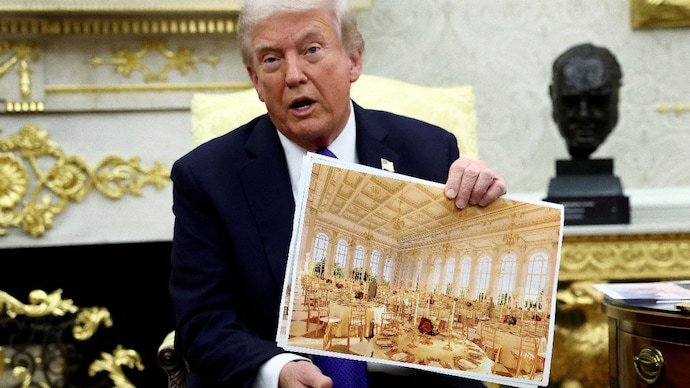
A US federal appeals court has ordered the Trump administration to halt above-ground construction of a planned $400 million ballroom at the White House, delivering a significant legal setback to President Donald Trump and raising a broader constitutional question over how far a president can go in changing one of the country’s most important historic buildings.
The Washington-based US Court of Appeals for the District of Columbia Circuit ruled 2-1 on Friday that the administration cannot fundamentally reshape the White House without congressional approval. The decision temporarily blocks the above-ground portion of the project while the legal dispute continues.
The ruling is particularly notable because the administration had already demolished the White House’s East Wing and begun work on a proposed 90,000-square-foot ballroom without first obtaining authorization from Congress. The Trump administration has defended the project as both a practical facility for large events and a security improvement.
Trump plans to appeal the decision to the US Supreme Court.
Why did the court stop Trump’s White House ballroom project?
At the centre of the case is a basic question about presidential authority: can a president make a fundamental physical alteration to the White House without Congress approving the project?
The appeals court’s majority concluded that he cannot.
The judges wrote that each president is a “temporary tenant, not the owner” of the White House. Their reasoning places the dispute within a larger constitutional principle: the executive branch cannot simply treat presidential control of government property as unlimited authority to permanently alter it.
The court upheld a preliminary injunction previously issued by US District Judge Richard Leon, who had twice blocked above-ground construction while permitting underground work to continue.
The National Trust for Historic Preservation brought the lawsuit after the administration demolished the East Wing and began construction on the ballroom.
The appeals court’s decision does not permanently prohibit a ballroom. Instead, it prevents the administration from continuing above-ground construction during the litigation and until the White House obtains the necessary congressional approval, according to the majority opinion.
What is Trump planning to build?
The proposed ballroom would occupy the site of the demolished East Wing and cover approximately 90,000 square feet, or about 8,360 square metres.
The project has been presented by the administration as a solution to the limitations of existing White House facilities for large formal events.
But the scale of the proposed structure makes the project much more than a minor renovation. The East Wing was a recognizable part of the White House complex, and replacing it with a large permanent structure represents a major physical change to the presidential campus.
That scale is one reason the project has become a legal and political Controversy rather than simply another construction project inside the executive complex.
The estimated price has also increased substantially. Trump initially discussed a smaller and less expensive proposal, but the projected cost eventually rose to about $400 million.
Trump has defended the increase by arguing that the ballroom is approximately twice the size and of substantially higher quality than the original proposal.
Trump says the ballroom is also a national security project
Trump’s defence of the project has increasingly focused on security.
In a Friday post on Truth Social, he referred to the proposed ballroom as a “military center” and argued that stopping the project would leave the president, White House personnel and visitors vulnerable to attack.
Trump said the design includes bomb shelters, medical facilities, protection against Drones and missiles, and other security measures that he described as part of a larger integrated system.
The administration has therefore attempted to frame the ballroom as more than a venue for formal events. Its argument is that the structure would address vulnerabilities associated with the existing White House complex.
That argument was presented in court as a reason for judicial restraint.
Justice Department attorney Yaakov Roth argued during appeals court proceedings that the courts should not second-guess the administration’s decision to build the privately funded project. He argued that the National Trust’s concerns about architecture should not outweigh National Security considerations.
The appeals court rejected national security as an automatic justification
The appeals court majority did not accept the administration’s security argument as sufficient to override the legal questions raised by the project.
The judges made clear that national security is an important government responsibility but does not automatically exempt the executive branch from legal requirements.
The opinion effectively draws a line between having a legitimate security objective and having unlimited authority to achieve it.
That distinction could matter beyond this particular ballroom dispute.
If national security alone allowed the executive branch to bypass laws governing government property and historic sites, the judges reasoned, the constitutional separation of powers could be weakened considerably.
The majority therefore concluded that the administration must operate within the legal framework governing major changes to the White House.
What did the court actually order?
The ruling is narrower than a permanent cancellation of Trump’s ballroom.
The appeals court’s Democratic-appointed majority, Circuit Judges Patricia Millett and Brad Garcia, said the decision does not permanently prevent construction of a ballroom. Instead, it blocks above-ground work while the lawsuit continues and until congressional approval is obtained.
The court has also placed its ruling on hold for 14 days, giving the Trump administration time to seek review from the US Supreme Court.
That means the legal battle is not over.
Trump has already said that his administration will appeal.
The Supreme Court could therefore become the next major venue for determining whether the administration can proceed without Congress or whether the lower court’s restrictions will remain in place.
Why the phrase “temporary tenant” matters
The most striking language in the majority opinion was its description of presidents as temporary tenants rather than owners of the White House.
That phrase captures the broader constitutional concern behind the case.
The White House is simultaneously a working government facility, the president’s official residence and one of the most recognisable historic structures in the United States. A president occupies it because of holding office, but does not acquire personal ownership of the building.
The court’s reasoning therefore treats the White House as an institutional asset that exists beyond any single administration.
Every president eventually leaves office. Permanent changes to the physical structure, the majority suggested, should therefore not be treated as though they were ordinary executive decisions that can be reversed simply when the next president takes office.
That is the significance of the “temporary tenant” concept. It places institutional continuity above the preferences of one administration.
Trump’s appeal could turn the case into a separation-of-powers dispute
The Supreme Court appeal could make the ballroom case much larger than a disagreement about architecture.
The central legal issue is whether the executive branch has authority to carry out a project of this scale on White House grounds without congressional approval.
That puts questions of presidential power, congressional authority and judicial review into the same dispute.
The Trump administration argues that courts should not interfere with a project connected to presidential security and executive operations. The National Trust and the lower courts have taken the position that the administration must comply with legal requirements even when the president claims an important governmental interest.
The Supreme Court’s eventual response could clarify how those competing principles interact.
A Trump-appointed judge disagreed with the majority
The appeals court decision was not unanimous.
Circuit Judge Neomi Rao, whom Trump appointed during his first term, dissented from the majority’s decision.
Rao argued that the lower court’s injunction went beyond what federal courts should be doing. In her view, allowing the injunction to remain in place amounted to judicial supervision of construction at the White House.
Her dissent highlights the central disagreement in the case.
The majority sees judicial intervention as necessary to prevent the executive branch from bypassing constitutional and legal limits. Rao sees the injunction itself as an improper expansion of judicial authority into an area belonging to the executive branch.
That disagreement is likely to be important if the Supreme Court considers the case.
Who challenged the ballroom project?
The National Trust for Historic Preservation is the organisation behind the legal challenge.
Its president, Brent Leggs, welcomed the appeals court ruling and described it as a victory for the public’s ability to participate in decisions involving historic places, including the White House.
The organisation’s involvement reflects the historic significance of the site. The dispute is not simply about whether a new event space would be useful. It also concerns who should have authority over major physical changes to a nationally significant landmark.
For preservation advocates, the case raises concerns about the precedent that could be created if a president can demolish a historic component and replace it without congressional involvement.
Why the East Wing demolition is central to the dispute
The ballroom case became especially contentious because the administration did not merely propose a future construction project. The East Wing was demolished before the courts had resolved the legal dispute over the broader project.
That sequence matters.
Once a historic structure has been demolished, reversing the decision becomes far more difficult than stopping a proposal before construction begins.
The courts therefore faced a dispute in which physical changes to the White House were already underway while questions about the administration’s authority remained unresolved.
The preliminary injunction allowed underground work to continue but stopped above-ground construction, effectively preserving the status quo while the legal challenge proceeded.
The ballroom is part of Trump’s broader effort to reshape Washington
The White House ballroom is not an isolated example of Trump’s interest in changing prominent buildings and spaces in central Washington.
The ballroom plan has been described as the most ambitious of several efforts by Trump to reshape parts of the capital’s government and monumental landscape.
A separate legal dispute has also emerged around the Kennedy Center, where a judge recently ruled that Trump’s name had been improperly added to the exterior of the performing arts complex and ordered its removal.
Taken separately, these cases concern different buildings and legal questions. Together, however, they illustrate a recurring issue surrounding Trump’s approach to public institutions: how much authority a president has to make highly visible changes to spaces and institutions that extend beyond an individual administration.
Why the $400 million cost has attracted attention
The price of the proposed ballroom has also become part of the political debate.
The project was initially expected to cost less, but the estimate increased to about $400 million.
Trump has defended the higher figure by saying that the project became substantially larger and would be built to a higher standard than originally proposed.
The administration has also described the project as privately funded, an argument that it says strengthens its case against court intervention.
But the source of funding does not necessarily settle the legal question before the court. The appeals court’s concern is focused on the authority to make a fundamental change to the White House, rather than simply on who pays for the construction.
What happens next?
The immediate next step is Trump’s planned appeal to the Supreme Court.
The appeals court’s 14-day pause gives the administration time to pursue that challenge. Until the legal situation changes, above-ground construction remains blocked under the court’s order.
The Supreme Court could ultimately decide whether the administration can proceed without congressional approval, leave the appeals court’s ruling in place or otherwise alter the legal restrictions surrounding the project.
The case could therefore remain unresolved for some time.
For Trump, the outcome matters not only because of the ballroom itself but because of the precedent that could be established for presidential authority over the White House.
The bigger constitutional question behind Trump’s ballroom
The White House ballroom dispute is ultimately about much more than whether the building needs another large event space.
It asks who gets to decide when a president wants to make a permanent and fundamental change to a national institution: the president, Congress or the courts.
The Trump administration argues that presidential authority and national security considerations give it substantial room to act. The appeals court majority has rejected the idea that those considerations provide an automatic exemption from legal constraints.
The opposing view, represented by Judge Rao’s dissent, warns that courts should not become supervisors of executive construction projects.
That tension is unlikely to disappear with the ballroom case.
Whatever eventually happens to the $400 million project, the dispute has established a broader principle that will be closely watched: a president may have enormous power over the executive branch, but occupying the White House does not make the president its owner.
For now, Trump’s ballroom plans are on hold above ground. The next decision belongs to the Supreme Court, and its response could determine not only whether the ballroom rises but also how far a future president can go in physically reshaping the White House without Congress.
For breaking news and live news updates, like us on Facebook or follow us on Twitter and Instagram. Read more on Latest World on thefoxdaily.com.






COMMENTS 0