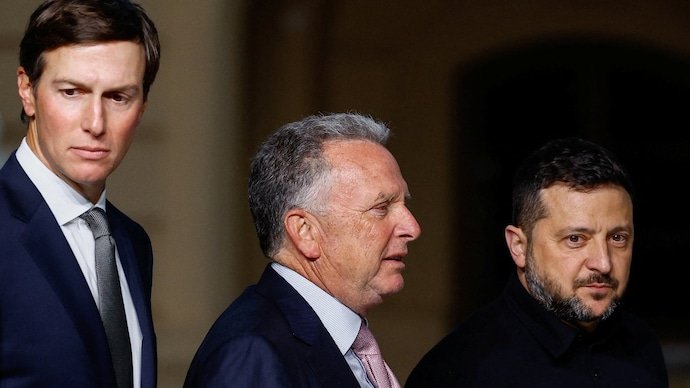
US President Donald Trump’s special envoys Steve Witkoff and Jared Kushner met Ukrainian President Volodymyr Zelenskyy in Kyiv on Sunday, September 6, a day after holding more than three hours of talks with Russian President Vladimir Putin in Moscow.
The back-to-back meetings represent Washington’s latest attempt to restart diplomatic efforts aimed at ending Russia’s war in Ukraine, but there was no immediate breakthrough on the central issues separating Moscow and Kyiv.
Witkoff and Kushner arrived in Kyiv by train after travelling through Poland, marking their first visit to the Ukrainian capital in their current diplomatic roles since Russia launched its full-scale invasion in February 2022. Zelenskyy met them near St Sophia Cathedral as discussions moved from Moscow to Kyiv.
After the first round of talks, Witkoff described the discussions as substantive and significant, while Kushner said Trump wanted more than an agreement that simply stopped the immediate fighting. The American delegation is seeking conditions for what it describes as a lasting peace.
For Kyiv, however, the diplomatic objective comes with a major condition: any peace settlement must provide credible security guarantees and prevent Russia from using a ceasefire to prepare for another attack.
Witkoff and Kushner arrive in Kyiv after Moscow meeting
The US envoys’ visit to Kyiv followed their meeting with Putin at the Kremlin on Saturday.
The Moscow discussions lasted more than three hours and were described by Russian officials as substantive, constructive and frank. But despite the positive language, neither Moscow nor Washington announced an agreement that would immediately change the course of the war.
Putin’s foreign-policy adviser Yuri Ushakov said the talks covered possible pathways toward a settlement as well as economic issues and potential US-Russia projects.
The Kremlin also said Russia had presented its assessment of the battlefield and reiterated the importance of addressing what Moscow calls the “root causes” of the conflict.
Those descriptions indicate that the talks were detailed, but they also highlight the continuing gap between the two sides. Russia’s definition of the underlying causes of the war has historically included demands involving Ukraine’s military posture, NATO and territory, positions that Kyiv has rejected.
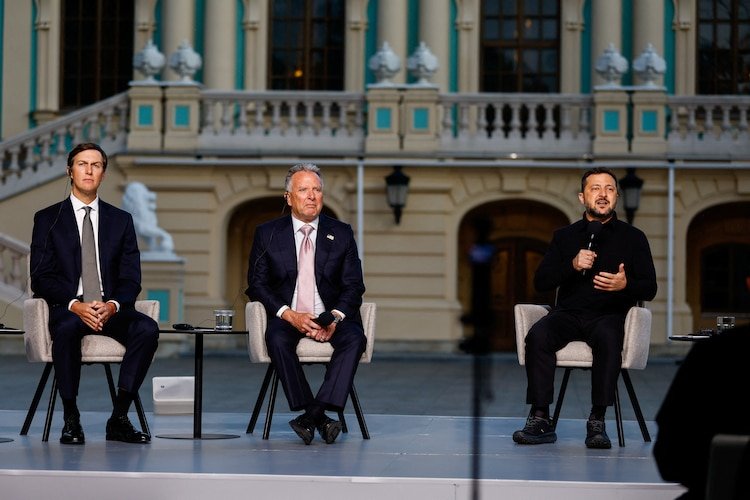
First US envoy visit to Kyiv since full-scale invasion
The Kyiv trip carries symbolic importance because it is the first visit to Ukraine by Witkoff and Kushner in this diplomatic effort since Russia launched its full-scale invasion.
The decision to travel to Kyiv immediately after meeting Putin also shows the strategy Washington is attempting to pursue: listen directly to both sides before trying to formulate a framework that could eventually bring them into the same negotiating process.
Ukraine has consistently argued that any meaningful settlement must involve Kyiv directly. A peace arrangement negotiated solely between Washington and Moscow would be unacceptable to the Ukrainian government if it required Ukraine to accept terms it had not agreed to.
The presence of the American envoys in Kyiv therefore serves a practical purpose as well as a diplomatic one. Washington is attempting to establish whether positions discussed with Putin can be converted into proposals acceptable to Zelenskyy.
Witkoff says talks were “meaningful”
Following the initial discussions, Witkoff described the meeting with Zelenskyy as “meaningful” and “substantive” and said the American side was encouraged by what it had heard.
The positive tone was similar to the language used by Russian officials after the Moscow meeting. That does not mean the parties have resolved their differences, but it suggests Washington wants to maintain momentum rather than publicly frame the diplomatic process as stalled.
The challenge is converting general goodwill into agreement on specific issues.
Those issues include territory, security guarantees, the future status of Ukraine, sanctions, military deployments and the sequencing of any ceasefire. Each involves questions that go far beyond the simple question of when the shooting should stop.
Kushner says Trump wants durable peace
Jared Kushner, who has become one of the key figures in Trump’s renewed diplomatic effort, said the president’s objective was not simply to stop the immediate fighting.
Kushner said Trump wanted to create conditions for a durable peace that would prevent the war from restarting.
That distinction is crucial because Russia and Ukraine have experienced repeated temporary agreements that failed to produce a lasting settlement.
A short ceasefire can reduce casualties and create room for negotiations, but it does not resolve the political and security issues that caused the conflict to remain entrenched.
The Trump administration’s challenge is therefore to find a formula that can simultaneously stop active combat and persuade both governments that the resulting security arrangement is sustainable.
Zelenskyy says talks were very substantial
Zelenskyy also described the discussions with the US envoys as “very substantial”.
According to the Ukrainian president, the talks focused heavily on security and economic guarantees for Ukraine and on urgent preparations for the approaching winter.
Ukraine’s energy infrastructure has repeatedly come under attack during the war, making winter preparedness a major concern for Kyiv. The government is seeking additional air-defence capabilities, missiles and support for protecting its electricity and energy systems.
Zelenskyy said Ukraine was preparing for the possibility that the war could continue into the colder months, suggesting that Kyiv is not assuming the latest diplomatic effort will automatically produce a ceasefire.
That combination of diplomacy and military preparation reflects the reality of the current situation: negotiations are continuing while both countries remain engaged in combat operations.
Security guarantees remain Ukraine’s central demand
The question of security guarantees is one of the biggest obstacles to a peace agreement.
Ukraine wants assurances that Russia cannot simply attack again after a ceasefire. Kyiv has argued that an agreement without credible deterrence could freeze the conflict temporarily without resolving its underlying security problem.
Russia, meanwhile, has consistently opposed arrangements that could allow Ukraine to become a heavily armed military platform closely integrated with NATO countries.
Bridging those positions would require a carefully designed security framework that both sides consider credible.
That could become one of the most difficult parts of any future peace agreement because guarantees have value only if the party providing them is willing and able to enforce them.
Ukraine wants trilateral negotiations to resume
Zelenskyy said he hoped the latest US-led effort could eventually lead to the resumption of trilateral negotiations involving Ukraine, Russia and the United States.
A three-way format would be significant because it would bring the governments most directly involved in the conflict into the same negotiating process.
Previous diplomatic efforts have often involved intermediaries or separate discussions rather than sustained direct negotiations involving all three sides.
Kyiv believes Washington can use its relationship with Moscow to pressure Russia while also addressing Ukrainian concerns. Moscow, meanwhile, appears interested in maintaining direct communication with the Trump administration over both the war and broader US-Russia relations.
The question is whether the United States can persuade both governments to accept a common framework for negotiations.
Europe is being brought into the diplomatic process
The Ukrainian side is also seeking a stronger role for European partners.
Zelenskyy said national security advisers from Britain, France and Germany would take part in further discussions in Kyiv.
The involvement of European countries matters because they are among Ukraine’s principal military and financial supporters and would likely play an important role in enforcing or supporting any future security arrangement.
Europe also has a direct strategic interest in the outcome of the war. A lasting settlement would affect the continent’s security architecture, defence spending, sanctions policy and relations with Russia for decades.
Any peace agreement that excludes European governments entirely could therefore face practical difficulties in implementation.
Putin talks produced no immediate breakthrough
The Moscow meeting may have been lengthy and detailed, but the most important fact is that it did not produce a public breakthrough.
Russian officials described the talks positively while reaffirming Moscow’s established positions.
That suggests the diplomatic process is still at the stage of testing possibilities rather than negotiating a finalized settlement.
The language used by the Kremlin also indicates that Russia continues to view military developments as an important part of its negotiating position.
As long as Moscow believes it can improve its position on the battlefield, its willingness to make concessions at the negotiating table may remain limited.
The battlefield has not stopped
The diplomatic meetings took place alongside continuing military operations.
Ukraine said its forces carried out overnight strikes against the Ryazan oil refinery and an airfield in Russia. Ukrainian military authorities also reported a Russian overnight barrage involving drones and missiles.
According to Ukrainian officials, Russia launched 108 drones and missiles, with Ukrainian air defences intercepting 82 drones and six missiles.
Russian officials, meanwhile, reported Ukrainian drone attacks on multiple areas inside Russia and said their air-defence systems had shot down 258 Ukrainian drones.
The competing claims could not be independently verified in full, but they underscore that the battlefield remains active despite the new diplomatic push.
Limited pause in attacks on Moscow and Kyiv
Russia and Ukraine have agreed to a temporary understanding involving strikes on each other’s capitals while the latest diplomatic contacts take place.
Moscow announced a three-day pause in attacks on Kyiv, while Zelenskyy said Ukraine would refrain from attacking Moscow through Monday.
The arrangement is important symbolically but falls well short of a comprehensive ceasefire.
Fighting elsewhere continues, including along the roughly 1,200-kilometre front where Russian and Ukrainian forces remain engaged.
Long-range missile and drone attacks also remain a major component of the war, allowing both countries to strike deep behind the front lines even when territorial positions change little.
Why the front line remains difficult to break
The ground war has become increasingly characterized by incremental territorial movements rather than rapid breakthroughs.
Both sides have invested heavily in drones, artillery, fortifications, electronic warfare and long-range strike capabilities.
That has made major advances difficult and expensive.
The result is a conflict in which the battlefield can remain largely static while attacks on military infrastructure, energy facilities and logistics networks continue far from the immediate front.
This deadlock is one reason diplomacy has renewed importance. A military victory appears difficult for either side to achieve quickly, while the economic and human costs of continued fighting remain high.
Winter is another urgent concern for Ukraine
Ukraine’s concerns about the approaching winter are particularly serious because Russia has repeatedly targeted the country’s energy system.
Power plants, transmission infrastructure and other energy facilities have been damaged during the war, creating challenges for heating and electricity supply during periods of extreme cold.
Additional air-defence missiles could help Ukraine protect critical infrastructure, but supply remains dependent on continued support from Western partners.
Zelenskyy’s decision to emphasize winter preparedness during talks with Washington reflects the practical reality facing the Ukrainian government: even while discussing peace, Kyiv must prepare for another period of potentially intense attacks.
Economic guarantees could be as important as military ones
Security is only one part of Ukraine’s postwar challenge.
The country will require enormous resources to rebuild homes, transport networks, factories, schools, hospitals and energy infrastructure damaged during the war.
That makes economic guarantees a significant part of the negotiations.
Ukraine needs confidence that international financial support will continue, private investment can return and reconstruction can proceed even if the security situation remains uncertain.
Russia, meanwhile, wants relief from sanctions and greater access to international markets.
Economic questions therefore overlap directly with the political negotiations.
Trump’s role is central to the diplomatic effort
Trump has repeatedly presented himself as a leader capable of bringing the Russia-Ukraine war to an end.
The decision to send Witkoff and Kushner to meet Putin and then Zelenskyy represents a highly personal form of diplomacy centred on the White House.
Trump has also suggested that the US delegation is carrying ideas for ending the conflict, although the specific contents of those proposals have not been fully disclosed publicly.
That lack of detail makes it difficult to assess how far the plan addresses the fundamental disagreements between Moscow and Kyiv.
For now, Washington appears to be using direct engagement with both capitals to identify areas where compromise may be possible.
Why Russia may still resist a rapid settlement
One of the biggest obstacles is the gap between Russia’s strategic goals and Ukraine’s minimum requirements.
Moscow has continued to insist on addressing what it describes as the root causes of the conflict and has maintained demands connected to territory and Ukraine’s future security orientation.
Kyiv has repeatedly rejected the idea of surrendering sovereign territory as the price of peace.
As long as those positions remain unchanged, diplomacy can produce discussions without producing an agreement.
Russia’s assessment of the battlefield also matters. If Moscow believes time is working in its favour, it may prefer negotiations that preserve its military leverage rather than accepting a compromise quickly.
Why Ukraine cannot treat the talks as a guarantee of peace
For Ukraine, the diplomatic process is valuable but cannot replace military preparedness.
Even as Zelenskyy welcomed the American envoys, Ukrainian forces continued operations against Russian targets and air defences remained active against incoming attacks.
This dual approach is deliberate.
Ukraine wants diplomacy to produce a settlement, but it also wants to ensure that entering negotiations from a position of weakness does not force it into accepting terms it considers unsafe.
That is why security guarantees, continued military assistance and winter preparedness remain linked to the peace process.
The role of the United States is unusually complicated
Washington is attempting to act simultaneously as mediator, military partner and economic power.
The United States has enormous influence over Ukraine because of its military and financial support. At the same time, Trump’s administration is seeking a workable relationship with Moscow.
That gives Washington leverage but also creates a credibility challenge.
Ukraine needs to believe the United States will defend its interests during negotiations, while Russia needs to believe that Washington is genuinely interested in reaching a settlement rather than simply strengthening Kyiv’s military position.
Maintaining trust on both sides may be one of the hardest parts of the mediation effort.
What could make the peace process move forward?
A meaningful breakthrough would probably require progress on several issues simultaneously.
First, Moscow and Kyiv would need some form of agreement on the basic conditions of a ceasefire. Second, both sides would need mechanisms for monitoring violations. Third, Ukraine would require sufficiently strong security assurances to make the ceasefire credible.
Fourth, questions involving territory, sanctions and reconstruction would need a political pathway rather than being postponed indefinitely.
The diplomatic sequence now underway could provide an opportunity to work through those issues, but none appears close to a final resolution.
The most realistic immediate objective may therefore be incremental progress rather than a comprehensive peace deal.
Why the Moscow-Kyiv sequence matters
The order of the US diplomatic visits is itself meaningful.
Witkoff and Kushner met Putin first, heard Moscow’s position directly and then travelled to Kyiv to speak with Zelenskyy.
That allows the US delegation to compare the two sides’ priorities while the discussions are still fresh.
It also sends a message to Kyiv that Washington is not negotiating exclusively with Moscow behind closed doors.
For Ukraine, having American representatives physically present in the capital can provide reassurance that its concerns are being heard directly rather than filtered through Russian or European intermediaries.
First Kyiv visit brings symbolic weight
The visit also has an important symbolic dimension for Ukrainians.
Arriving in Kyiv after a meeting with Putin demonstrates that Washington views Ukraine as an essential participant in any peace process.
That matters because many Ukrainians remain deeply sceptical of negotiations that could result in an agreement imposed on their country.
Seeing American negotiators in Kyiv gives the Ukrainian government an opportunity to publicly communicate its conditions and demonstrate that the diplomatic process includes Ukrainian priorities.
No breakthrough does not mean diplomacy has failed
The absence of an immediate agreement should not necessarily be interpreted as the failure of the latest diplomatic effort.
Complex wars rarely end through a single meeting.
Initial negotiations often focus on identifying positions, testing possible compromises and establishing whether further discussions are worthwhile.
The Moscow and Kyiv meetings could therefore represent preliminary stages of a longer process.
However, the continued fighting means time is costly. Each additional week of war can bring more casualties, infrastructure destruction and economic damage.
That creates pressure on Washington to demonstrate that the diplomatic process is producing more than optimistic statements.
The next phase could involve European security advisers
The expected involvement of British, French and German national security advisers could broaden the negotiations.
European participation matters because Britain, France and Germany are among the most important European supporters of Ukraine and possess military, financial and diplomatic capabilities that could contribute to a future settlement.
Their involvement could also help address concerns that a peace agreement designed solely by Washington might not sufficiently account for European security interests.
For Moscow, however, greater European involvement could be viewed with suspicion because several European governments have strongly backed Ukraine throughout the war.
Managing those perceptions will be another challenge for the US diplomatic team.
What happens if the war continues through winter?
If the diplomatic process does not produce a ceasefire, Ukraine will have to prepare for another winter of attacks and economic pressure.
That would place additional demands on Western countries to supply air-defence missiles, energy equipment, ammunition and financial support.
Russia would also continue facing the costs of prolonged mobilisation and military operations.
The longer the conflict continues, the more important the ability of both sides to sustain their respective war economies becomes.
That is another reason the diplomatic effort is attracting attention even without a breakthrough: both governments face substantial costs from continued fighting.
Ukraine’s message to Washington is clear
Zelenskyy’s position after meeting the American envoys can be distilled into three priorities: end the war, obtain credible security guarantees and ensure that any peace is dignified and durable.
Kyiv does not appear to oppose negotiations. Instead, it wants negotiations to produce a settlement that does not leave Ukraine exposed to another invasion.
That puts the burden on Washington to bridge the gap between Ukraine’s security demands and Russia’s insistence on major political and territorial concessions.
Whether that can be achieved remains uncertain.
The diplomatic push now faces its hardest test
The meetings between US envoys, Putin and Zelenskyy have opened a new channel for negotiations, but they have not yet changed the underlying strategic reality.
Russia and Ukraine remain far apart over territory, security arrangements and the political future of Ukraine. The battlefield remains active, and the temporary pause around Moscow and Kyiv does not amount to a general ceasefire.
Yet the renewed American effort has created one important development: Washington is now speaking directly with both capitals within the same diplomatic sequence.
That could provide a foundation for more structured negotiations if the parties are willing to make compromises.
No peace breakthrough yet, but talks could shape the next stage of the war
Steve Witkoff and Jared Kushner’s meeting with Volodymyr Zelenskyy in Kyiv marks a significant step in the Trump administration’s renewed attempt to find a path toward ending the Russia-Ukraine war.
Their talks came only a day after a lengthy meeting with Vladimir Putin in Moscow. Both discussions were described in positive terms, but neither produced a public breakthrough.
For Russia, the key issues remain tied to its demands concerning the causes and future security structure of the conflict. For Ukraine, any settlement must include credible security guarantees and protection against another Russian attack.
The continuing battlefield activity makes the situation even more difficult. Russian and Ukrainian forces continue exchanging drones and missiles, while the front line remains largely deadlocked.
The temporary understanding to avoid strikes on Kyiv and Moscow offers a narrow window for diplomacy, but it is not a comprehensive ceasefire.
The next stage will depend on whether Washington can turn separate conversations with Moscow and Kyiv into a negotiating framework that both sides are prepared to accept. European involvement could broaden that process, while discussions over security guarantees and winter support could determine whether Ukraine sees the effort as credible.
For now, the diplomatic process has produced encouraging language but no peace deal. The real test will come when the negotiators move from general commitments to the hardest questions of territory, security, sanctions and enforcement.
Until those issues are resolved, the war continues even as Washington works to persuade Russia and Ukraine that a lasting peace is still possible.
For breaking news and live news updates, like us on Facebook or follow us on Twitter and Instagram. Read more on Latest World on thefoxdaily.com.




COMMENTS 0