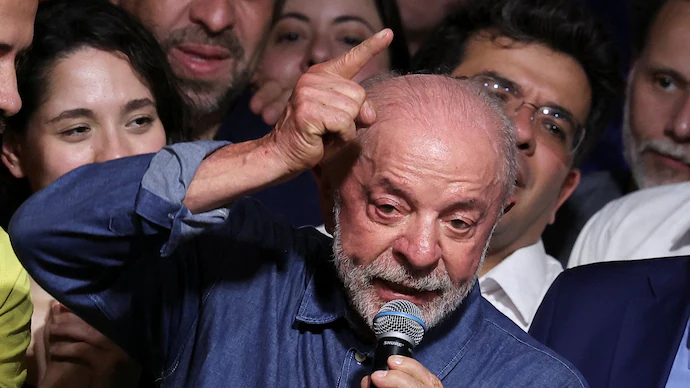
Brazilian President Luiz Inácio Lula da Silva has delivered a pointed message to Washington after securing a historic fourth term, declaring that Brazil is “no one’s backyard” as he pledged to defend the country’s sovereignty and democratic institutions.
Lula’s victory, confirmed by Brazil’s electoral court, came after a runoff against Senator Flávio Bolsonaro, the eldest son of former president Jair Bolsonaro. The result gives the 80-year-old leader another term in office but also sets the stage for a difficult political period, with Bolsonaro’s camp rejecting the outcome, a conservative Congress holding substantial influence and economic pressures threatening to constrain government spending.
The election has broader implications for relations between Brasília and Washington. US President Donald Trump’s administration had supported efforts to bring the Bolsonaro family back to power, making Lula’s continued leadership a setback for those seeking a political shift in Brazil.
At the centre of Lula’s message is a promise to protect Brazil’s independence from foreign interference, including what he described as attempts to influence the electoral process through digital platforms.
Lula Says Brazil Will Not Accept Foreign Interference
Following his victory, Lula emphasised that Brazil would determine its own political future and that his administration would work to safeguard national sovereignty and democracy.
His declaration that Brazil was “no one’s backyard” underscored his opposition to outside influence over the country’s domestic affairs. The remark also set a confrontational tone for his relationship with Trump’s administration, amid wider political divisions across Latin America.
Lula argued that digital platforms had become part of the debate over foreign intervention and called for their regulation. He presented the election result as evidence that voters could be persuaded to defend democratic participation despite the challenges surrounding the campaign.
“We managed to convince people that voting was extremely important to safeguard democracy in Brazil,” Lula said after his victory.
His comments place digital regulation and electoral integrity among the issues likely to feature in the new administration’s agenda. However, the claim that foreign actors interfered through online platforms was Lula’s assessment; the supplied account does not detail specific operations or establish the extent of any such interference.
The president also pledged to govern for all 215 million Brazilians, signalling an intention to reach beyond his electoral base. He said he would work with the conservative Congress elected by voters and seek to increase public participation in government decision-making.
That approach will be important as Lula attempts to turn his electoral mandate into legislation. Winning the presidency does not automatically give his administration control over the legislature, where conservative parties and Bolsonaro’s allies are expected to retain considerable influence.
Flávio Bolsonaro Rejects the Result and Seeks Annulment
Flávio Bolsonaro refused to accept Lula’s victory and said he would ask authorities to annul the election. His challenge centres on a Supreme Court ruling that extended voting hours by two hours on election day.
“It is impossible to acknowledge the election results,” the senator said, indicating that his campaign would contest the outcome.
The extension became a central argument in Bolsonaro’s challenge. However, the supplied account notes that Bolsonaro’s own campaign had also sought an extension because heavy rain affected southern Brazil. That detail complicates the campaign’s objection to the change in voting hours.
Analysts considered an annulment unlikely, pointing to the scale of Lula’s victory. Lula defeated Bolsonaro by more than four million votes in the runoff, overturning the first-round advantage held by the senator.
The dispute raises the prospect of renewed political tensions in the days following the vote. Mario Braga, a Latin America analyst at risk consultancy RANE, said right-wing protests could emerge in the coming days but assessed that reversing the result was highly unlikely.
Any challenge to the result will depend on the relevant authorities and the arguments presented through the formal process. Bolsonaro’s rejection of the outcome, by itself, does not invalidate the electoral court’s confirmation of Lula’s victory.
The dispute also recalls Brazil’s previous presidential election. In 2022, former president Jair Bolsonaro refused to accept his defeat to Lula. The former president was later sentenced to 27 years in prison for plotting a coup to remain in power, according to the supplied account.
The latest rejection of an election result therefore comes against a backdrop of recent disputes over the transfer of political power in Brazil. Whether the new challenge develops into sustained demonstrations or a prolonged legal battle remains to be seen.
Lula’s Political Comeback and the Message to Washington
Lula’s latest victory marks another chapter in a political career shaped by electoral success, legal controversy and a return to power. The 80-year-old president was imprisoned from 2018 to 2019 on corruption charges that were later overturned. He returned to the presidency after defeating Jair Bolsonaro in 2022.
His fourth-term victory comes as parts of Latin America have shifted towards right-wing governments, creating a region in which leaders hold different views on economic policy, social welfare, environmental protection and relations with the United States.
During the campaign, Lula accused Bolsonaro’s camp of threatening Brazil’s sovereignty. He also warned against policies that, in his view, could weaken social welfare programmes and reverse gains in poverty reduction and environmental protection.
These issues are central to the political divide between Lula and the Bolsonaro family. Lula has emphasised the role of social programmes and the protection of environmental gains, while his opponents have challenged his political approach. The election result means that these disagreements will continue to shape Brazil’s domestic debate.
The outcome is also a setback for Trump, whose administration had supported efforts to return the Bolsonaro family to power. Lula’s continued presidency could provide a counterweight to Washington’s influence in the region, although the precise direction of US-Brazil relations will depend on decisions made by both governments.
Celso Amorim, a former foreign minister under Lula, told Reuters that the Brazilian president would be important in establishing a balance in Latin America.
For Lula, asserting sovereignty is not only a message to the United States. It also speaks to his domestic political base, which he has asked to view the election as a defence of Brazil’s democratic institutions. The challenge will be to translate that message into practical policy while managing relations with foreign governments and institutions.
His government will also need to distinguish between defending legitimate national interests and maintaining working relationships with major economic and diplomatic partners. A firm public stance on sovereignty does not remove the need for cooperation on trade, investment and regional issues.
Conservative Congress Could Limit Lula’s Agenda
Despite securing another presidential term, Lula faces a significant legislative obstacle. Brazil has elected its most conservative Congress since the country returned to democracy in the 1980s, with Bolsonaro’s Liberal Party and its allies expected to exercise substantial influence in both houses.
The composition of Congress could make it harder for the president to pass legislation, secure support for policy changes and maintain control over budget decisions. Even with a clear electoral mandate, the administration will need to negotiate with lawmakers whose priorities may differ from its own.
This creates a central tension for Lula’s fourth term. He has promised to protect social programmes and expand public participation in decision-making, but delivering on those commitments may require compromises with conservative legislators.
Budget negotiations could prove particularly important. Social spending, government investment and fiscal restraint often compete for limited public resources. A legislature with substantial conservative representation could demand changes to the administration’s spending priorities or resist proposals it considers too costly.
Lula’s pledge to work with Congress suggests that negotiation will be a necessary part of his governing strategy. The practical test will be whether he can build support across party lines without abandoning the policies that helped define his campaign.
Economic Pressures Add to the Challenge
Brazil’s economic outlook presents another constraint for the incoming administration. The government forecasts economic growth of 2.3% next year, while public debt has risen above 82% of gross domestic product, according to the supplied figures.
High interest rates, household debt and pressure to contain public spending are expected to weigh on the government. These factors could narrow the room available for new initiatives, even as Lula seeks to preserve social programmes and support economic activity.
Slower growth can complicate efforts to increase public revenue, while high borrowing costs can put pressure on households and businesses. Meanwhile, a high public-debt burden can intensify debate over how much the government should spend and which programmes should receive priority.
The figures do not, on their own, determine the course of Brazil’s economy during Lula’s fourth term. Actual performance will depend on a range of factors, including policy decisions, investment, borrowing costs and developments in domestic and international markets.
Nevertheless, the combination of fiscal pressure and a conservative Congress means that economic policy is likely to require difficult negotiations. Lula will need to demonstrate how his government intends to protect social priorities while addressing concerns about public finances.
What Lula’s Fourth Term Means for Brazil
Lula’s victory secures another term in office, but the election has not resolved Brazil’s political divisions. Flávio Bolsonaro’s refusal to accept the result has introduced the prospect of legal challenges and demonstrations, while the conservative balance in Congress could complicate the president’s legislative plans.
Internationally, Lula’s declaration that Brazil is “no one’s backyard” signals that national sovereignty will remain a prominent part of his political message. His position could shape relations with Trump’s administration and reinforce his role in regional debates about the balance of influence in Latin America.
At home, the administration faces a more immediate test: turning its promises into policies that can pass through Congress and be funded under economic constraints. Protecting social programmes, managing public debt and maintaining democratic participation will require decisions that may not always be politically straightforward.
The election result gives Lula a renewed mandate, but it does not remove the obstacles ahead. His ability to govern will depend on how he responds to the challenge from Bolsonaro’s camp, negotiates with a conservative legislature and balances his domestic priorities with Brazil’s economic and diplomatic interests.
For now, Lula’s message is clear: Brazil intends to chart its own course. Whether that ambition translates into lasting political stability and policy progress will depend on what his government can achieve during its fourth term.
For breaking news and live news updates, like us on Facebook or follow us on Twitter and Instagram. Read more on Latest World on thefoxdaily.com.



COMMENTS 0