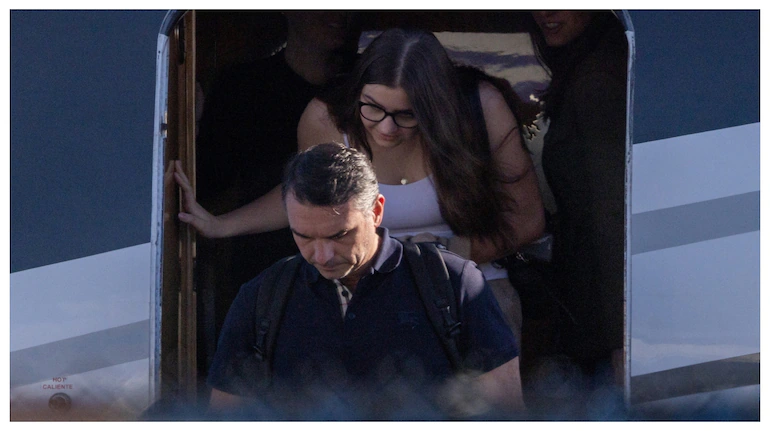
Flávio Bolsonaro, the Brazilian senator who lost the October 25 presidential runoff to incumbent Luiz Inácio Lula da Silva, has spoken publicly about his departure from Brazil, describing himself as a victim of political persecution. In an Instagram livestream, he said he travelled to the United States because he believed pressure from Brazilian authorities was escalating and that remaining in the country could expose him to further legal action.
Bolsonaro left Brazil on October 27, two days after the election, and arrived in Florida the following day with his wife and two daughters. His departure came amid an investigation involving alleged financial misconduct and a judicial order concerning his passports. He has denied wrongdoing and has portrayed the legal scrutiny as politically motivated.
During the livestream, Bolsonaro said the developments had happened sooner than he expected. He claimed that police informed him on October 26 that his Brazilian passports were being revoked or that he was required to surrender them, as he was returning from a visit to his father, former president Jair Bolsonaro.
He presented the notification as the decisive moment behind his decision to leave. According to his account, he spoke to his father about the situation and understood that the legal pressure could intensify.
Recalling the exchange, Flávio said his father had tears in his eyes and asked him: “You know where they’re going with this, don’t you?”
He said he replied: “Dad, I know… Now I know what I have to do.”
The senator did not provide documentary details of the passport decision during the livestream. Reports about the case have described an order requiring him to surrender his travel documents. The distinction matters because a requirement to hand over passports and a completed cancellation are not necessarily the same legal step.
How Flávio Bolsonaro travelled to the United States
Bolsonaro did not explain in detail how he crossed Brazil’s borders or arranged the journey. He said the decision to leave had been made privately with his wife and that “without anyone knowing” was central to the way they organised their departure. He also urged supporters not to accuse or blame other people for helping him.
Although he avoided discussing the arrangements, reporting on his journey has provided a broader outline. According to accounts cited by Brazilian and international media, Bolsonaro and his family travelled overland to Argentina before boarding a private aircraft. The flight made a stop in Guayaquil, Ecuador, before reaching Miami, Florida.
The route has drawn attention because the senator was facing a judicial process involving his passports. However, the publicly reported travel details do not by themselves establish who organised or financed the journey, or whether any individual helped him avoid a legal restriction. Bolsonaro did not identify anyone involved during his livestream.
His arrival in the United States followed confirmation from a senior US State Department official that the family would receive visas. The development also placed the senator in the same country as his brother Eduardo Bolsonaro, a former Brazilian lawmaker who has been living in the United States and has maintained relationships with figures in President Donald Trump’s political circle.
Bolsonaro’s departure has therefore become more than a personal decision to relocate after an election defeat. It has raised questions about the relationship between Brazil’s judicial authorities, the Bolsonaro family and political contacts in Washington, particularly as the investigation and the senator’s claims of persecution continue to attract attention.
Money-laundering investigation and allegations against the senator
The passport dispute is connected to a wider investigation into Flávio Bolsonaro’s financial relationships. Reports have linked the inquiry to alleged financial misconduct and possible money laundering. The investigation has examined connections involving a banker accused of financial irregularities and a person suspected of involvement in money laundering connected to Brazil’s betting industry.
These are allegations under investigation, not findings that establish the senator’s guilt. Bolsonaro has rejected accusations against him and has argued that the proceedings are being used to target him politically. His livestream did not provide a detailed legal response to the evidence or explain the specific transactions at the centre of the investigation.
The distinction between an investigation and a conviction is important in assessing the political dispute. Brazilian authorities can investigate suspected financial crimes and seek judicial measures, while the people under investigation retain the right to challenge the allegations through the legal process. Whether the case supports the senator’s claims of persecution is a separate question that cannot be settled by his public statements alone.
His departure also does not automatically bring the investigation to an end. Legal proceedings in Brazil can continue even when a person under investigation is outside the country. The practical consequences will depend on the court orders in force, the status of the inquiry and any steps taken by Brazilian authorities in response to his departure.
Jair Bolsonaro remains under house arrest
Flávio’s account of the conversation with his father has added a personal dimension to the family’s legal and political difficulties. Jair Bolsonaro, who served as Brazil’s president from 2019 to 2022, is under house arrest while serving a prison sentence following his conviction over an attempt to overturn the 2022 election result.
The former president has remained a central figure in Brazil’s conservative movement, even as legal cases have limited his political activities. His supporters have continued to describe the proceedings against him as politically driven, while Brazilian authorities and courts have defended the legal process. Flávio’s comments suggest that his father’s legal situation influenced the family’s assessment of the risks he faced after the election.
The Bolsonaro family has also maintained links with political figures outside Brazil. Eduardo Bolsonaro, Flávio’s brother and a former federal lawmaker, has been based in the United States. His contacts with Trump-aligned figures have made the family’s US connections a recurring subject of scrutiny in the broader dispute between the two countries.
Trump has previously criticised Brazilian proceedings involving Jair Bolsonaro and has made claims that Brazil’s election process was unfair. Those statements have added an international dimension to a dispute that is primarily being handled through Brazil’s electoral and judicial institutions.
Flávio Bolsonaro questions the presidential runoff
Alongside explaining his departure, Flávio Bolsonaro questioned the legitimacy of the presidential runoff, suggesting that irregularities had taken place. He compared the alleged incidents to goals in handball that should have been disallowed by the video assistant referee, or VAR, but were allowed to stand.
He did not identify specific polling stations, describe particular incidents or present evidence during the livestream to substantiate the comparison. His comments therefore amounted to an allegation rather than a documented demonstration that the election result had been affected by irregularities.
The official result announced by Brazil’s Superior Electoral Court, known as the TSE, gave Lula 51.79 per cent of valid votes, or 64,256,232 ballots. Flávio Bolsonaro received 48.21 per cent, equivalent to 59,826,041 votes. Lula’s margin was approximately 4.43 million votes.
The result followed a closely contested first round on October 4, when Flávio finished ahead of Lula but neither candidate secured the majority of valid votes required to avoid a runoff. The second round on October 25 produced a reversal, with Lula gaining enough support to win a fourth, non-consecutive presidential term.
Brazil’s electoral authority declared Lula the winner after the count was completed. Any formal challenge to the result would need to proceed through the country’s legal and electoral mechanisms and be supported by evidence. Broad claims of irregularities, without specific details or substantiation, do not independently establish that the vote was fraudulent.
Lula’s victory and the political divide in Brazil
The runoff result reflected a deeply competitive political environment. Lula, a former president who returned to office in 2023, secured another term after defeating Flávio Bolsonaro, the son of the conservative former president. The election was closely watched because it brought the political forces associated with the two men into direct competition.
Flávio’s campaign represented a continuation of the Bolsonaro family’s influence in national politics. His candidacy drew support from voters who backed his father’s political movement, while Lula’s campaign sought to consolidate support among voters who favoured his administration and opposed a return of the Bolsonaro political camp.
The final margin showed that Flávio retained substantial electoral support despite losing the runoff. His nearly 60 million votes provide a significant political base from which he can continue to operate as an opposition figure. At the same time, the official result gives Lula the mandate to begin another term, with the transfer of power scheduled for January 2027.
The election dispute is likely to remain part of Brazil’s political debate. Flávio’s refusal to accept the result and his suggestions of irregularities could sustain criticism of the electoral process among his supporters. However, political disagreement with the outcome and proof of wrongdoing in the voting process are different matters.
Bolsonaro predicts economic trouble under Lula
During the livestream, Flávio Bolsonaro also made a prediction about Brazil’s economic future, saying the economy would “go bust” under Lula’s presidency. He did not set out a detailed economic forecast or identify specific indicators that would support the prediction.
The remark signals that the senator intends to challenge the incoming administration on economic policy as well as on questions surrounding the election and the legal cases involving his family. Brazil faces policy choices involving public finances, inflation, employment, investment and economic growth, but the outcome of those issues will depend on decisions taken by the government and wider domestic and international conditions.
Lula’s new term will begin against the background of a divided electorate and a strong opposition presence. The administration will need to govern after a close election, while opposition politicians will have opportunities to scrutinise its budget decisions, economic priorities and public policies through Congress and other democratic institutions.
Flávio signals he could seek the presidency again
Flávio Bolsonaro also indicated that his political ambitions extend beyond the immediate aftermath of the election. He suggested that he was prepared to contest the presidency again, but did not commit to waiting until the next scheduled presidential election in 2030.
“I’m not talking about 2030, I’m talking about before then,” he said.
The statement leaves open what political route he has in mind. It could refer to a future electoral contest, a change in the political circumstances or a possible challenge to the current election result through legal channels. He did not provide a timetable or explain what specific event could lead to an election before 2030.
Brazil’s electoral calendar and constitutional rules determine when presidential elections take place and under what circumstances an early vote can be called. A political figure’s stated willingness to run again does not, on its own, create a legal basis for an early election. Any change to the timetable would have to follow the country’s constitutional and electoral procedures.
For now, Flávio’s immediate position is that of a defeated presidential candidate living in the United States while facing scrutiny in Brazil. His public comments have combined allegations of persecution, questions about the election and criticism of Lula’s economic outlook. The claims will remain politically significant, but their legal and factual consequences depend on evidence and decisions by the relevant Brazilian institutions.
What happens next?
Several issues will shape the next stage of the controversy: the status of the investigation into Flávio Bolsonaro’s financial relationships, the legal measures concerning his passports, and whether he or his political allies pursue formal challenges to the election result. His decision to remain in the United States may also affect how he participates in Brazilian politics and communicates with supporters.
The senator has not publicly explained the full arrangements behind his departure, and his livestream did not resolve the questions surrounding the passport order. Nor did he provide evidence for his suggestion that the runoff was affected by irregularities. These unanswered points are likely to remain central as the dispute develops.
His remarks nevertheless make clear that he does not intend to withdraw from political life after losing the presidency. By criticising Lula, questioning the election and leaving open the possibility of another presidential bid before 2030, Flávio Bolsonaro is positioning himself as a continuing opposition voice while the legal proceedings involving him and his family remain unresolved.
For breaking news and live news updates, like us on Facebook or follow us on Twitter and Instagram. Read more on Latest World on thefoxdaily.com.



COMMENTS 0