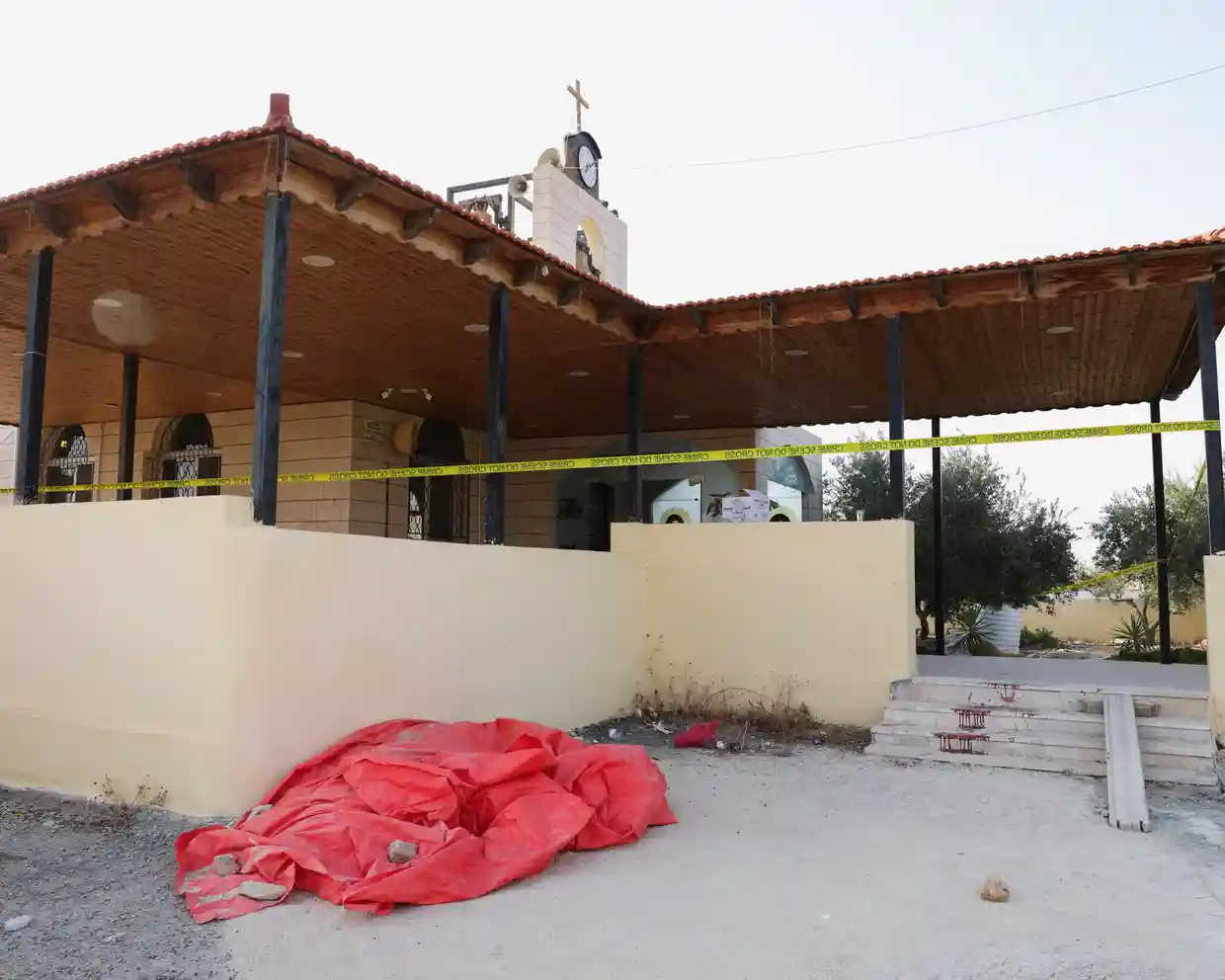
Eight people have been killed and 40 injured after gunmen opened fire during a funeral at St George’s Greek Orthodox Church in Hamoud, in Jordan’s Karak governorate, in a rare attack targeting a gathering at a place of worship. Jordanian authorities described the shooting as a terrorist act carried out by extremists, while investigations into the attackers and their possible connections were continuing.
The shooting took place on Friday, prompting a security response and renewed concern over extremist violence in the relatively stable Middle Eastern country. Jordan’s Interior Minister, Mazin Al Farrayeh, said it was too early to establish whether the attackers had links to known militant groups inside or outside the country.
Authorities had not reported an immediate claim of responsibility. The attack also prompted King Abdullah to visit Karak and issue a warning that those responsible would face severe consequences.
What Happened at the Greek Orthodox Church in Karak?
The attack occurred during a funeral at St George’s Greek Orthodox Church in Hamoud, within Karak governorate. According to witnesses, dozens of people were gathered for the funeral when the gunmen began firing, leaving people injured and triggering scenes of panic.
Jordan’s Public Security Directorate chief, Maj Gen Abdallah al-Maaytah, said most of those injured were receiving treatment and that security forces were continuing the search for the attackers. The country’s health minister put the number of injured at 40, while eight people were reported killed.
A video broadcast by Jordan’s state-owned Al-Mamlaka television station appeared to show three attackers approaching the church and firing from the pavement. The footage showed them taking cover behind trees and a low wall before running towards the church entrance.
Reuters reported that it verified the footage using the church’s entrance path, surrounding wall and other details. The video offered investigators material that could help reconstruct the sequence of events, although authorities had not publicly established all the circumstances surrounding the attack.
After the shooting, Reuters footage from the church showed blood smeared on the floor near the entrance, with security personnel deployed at the scene.
Witnesses Describe Panic and Chaos During the Shooting
People attending the funeral described a frightening scene as the gunmen opened fire on the gathering. Khaled Burqan, who was present at the funeral, told Al-Mamlaka that dozens of people were there and that the attackers fired for several minutes.
Another witness, Ihab Ammareen, described seeing injured people collapse on the floor. Recalling the immediate aftermath, he said: “People were crying, wailing, screaming – it’s hard to describe.”
The accounts highlighted the distress experienced by those attending the funeral, where people had gathered to mourn rather than attend a public or political event.
At a government hospital in Karak, people gathered to support the injured and expressed shock over the violence. Hani Al-Mbaydeen, who was outside the hospital, called for an investigation into the ideas and influences that could lead young people towards extremism.
His comments reflected wider concerns among people affected by the attack about how extremist beliefs develop and how authorities and communities can prevent them from leading to violence.
Jordan Calls the Shooting a Terrorist Attack
Jordanian authorities characterised the shooting as a terrorist act linked to extremist ideology. However, officials cautioned against drawing conclusions about the attackers’ affiliations before the investigation had established the facts.
Interior Minister Mazin Al Farrayeh said the perpetrators were extremists but added that it was too early to determine whether they had connections to known groups within Jordan or abroad.
Jordan’s Prime Minister, Jafar Hassan, condemned the attack in a post on X, attributing it to extremist ideology. “This is a result of a terrorist ideology and blind extremism and we will not allow society to go down this path,” he said.
The government’s response placed emphasis on preventing violence from dividing Jordanian society. Authorities had not announced a confirmed motive or identified a group that had claimed responsibility for the shooting in the information available at the time of the report.
The continuing investigation is expected to focus on identifying those involved, determining how the attack was organised and establishing whether any wider network supported the perpetrators.
King Abdullah Visits Karak and Vows a Strong Response
Jordan’s King Abdullah visited Karak within hours of the attack. The monarch, whose country is a close US partner in efforts to counter militant Islamist groups, condemned the violence and warned that those responsible would be punished.
In a statement, the king said the attack would be met with the harshest response and stressed the importance of national unity.
“The terrorist attack against Karak will be met with the harshest retaliation. Those who delude themselves into thinking they can divide Jordanians with their bullets have no chance in the face of our unity,” he said.
He also said the perpetrators would be punished “with an iron fist”. His remarks underscored the government’s determination to pursue those responsible while presenting national solidarity as a central response to the attack.
The investigation and the continuing search for the gunmen remained key priorities following the king’s visit.
Security Tightened Across Jordan After the Attack
Security measures were stepped up at shopping malls, foreign embassies and other locations across Jordan, according to the US embassy in Amman, which issued the information on Saturday.
The increased security presence reflected concern about the possibility of further threats while authorities investigated the shooting. The reported measures extended beyond the church where the attack took place, covering other public and diplomatic locations.
Jordan has generally been regarded as relatively stable despite the security challenges affecting parts of the wider region. Authorities in the United States have said that Jordanian officials have repeatedly foiled attempted attacks by Islamist militants in recent years.
The shooting was therefore notable not only because of its reported death toll but also because attacks of this nature are rare in the country. Nevertheless, the available information did not establish that the church attack was connected to any previously disrupted plot or known militant organisation.
Investigators will need to establish whether the perpetrators acted independently or had links to a wider extremist network. Until authorities release verified findings, the attackers’ affiliations and precise motivations remain unresolved.
UN Secretary-General Condemns Violence Against Civilians
United Nations Secretary-General António Guterres condemned the attack, saying violence against civilians and places of worship was unacceptable.
His statement placed the incident within a broader concern about attacks on religious gatherings and civilian spaces. Places of worship often serve as important centres of community life, making attacks against them especially distressing for the people who rely on them.
The US ambassador to the United Nations, Mike Waltz, also condemned the shooting, describing it on X as a “depraved and brutal attack on a house of worship”.
The condemnations came as Jordan continued its investigation and increased security around selected locations. No immediate claim of responsibility had emerged in the report, leaving officials to establish who carried out the attack and why the church funeral was targeted.
Jordan’s Christian Community and the Significance of the Attack
Christians make up a minority of Jordan’s population, and the country is home to several biblical sites that attract Christian pilgrims from around the world. Christian communities have a presence in Jordan’s religious and social life, making the attack at a Greek Orthodox church a significant event for the wider population.
The shooting took place during a funeral, a gathering associated with mourning and community support. The attack consequently affected not only those killed or injured but also the families and others who had come to pay their respects.
Authorities had described the incident as an extremist terrorist attack, but the information available did not conclusively establish whether the church was selected because of its religious identity or for another reason. The distinction matters as investigators work to determine the motive without assuming facts that have not been verified.
The attack also comes against a backdrop of regional instability. The report noted that Jordan was among the US allies in the region affected by Iranian attacks earlier in the year, following US and Israeli strikes against Iran in February. However, no evidence presented in the report linked those regional developments to the shooting in Karak.
What Investigators Need to Establish
Several key questions remained unanswered following the attack. Authorities were still searching for the gunmen, and officials had not confirmed whether they belonged to a known extremist organisation or received support from people elsewhere.
The investigation will need to establish the identities of the attackers, their movements before and after the shooting, the weapons used and whether the attack involved additional participants. Investigators may also examine the available security-camera footage and witness accounts to reconstruct the incident.
Another central question is whether the attack was motivated by hostility towards Christians or the church, or whether other factors contributed to the choice of target. Although officials characterised the perpetrators as extremists, the precise motive had not been established in the reported information.
Authorities will also need to determine whether the shooting was an isolated act or part of a wider plan. Any conclusions about links to militant groups should depend on evidence gathered during the investigation rather than speculation.
Outlook: Investigation Continues After Deadly Church Shooting
The killing of eight people and the injury of 40 others at St George’s Greek Orthodox Church has prompted a major security response in Jordan. The government has condemned the shooting as a terrorist act, the king has vowed a forceful response, and security has been tightened at selected locations across the country.
At the same time, important questions remain about the perpetrators, their affiliations and their motives. Officials have said it is too early to determine whether the attackers were connected to known groups, and no immediate claim of responsibility was reported.
For the families of those killed and injured, the immediate priority remains the impact of the violence and the recovery of those receiving treatment. For Jordanian authorities, the focus is on locating the attackers, establishing the facts and preventing further violence.
The investigation’s findings will be crucial to understanding how the attack occurred and whether it signals a broader security threat. Until those findings are confirmed, the incident stands as a deadly assault on a funeral gathering that has shocked the local community and drawn condemnation from Jordanian and international leaders.
For breaking news and live news updates, like us on Facebook or follow us on Twitter and Instagram. Read more on Latest World on thefoxdaily.com.

COMMENTS 0