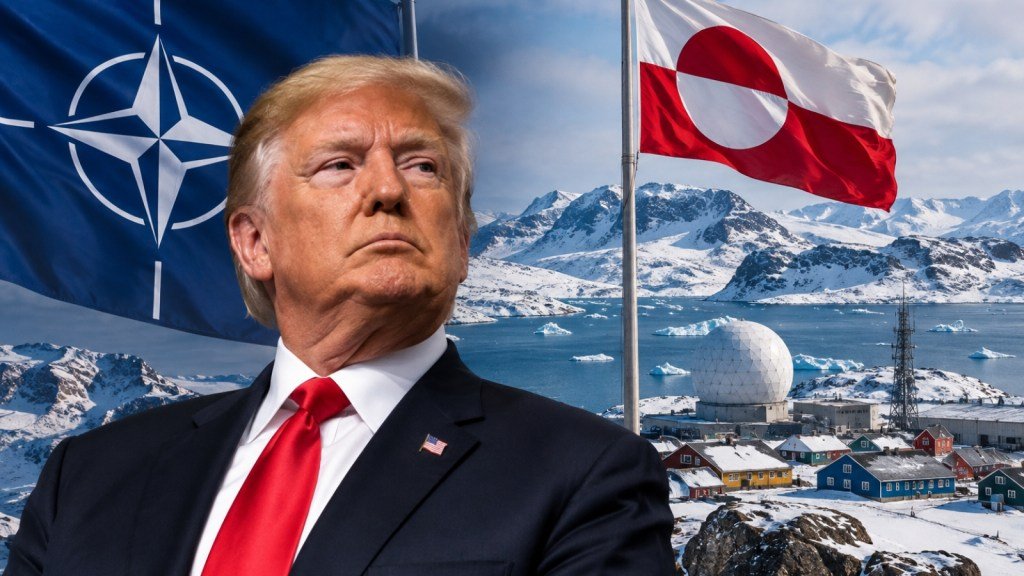
President Donald Trump has spent months questioning the value of NATO and even publicly raised the possibility of withdrawing the United States from the alliance. Yet a new agreement signed with Denmark and Greenland points in a different direction, expanding the US military presence on the strategically important Arctic island while explicitly connecting its security to NATO.
Trump, Danish Prime Minister Mette Frederiksen and Greenland Prime Minister Jens-Frederik Nielsen signed the agreement at the United Nations General Assembly in New York on September 22. The pact does not transfer Greenland to the United States or change Danish sovereignty over the island. Instead, it gives Washington broader military access and allows for the establishment of additional US defence areas.
The arrangement creates an unusual contrast in Trump’s foreign policy. Earlier in the year, he described NATO as a “paper tiger” and said he was considering withdrawing the United States from the alliance. Five months later, his administration has negotiated a security agreement with a NATO ally that places Greenland’s defence within the alliance’s broader security structure.
The contradiction does not necessarily settle the question of whether Trump intends to remain in NATO. But it illustrates the difficulty of separating US military interests in the Arctic from the alliance that has helped define the security architecture of the North Atlantic for decades.
Trump’s earlier threat to leave NATO
Trump’s latest Greenland agreement comes after particularly strong criticism of NATO.
On April 1, Trump told Reuters that he was considering withdrawing the United States from NATO. When asked directly whether he was thinking about pulling the country out of the alliance, Trump responded that he was considering it and said he would discuss his dissatisfaction with NATO in an address to Americans.
His frustration was linked in part to disagreements with European NATO members over their response to the conflict surrounding the Strait of Hormuz. Trump had wanted European allies to contribute to efforts to reopen the strategic waterway, while European governments did not agree to the US request in the form Washington sought.
The comments also came shortly after then-US Defence Secretary Pete Hegseth declined to reaffirm the United States’ commitment to NATO’s collective-defence principle, adding to uncertainty surrounding Washington’s long-term position within the alliance.
However, the threat did not result in an immediate US withdrawal. Instead, Washington continued reviewing its military posture in Europe, including the possibility of reducing the number of American troops stationed on the continent.
The United States has roughly 80,000 troops in Europe, and one option reportedly under consideration involved withdrawing as many as 25,000. No final decision had been made on such a reduction in the material provided.
Then came the Greenland security agreement
The Greenland dispute itself predates Trump’s latest NATO controversy.
Trump first expressed interest in purchasing Greenland in 2019, during his first presidency. The idea was rejected by Denmark and Greenland, where officials emphasized that the island was not for sale.
In December 2024, Trump again described American control of Greenland as an important strategic objective. Greenland’s then-prime minister, Múte Bourup Egede, responded that Greenland was not for sale and would never be for sale.
Trump subsequently refused to rule out the use of military force to obtain control of the island, a position that generated concern in Denmark and Greenland and became an important issue in relations between Washington and Copenhagen.
The September 22 agreement represents a fundamentally different arrangement. Rather than transferring sovereignty, it expands American military access while maintaining Danish sovereignty and recognizing Greenland’s right to self-determination.
That distinction is central to understanding what the deal actually accomplishes.
What the new Greenland deal gives the United States
The agreement allows the United States to establish two additional defence areas in Greenland, at Narsarsuaq in the south and Mestersvig in the east.
Narsarsuaq has a history as a US military installation dating back to the Cold War. Mestersvig, meanwhile, is associated with Denmark’s Sirius Dog Sled Patrol, which operates in Greenland’s remote northeastern territory.
The agreement also provides Washington with expanded opportunities to conduct activities at Pituffik Space Base, the existing US installation in northwestern Greenland.
Trump said the United States would begin developing a larger military presence in appropriate locations and referred to the possibility of building two major military bases. However, the agreement does not establish specific troop numbers or provide a fixed timetable for construction.
The military access covered by the pact extends beyond individual installations. The United States will have broader access across Greenland, including provisions involving overflight, landing and undersea access.
Those arrangements give Washington additional options for operating in a region that has become increasingly important for military surveillance, missile warning, space-related activity and North Atlantic security.
Greenland remains under Danish sovereignty
Despite Trump’s previous statements about acquiring Greenland, the new agreement does not make the island part of the United States.
Greenland remains within the Kingdom of Denmark, while the agreement recognizes Greenland’s right to self-determination. The arrangement therefore expands US military access without resolving the underlying political question of Greenland’s constitutional relationship with Denmark.
That distinction was emphasized by Greenlandic and Danish leaders following the signing.
Nielsen said the agreement recognizes Greenland as a people with the right to self-determination while also recognizing its role in the shared security of the Arctic. He also said maintaining a strong NATO presence in the Arctic was important.
Frederiksen similarly described the agreement as strengthening Arctic and North Atlantic security while respecting Danish sovereignty and Greenland’s right to determine its future.
The language is important because the agreement attempts to address two objectives at the same time: expanding American military capabilities in Greenland and maintaining the political status of the island.
Why NATO is central to the Greenland agreement
Greenland’s strategic position makes its defence closely connected to the wider security of the North Atlantic.
The island sits between North America and Europe, making it an important geographic point for monitoring approaches between the two regions. Its location also gives it significance for missile warning, surveillance and space operations.
Denmark’s government has described the new agreement as being deeply rooted in NATO. That language places the expanded American military presence within an alliance framework rather than presenting it as a purely bilateral US-Danish military arrangement.
The agreement also includes restrictions on non-NATO countries establishing military installations or maintaining a persistent military presence in Greenland. It states that countries outside NATO will not be permitted to establish manned or unmanned military installations on the island or maintain a persistent military presence there.
That provision reflects the strategic importance of Greenland at a time when Arctic competition has become increasingly significant for major powers.
What happens if the US reduces its Greenland presence?
The current agreement is designed to expand the US role rather than reduce it. There is no current decision to withdraw American troops from Greenland.
But the broader question about Trump’s relationship with NATO creates a hypothetical issue: what would happen if Washington eventually decided to reduce its military presence in Greenland?
The agreement has no fixed end date and cannot simply be terminated unilaterally. Changes require mutual consent.
A reduction in US forces would therefore create a practical security question rather than automatically ending the agreement. Denmark and other NATO members would have to consider whether additional personnel, infrastructure or capabilities were needed to compensate for any American reduction.
The issue would be particularly important at Pituffik Space Base because of its role in surveillance, missile warning and space-related activities.
NATO itself could not simply replace every American capability overnight. The alliance coordinates the national militaries of its members; it does not operate as a single military force capable of automatically taking over every US installation or mission.
Could Trump actually withdraw the US from NATO?
Trump’s April comments raised a separate legal and political question about the authority to withdraw the United States from NATO.
Under the NATO treaty, Article 13 establishes a formal withdrawal process. A member can leave the alliance one year after giving formal notice to the other parties.
US law, however, places additional restrictions on presidential authority to withdraw the United States from NATO. The statute cited in the supplied material, 22 USC §1928f, provides that the president cannot withdraw the United States from the North Atlantic Treaty without either the Senate’s advice and consent, with two-thirds of senators present concurring, or an Act of congress.
That creates a potential separation-of-powers dispute if a president attempts to withdraw without congressional approval.
Trump has previously argued that he does not need Congress to make such a decision. The legal question therefore involves not only the treaty itself but also the limits established by US law concerning presidential authority over the country’s participation in NATO.
Greenland exposes the strategic value of NATO
The Greenland agreement also demonstrates why NATO remains relevant to the Arctic even as Trump questions the alliance’s usefulness.
The United States has significant military interests in Greenland that are difficult to separate from the broader North Atlantic security environment. Denmark is a NATO member, and Greenland’s geographic position connects North American and European defence concerns.
By placing the agreement within the NATO framework, Washington can expand its military presence while working through an existing alliance structure with Denmark.
This is different from establishing an entirely separate US military arrangement independent of NATO.
For Denmark, the agreement provides an opportunity to strengthen the American military commitment to Greenland while retaining sovereignty. For Greenland, the pact recognizes self-determination while incorporating the island into a broader Arctic security framework.
For Washington, it provides greater access to a strategically important part of the Arctic without requiring a transfer of sovereignty.
The contradiction between Trump’s NATO rhetoric and Greenland policy
The central tension is therefore straightforward.
Trump has questioned whether NATO provides enough value to the United States and has called the alliance a “paper tiger.” He has also expressed frustration with European allies over their willingness to support American military objectives.
Yet the Greenland agreement relies on precisely the kind of alliance relationship Trump has criticized.
Denmark is a NATO member. Greenland’s defence is being addressed through a pact described by Copenhagen as deeply rooted in NATO. The agreement restricts non-NATO military activity on the island while expanding the role of the United States, NATO’s largest military power.
That does not necessarily mean Trump’s administration has abandoned its concerns about NATO. It does, however, demonstrate that the United States continues to see value in using the alliance framework for specific strategic objectives.
The Arctic is becoming more important to US security policy
The Greenland agreement also reflects the growing strategic importance of the Arctic.
The region has become increasingly important because of its geography, military access, natural resources, shipping routes and proximity to North America, Europe and Russia.
Greenland’s position makes it particularly relevant to monitoring the North Atlantic and the approaches between North America and Europe. Its large geographic area and remote location also provide opportunities for military and space-related infrastructure.
That helps explain why Washington has maintained a military presence on the island for decades, even though the size of that presence has changed substantially since the Cold War.
At its peak, the US military operated across numerous installations in Greenland with thousands of personnel. Today, the American presence at Pituffik is far smaller, with roughly 200 personnel cited in the supplied material.
The new agreement could therefore represent a shift toward expanding capabilities again, although the precise size and timetable of any new deployment remain unspecified.
What the Greenland deal does not resolve
The September agreement does not answer the larger question of America’s future relationship with NATO.
It does not prevent Trump from continuing to criticize the alliance, reviewing US troop deployments in Europe or seeking changes in how NATO members contribute to collective defence.
It also does not establish that the United States will remain in NATO indefinitely. A formal withdrawal would involve the treaty’s procedures as well as the restrictions imposed by US law.
What the pact does demonstrate is that American military strategy in the Arctic currently remains closely connected to NATO and to Denmark’s role within the alliance.
That makes Greenland an important test case for the tension between Trump’s broader criticism of NATO and the practical military advantages Washington receives from cooperation with NATO allies.
Trump’s NATO dilemma is now tied to Greenland
The new Greenland security agreement does not end the debate over Trump’s NATO policy. Instead, it makes the question more complicated.
In April, Trump openly discussed the possibility of withdrawing the United States from NATO and described his dissatisfaction with the alliance. In September, his administration signed an agreement with Denmark and Greenland that expands the American military role in Greenland while explicitly connecting the island’s security to NATO.
The two positions can coexist in the short term because criticizing NATO does not necessarily mean abandoning every military arrangement involving its members. But the Greenland deal highlights how deeply US strategic interests in the Arctic are intertwined with the alliance.
For Greenland, the agreement maintains Danish sovereignty and recognizes its right to self-determination while allowing a greater US military role. For Denmark, it strengthens cooperation with Washington in an increasingly important Arctic security environment. For the United States, it expands access to strategically valuable territory without requiring a change in sovereignty.
The larger question is what happens to that arrangement if Trump’s NATO policy changes further.
As long as the United States remains committed to its current role, the Greenland pact provides a framework for deeper military cooperation. If Washington eventually moves toward a substantial withdrawal from NATO or a major reduction in its European and Arctic presence, the agreement could become part of a much broader debate about who would provide the capabilities currently supplied by the United States.
For now, the Greenland deal represents a clear expansion of US military access in the Arctic. At the same time, it underscores an unresolved contradiction at the heart of Trump’s foreign policy: the president has questioned the value of NATO while relying on a NATO-centered security framework to strengthen America’s position in one of the world’s most strategically important regions.
For breaking news and live news updates, like us on Facebook or follow us on Twitter and Instagram. Read more on Latest World on thefoxdaily.com.





COMMENTS 0