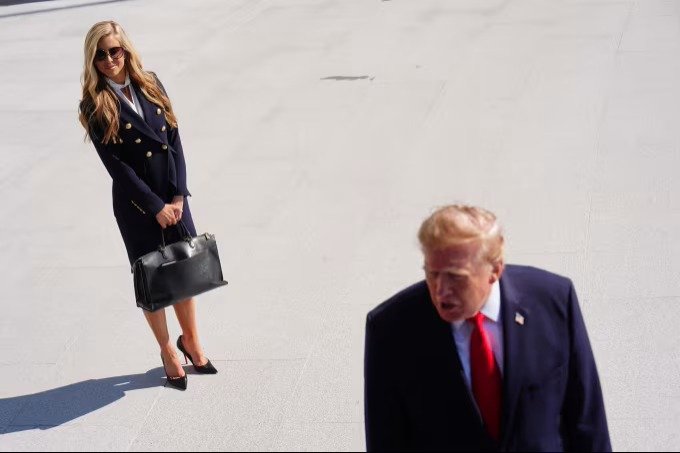
The short tenure of Katie Zacharia as White House press secretary has raised questions about how women are treated within Donald Trump’s administration, particularly when they are perceived to have made mistakes. In an episode of Guardian Australia’s US Politics podcast, Decoding America, co-hosts Jonathan Yerushalmy and Reged Ahmad examine Zacharia’s departure and compare the treatment of women in Trump’s team with the way male officials appear to navigate political and communication setbacks.
The discussion focuses on a broader question about accountability inside the Trump administration: are women more likely than men to face consequences when their public performances or decisions attract criticism? The episode explores this issue through Zacharia’s brief time in the press secretary role and a wider pattern identified by the podcast’s hosts.
Why did Katie Zacharia’s White House tenure end so quickly?
Zacharia’s appointment as White House press secretary ended after just five days, making her the shortest-serving person to hold the position. She took over following Karoline Leavitt’s departure but quickly came under scrutiny after her first appearance in the White House briefing room.
Her debut briefing on October 13, 2026, lasted approximately 14 minutes. She delivered prepared remarks praising Donald Trump’s administration and answered questions from just three media outlets. Her presentation attracted criticism, with observers questioning her delivery and the limited scope of the exchange.
Questions about her professional background also became a source of controversy. Zacharia faced scrutiny over her legal credentials, including her description of herself as a lawyer. The issue added to the attention surrounding her brief time in the role.
Subsequent television interviews did little to reverse the negative reaction. Her departure was confirmed on October 16, bringing an abrupt end to her appointment.
These events provide the immediate context for the Decoding America discussion. Zacharia’s exit was not simply a case of a new press secretary struggling in a demanding public-facing job; it also prompted questions about the standards applied to people appointed to prominent positions in Trump’s administration.
What is the podcast examining about Trump’s treatment of women?
In the episode, Guardian Australia journalists Jonathan Yerushalmy and Reged Ahmad look beyond the circumstances of Zacharia’s departure to consider a broader pattern involving women who have worked in Trump’s political orbit.
The central question is whether women in the administration face different consequences from men when their actions, public statements or professional performances attract criticism. The hosts examine how women are treated when they are perceived to have made mistakes and contrast that with the apparent ability of some male figures to survive comparable controversies.
This is a question about political accountability, workplace dynamics and the distribution of power within a presidential administration. It also raises the issue of whether public criticism is applied consistently, or whether expectations surrounding gender influence how political figures are judged.
However, the comparison requires care. A short tenure or a public controversy involving a woman does not, by itself, establish that gender was the reason for her departure. Assessing whether women are treated differently requires looking at the circumstances of individual cases, the explanations given for personnel decisions and how comparable situations involving men have been handled.
The podcast approaches Zacharia’s experience as part of a wider discussion rather than treating one appointment as conclusive proof of a systematic difference. Its focus is on examining the pattern and asking what it may reveal about the administration.
Why the White House press secretary role matters
The White House press secretary occupies a prominent position in the US political system. The job involves communicating the president’s positions, answering questions from journalists, explaining administration decisions and responding to breaking developments.
It is also a role in which public performance can quickly become a political issue. Briefings and television interviews are watched by journalists, political opponents, supporters and the wider public. An unclear answer, an apparent contradiction or an unsuccessful defence of administration policy can attract immediate scrutiny.
For a press secretary serving a president who frequently dominates the news cycle, the challenge can be especially demanding. The official must communicate the administration’s message while responding to questions that may involve contentious policies, controversies or unexpected developments.
The position therefore combines communication skills with political judgement and the ability to respond under pressure. A press secretary’s performance can influence how the administration’s message is received, even though the official is not solely responsible for the policies being defended.
Zacharia’s brief tenure illustrates how quickly the role can become a source of controversy. Her initial briefing and subsequent media appearances attracted scrutiny, while questions about her background added another dimension to the story.
Women in Trump’s administration: A wider pattern under scrutiny
The podcast’s discussion places Zacharia’s departure alongside a broader question about women who have held visible roles in Trump’s political world. The issue is not limited to the press secretary’s office: it concerns how female officials and public-facing figures are evaluated when they become embroiled in controversies or lose the confidence of influential people around the president.
Women in high-profile political positions often face scrutiny over both their professional decisions and how they present themselves publicly. The extent to which this scrutiny differs from that directed at male colleagues is a question that requires evidence from individual cases rather than assumptions about gender alone.
In Trump’s administration, where public loyalty to the president and the ability to communicate his agenda can be important features of a political appointment, personnel changes can also become tests of how the administration manages mistakes and controversy.
The comparison with male officials is central to the podcast’s framing. If men are allowed to remain in influential positions after public missteps while women are removed under similar circumstances, that could raise questions about unequal standards. Establishing such a pattern, however, requires examining the severity of the incidents, the responsibilities of the individuals involved and the reasons provided for decisions about their roles.
It is also important to distinguish between a documented personnel decision and an interpretation of the reasons behind it. An official’s departure may be confirmed, while the relative importance of performance, political relationships, public criticism and gender may remain open to debate.
What does Zacharia’s departure tell us about accountability?
Zacharia’s five-day tenure highlights the speed with which a high-profile appointment can unravel when a public debut attracts criticism and questions emerge about the appointee’s qualifications. It also illustrates the vulnerability of positions that depend on maintaining confidence within the administration while communicating effectively to an outside audience.
The broader question raised by Decoding America is whether the consequences of such controversies are applied consistently. Political administrations regularly face decisions about whether to retain officials after mistakes, but those decisions are not always explained in enough detail to establish a clear comparison between individuals.
For that reason, the treatment of women and men in similar positions is a useful subject for scrutiny. Comparing documented cases can help clarify whether officials face different consequences for comparable conduct or whether differences are better explained by their responsibilities, the nature of the controversy or the political circumstances surrounding it.
The podcast’s focus invites listeners to consider not only why Zacharia’s appointment ended so quickly, but also how the administration handles public failure, loyalty and accountability across its ranks.
How to listen to the Decoding America podcast
The episode features Guardian Australia’s US politics podcast co-hosts Jonathan Yerushalmy and Reged Ahmad. Their discussion centres on Zacharia’s record-short tenure as White House press secretary and the broader question of how women in Trump’s administration are treated when they are perceived to have made mistakes.
The episode also connects with two related Guardian reports: Enter the Zachbot: Trump’s new press secretary malfunctions on podium debut and All the president’s women: a familiar downward trajectory on Trump’s team. These reports provide additional context for the discussion about Zacharia’s debut and the treatment of women in Trump’s political circle.
Conclusion
Katie Zacharia’s departure after just five days as White House press secretary has become the starting point for a wider discussion about gender, political accountability and the treatment of officials in Donald Trump’s administration.
In Decoding America, Jonathan Yerushalmy and Reged Ahmad examine whether women who are perceived to have made mistakes face consequences that differ from those experienced by men. Zacharia’s brief tenure offers a case through which to explore that question, although a single departure cannot establish a broader pattern on its own.
The debate ultimately centres on how political administrations judge public performance, respond to controversy and decide who retains their position when mistakes attract attention. Comparing cases involving women and men, while accounting for the circumstances of each, is essential to understanding whether those standards are being applied consistently.
For breaking news and live news updates, like us on Facebook or follow us on Twitter and Instagram. Read more on Latest World on thefoxdaily.com.






COMMENTS 0