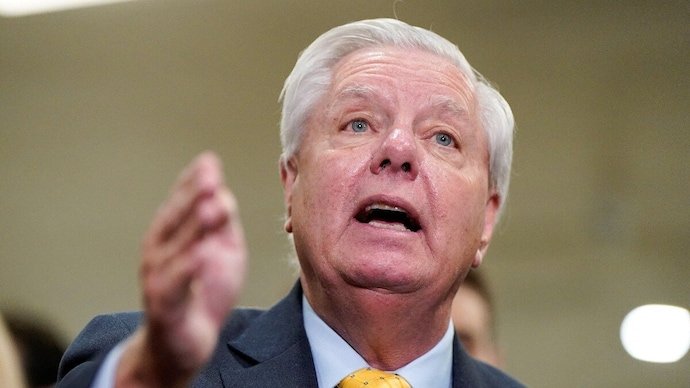
The possibility of Saudi Arabia formally recognising Israel has once again moved to the centre of global diplomacy after Republican Senator Lindsey Graham declared that Donald Trump should receive a Nobel Peace Prize if he succeeds in expanding the Abraham Accords.
Speaking during a television interview, Graham argued that a Saudi-Israel normalisation agreement would represent one of the most transformative geopolitical developments in modern Middle Eastern history.
His remarks came amid renewed diplomatic efforts involving the United States, Israel, Gulf nations, and regional security negotiations tied to Iran.
The comments also reflect a larger geopolitical reality: the Abraham Accords are no longer viewed simply as bilateral diplomatic agreements. They are increasingly seen as part of a broader restructuring of Middle East power dynamics.
At the centre of this evolving diplomatic chessboard lies one critical question: can Saudi Arabia and Israel eventually establish formal ties?
If that happens, analysts believe it could trigger a historic realignment affecting security, trade, technology, Energy Markets, regional alliances, and even the future of the Palestinian issue.
What Are the Abraham Accords?
The Abraham Accords are a series of diplomatic normalisation agreements brokered by the United States in 2020 between Israel and several Arab countries.
The accords initially included:
- United Arab Emirates
- Bahrain
- Morocco
- Sudan
These agreements marked a historic shift because several Arab nations officially recognised Israel without waiting for a final resolution to the Palestinian conflict.
For decades, much of the Arab world maintained that recognition of Israel would only come after the establishment of a Palestinian state.
The accords altered that long-standing diplomatic framework.
Supporters described them as a breakthrough for regional peace and economic integration, while critics argued they sidelined Palestinian concerns.
Why Saudi Arabia Is the Biggest Prize in Middle East Diplomacy
Saudi Arabia occupies a unique position in the Islamic and Arab world.
It is:
- The largest Arab economy
- The world’s leading oil exporter
- Home to Islam’s holiest cities
- A central strategic US ally
- A major regional counterweight to Iran
Because of this influence, any formal Saudi recognition of Israel would carry enormous symbolic and geopolitical significance.
Unlike smaller Gulf states, Saudi Arabia’s position shapes broader Arab and Muslim diplomatic sentiment.
Many analysts believe that if Riyadh normalises ties with Israel, several other Muslim-majority nations could eventually follow.
This is precisely why the issue has become one of the most strategically important diplomatic objectives in the region.
Why Lindsey Graham Linked Trump to the Nobel Prize
Lindsey Graham’s comments were partly political rhetoric, but they also highlight how transformative a Saudi-Israel agreement would be viewed internationally.
According to Graham, convincing Saudi Arabia to formally recognise Israel would effectively redefine the Arab-Israeli conflict.
While critics argue the conflict involves far more than diplomatic recognition, supporters of the Abraham Accords believe regional normalisation could reduce decades of hostility and create stronger incentives for economic cooperation over military confrontation.
The Nobel Prize reference reflects how major peace agreements in the Middle East have historically attracted global recognition.
Past Middle East diplomacy linked to Nobel recognition includes:
- Egypt-Israel Camp David Accords
- Israel-Jordan peace treaty
- Oslo Accords negotiations
Whether or not Trump would ever receive such recognition, the statement underscores the extraordinary diplomatic weight attached to Saudi-Israel normalisation.
Why Iran Is Central to the Entire Equation
One of the most important aspects often missed in public discussions is that the Abraham Accords are not only about Israel and Arab states.
They are also deeply connected to Iran.
Over the past decade, shared concerns over Iran’s regional influence have quietly pushed Israel and several Gulf states closer together.
These concerns include:
- Iran’s missile programme
- Regional proxy groups
- Nuclear tensions
- Maritime security threats
- Attacks on Gulf energy infrastructure
For several Gulf monarchies, Israel increasingly came to be viewed less as a historic adversary and more as a strategic security partner.
This gradual convergence helped create the conditions that made the Abraham Accords politically possible.
Graham’s remarks about “putting Iran in a box” reflect this larger regional strategy.
How the Gaza War Complicated Normalisation Efforts
While Saudi-Israel normalisation discussions have continued behind the scenes, the Gaza conflict significantly complicated the process.
Public anger across the Arab world over civilian casualties and humanitarian concerns made overt diplomatic engagement politically sensitive for Arab governments.
Saudi Arabia has repeatedly insisted that progress toward Palestinian statehood remains essential.
This creates a delicate balancing act.
On one side, Saudi Arabia sees potential strategic and economic benefits in stronger ties with Israel and the United States.
On the other, Riyadh must manage domestic, regional, and religious sensitivities linked to the Palestinian issue.
As a result, any future agreement would likely involve complex negotiations around:
- Palestinian governance
- Security guarantees
- US defence commitments
- Civil nuclear cooperation
- Regional de-escalation mechanisms
The Economic Stakes Behind the Abraham Accords
Beyond diplomacy, the Abraham Accords are fundamentally about economics and regional integration.
The agreements opened pathways for cooperation in:
- Technology
- Artificial intelligence
- Cybersecurity
- Tourism
- Energy
- Infrastructure
- Agriculture
- Defence technology
Trade between Israel and Gulf nations expanded rapidly after the original accords.
Direct flights, investment partnerships, tourism deals, and joint ventures followed.
If Saudi Arabia joins the process, the scale of economic integration could become dramatically larger.
| Potential Impact Area | Possible Effects of Saudi-Israel Normalisation |
|---|---|
| Energy Markets | Greater regional stability around oil shipping routes |
| Technology | Expanded AI, cybersecurity and innovation partnerships |
| Trade | New investment corridors across the Middle East |
| Tourism | Religious, cultural and business travel expansion |
| Security | Closer regional coordination against common threats |
| Infrastructure | Potential transport and logistics mega-projects |
Some analysts believe the long-term economic impact could rival major regional trade transformations seen elsewhere in the world.
Pakistan’s Position Adds Another Layer of Complexity
The recent controversy involving Pakistan highlights how sensitive the Abraham Accords remain across the Muslim world.
Pakistan has historically refused to recognise Israel, linking the issue directly to Palestinian statehood.
Its rejection of calls to join the accords reflects broader divisions within the Islamic world over how to approach Israel diplomatically.
The situation also illustrates how Middle East diplomacy increasingly overlaps with wider geopolitical calculations involving:
- US alliances
- Iran relations
- Domestic political pressures
- Military partnerships
- Religious identity
This is why even symbolic statements about the Abraham Accords often trigger significant diplomatic reactions.
Could the Abraham Accords Really Transform the Middle East?
Supporters argue that the accords represent a generational shift away from permanent regional hostility.
They believe economic cooperation and shared security interests can gradually reduce the likelihood of large-scale regional conflict.
Critics, however, argue that the accords do not solve the core Israeli-Palestinian dispute and risk creating a fragile peace focused more on elite strategic interests than lasting political resolution.
Both perspectives contain elements of truth.
The accords have undeniably reshaped diplomatic relationships.
At the same time, unresolved tensions surrounding Gaza, settlements, Palestinian governance, and regional militancy continue to limit the possibility of comprehensive peace.
The future of the Abraham Accords may therefore depend on whether regional diplomacy evolves beyond strategic alignment into broader political reconciliation.
Why the Middle East Is Entering a New Strategic Era
One major trend increasingly visible across the region is the shift from ideology-driven politics toward security-and-economics-driven diplomacy.
Several Middle Eastern governments are prioritising:
- Economic diversification
- Foreign investment
- Technology partnerships
- Energy transition planning
- Regional stability
This shift partly explains why some former geopolitical taboos are being reconsidered.
Regional leaders increasingly view prolonged instability as economically unsustainable.
The Abraham Accords emerged from this changing strategic mindset.
Whether they ultimately succeed long-term may depend less on symbolic agreements and more on whether they improve regional prosperity and reduce conflict incentives.
Could Trump Actually Get a Nobel Peace Prize?
The Nobel Prize discussion is politically charged and highly speculative.
Donald Trump has long argued that his administration’s role in brokering the Abraham Accords deserved greater international recognition.
Supporters credit the agreements with achieving breakthroughs previous administrations failed to secure.
Critics counter that the accords largely bypassed the Palestinian issue and therefore cannot be considered a comprehensive peace settlement.
Historically, Nobel Peace Prize decisions often reflect both diplomatic achievements and international political sentiment.
Even major agreements do not guarantee recognition.
Still, if Saudi Arabia were eventually to formally establish ties with Israel under a US-brokered framework, it would almost certainly be viewed as one of the defining diplomatic events of the decade.
Conclusion: The Abraham Accords Are About More Than Diplomacy
Lindsey Graham’s dramatic remarks about renaming the Nobel Prize after Donald Trump may sound hyperbolic, but they highlight the enormous geopolitical significance attached to the Abraham Accords.
At stake is not merely diplomatic symbolism, but the possible restructuring of Middle Eastern alliances, economic relationships, and regional security architecture.
Saudi-Israel normalisation would represent far more than another bilateral agreement.
It could reshape the balance of power across the Middle East, influence Global energy security, alter US regional strategy, and redefine how Arab states engage with Israel in the decades ahead.
Yet enormous obstacles remain.
The Palestinian issue, Iran tensions, regional conflicts, domestic political sensitivities, and security concerns continue to complicate any path toward lasting peace.
For now, the Abraham Accords remain both a diplomatic breakthrough and an unfinished geopolitical experiment.
Whether they ultimately become the foundation for a more stable Middle East or merely a temporary strategic alignment may determine how history remembers this era of regional transformation.
For breaking news and live news updates, like us on Facebook or follow us on Twitter and Instagram. Read more on Latest World on thefoxdaily.com.




COMMENTS 0