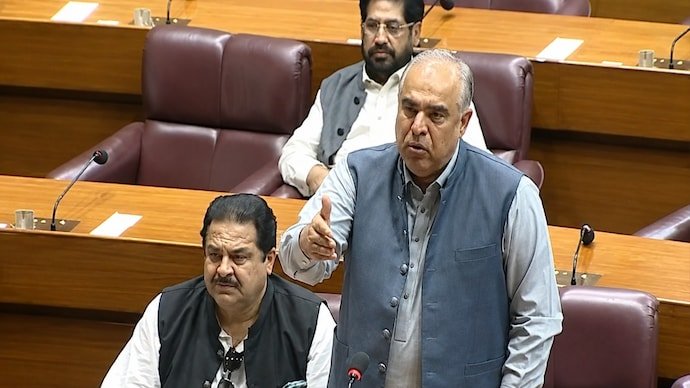
A senior Pakistani lawmaker has raised concerns in the country’s National Assembly after alleging that Pakistani passengers were treated differently from Indian and American travellers at a hotel in the United Arab Emirates following a cancelled flight.
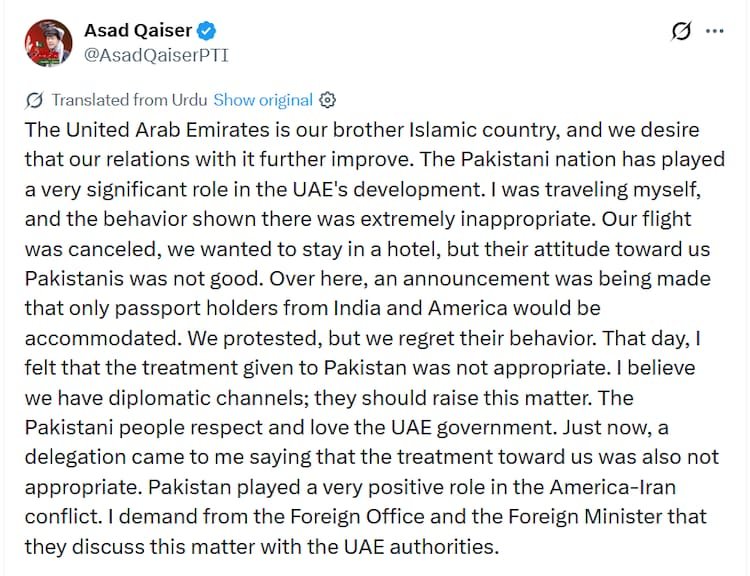
Asad Qaiser, a former speaker of Pakistan‘s National Assembly, said he personally experienced the incident while travelling through the UAE. According to his account, passengers whose flight had been cancelled sought hotel accommodation, but an announcement was allegedly made that only people holding Indian and US passports would be accommodated.
Qaiser described the treatment of Pakistani travellers as inappropriate and called on Pakistan’s government to raise the matter through diplomatic channels with UAE authorities.
The allegation has attracted attention because of the close relationship between Pakistan and the UAE and the large Pakistani expatriate population living and working in the Gulf country. However, the account presented in parliament remains an allegation by the Pakistani lawmaker. The supplied information does not include a response from UAE authorities, the hotel involved or the airline that cancelled the flight.
What did Asad Qaiser allege about the UAE hotel?
Qaiser raised the issue during a session of Pakistan’s National Assembly, saying he had personally been travelling when the flight cancellation occurred.
He said passengers needed accommodation after the flight was cancelled but claimed that Pakistani travellers were treated differently at the hotel.
According to Qaiser’s account, an announcement stated that accommodation would be provided only to Indian and US passport holders.
The former National Assembly speaker said he protested against what he described as inappropriate treatment of Pakistani citizens.
His account was presented in parliament as a matter requiring government attention rather than as a confirmed finding by Pakistani authorities. No independent evidence establishing the hotel’s policy has been provided in the supplied material.
That distinction is important. A traveller’s account of an incident can raise legitimate diplomatic concerns, but establishing whether the hotel deliberately discriminated on the basis of nationality would require confirmation from the hotel, airline, UAE authorities or other independent evidence.
Why Qaiser wants Pakistan to intervene
Qaiser urged Pakistan’s Foreign Office and foreign minister to raise the matter with the UAE through diplomatic channels.
He argued that Pakistan and the UAE share close ties and described the UAE as a “brother Islamic country.”
He also pointed to the contribution of Pakistani workers and residents to the UAE’s development, saying relations between the two countries should become stronger rather than being affected by incidents involving Pakistani travellers.
The appeal is significant because the UAE is not only an important destination for Pakistani workers and visitors but also a major economic and diplomatic partner for Islamabad.
For Pakistan, ensuring that its citizens receive appropriate treatment abroad is an issue that can quickly become politically sensitive, particularly when a complaint involves a country with which it maintains close relations.
Qaiser says other Pakistani travellers also complained
Qaiser also claimed that the issue was not limited to his own experience.
He said a delegation had approached him with complaints about similar treatment. The supplied account does not provide independent details about those complaints or establish whether they involved the same hotel, airline or circumstances.
If multiple travellers experienced the same policy, it would make the issue more significant. But determining whether there was a broader pattern would require additional evidence and clarification from the relevant authorities.
For now, Qaiser’s parliamentary statement is the principal account available in the supplied material.
What is known about Pakistanis living in the UAE?
The UAE is home to a large Pakistani expatriate community.
Recent estimates cited in the supplied material put the number of Pakistanis living in the UAE at more than 1.5 million, making Pakistanis one of the country’s largest expatriate communities.
The community includes workers and professionals across different sectors, as well as Business owners, families and other long-term residents.
This large population gives any issue involving Pakistani citizens in the UAE a significance beyond an isolated travel complaint.
At the same time, the size of the community means that routine interactions involving airlines, hotels, Immigration authorities and other services occur on a very large scale. Individual disputes therefore need to be distinguished from established government policy or a wider pattern of discrimination.
Why the UAE matters so much to Pakistan
Relations between Pakistan and the UAE extend across trade, investment, employment, remittances and diplomatic engagement.
For decades, the Gulf has been an important destination for Pakistani workers. Income earned by Pakistanis abroad also plays an important role in the country’s external finances, making Gulf employment economically significant for Pakistani households and the wider economy.
The UAE’s position as a major aviation and business hub also means that Pakistani travellers frequently pass through its airports, either as their final destination or while connecting to other countries.
A disruption such as a cancelled flight can therefore affect large numbers of international travellers.
When airlines cancel flights, passengers may need Food, transportation, refunds, rebooking or hotel accommodation depending on the circumstances and the applicable airline and airport arrangements. Which services are provided can depend on the airline’s policies, the reason for the cancellation and the specific arrangements made with accommodation providers.
That makes it particularly important to establish what exactly happened in Qaiser’s case before drawing conclusions about UAE policy.
Was the alleged hotel policy a UAE government rule?
There is no information in the supplied material establishing that the alleged restriction was a UAE government policy.
This is a critical distinction.
Qaiser alleged that an announcement at a hotel stated that Indian and US passport holders would be accommodated. That does not, by itself, establish that the UAE government ordered hotels to provide preferential treatment to citizens of particular countries.
The incident could potentially involve a hotel-specific decision, an airline arrangement, availability constraints, a misunderstanding or another factor that has not yet been publicly explained.
Without a response from the hotel, airline or UAE authorities, the reason for the alleged treatment remains unclear.
For that reason, the claim should be understood as an allegation requiring verification rather than as an established UAE policy.
Why passport-based treatment would be a sensitive issue
Airports and hotels routinely deal with travellers of different nationalities, and nationality can sometimes affect visa or entry requirements. But an allegation that accommodation was offered to some passport holders while being denied to others is particularly sensitive because it raises questions about equal treatment.
In a situation involving a cancelled flight, passengers are generally concerned about finding a safe place to stay and reaching their next destination. A sudden distinction based on nationality could therefore cause confusion and frustration, particularly if passengers believe they have been treated differently without a clear explanation.
However, the precise reason behind the alleged decision is still unknown.
The most important next step would be an explanation from the relevant service provider or authorities, rather than assuming the reported incident represents a wider policy.
Qaiser’s reference to Pakistan’s role in the US-Iran conflict
During his comments, Qaiser also referred to Pakistan’s role in the broader regional situation, saying the alleged treatment was particularly disappointing given what he described as Pakistan’s positive role in the US-Iran conflict.
The connection was part of his political argument for why Pakistan deserved appropriate treatment from a close regional partner.
However, the alleged hotel incident and Pakistan’s role in regional Diplomacy are separate issues. The circumstances surrounding a cancelled flight would need to be examined independently of wider geopolitical developments.
Qaiser’s comments nevertheless show how quickly an individual travel dispute can become connected to broader diplomatic concerns when raised inside a national parliament.
Could the issue affect Pakistan-UAE relations?
Qaiser himself stressed that Pakistanis continue to respect and have affection for the UAE government and said the incident should not damage bilateral relations.
That suggests his primary objective is to seek clarification and diplomatic intervention rather than create a broader confrontation.
Governments frequently use diplomatic channels to address complaints involving their citizens abroad. A request for clarification does not necessarily indicate a serious deterioration in bilateral relations.
In this case, the issue’s eventual significance will depend heavily on how UAE authorities and the relevant hotel respond.
If the allegation is shown to have resulted from an isolated operational decision or misunderstanding, the matter could potentially be resolved through clarification. If evidence establishes a broader nationality-based policy, it would raise a substantially more serious diplomatic issue.
What Pakistani travellers should understand
For travellers, the episode highlights the importance of understanding what happens when an international flight is cancelled.
Passengers should retain their booking information, cancellation notifications and communication from the airline. If accommodation is promised, they should obtain clear information about where the hotel is located, WHO is responsible for payment and what identification is required.
When a flight is cancelled in a foreign country, passengers may also have different rights depending on the airline, ticket conditions, route and reason for cancellation.
Keeping written records can be particularly useful if a passenger later needs to file a complaint with an airline, airport, hotel or relevant authority.
However, these practical considerations should not be confused with confirmation of Qaiser’s allegation. The circumstances of the reported UAE hotel incident remain subject to further clarification.
What happens next?
The next significant development will likely be whether Pakistan’s Foreign Office formally raises the matter with UAE authorities and whether an explanation emerges from the UAE side.
A response from the hotel or airline could help establish whether the reported announcement occurred, what prompted it and whether passport nationality was actually the determining factor.
If UAE authorities confirm that the incident occurred as described, the two governments would have an opportunity to address the matter through established diplomatic channels.
If the claim is disputed, further information from passengers or the service providers involved could help establish what happened.
Allegation puts spotlight on treatment of Pakistani travellers
Asad Qaiser’s allegation has placed an individual travel incident on the agenda of Pakistan’s National Assembly and brought attention to the broader relationship between Pakistan and the UAE.
The claim is serious because it involves an alleged distinction between Pakistani, Indian and US passport holders after a flight cancellation. But at this stage, the available information comes primarily from the Pakistani lawmaker’s account, and there is no response from UAE authorities or the hotel in the supplied material confirming the allegation.
That makes verification the key issue.
The UAE hosts a large Pakistani community and remains an important destination for Pakistani workers, businesses and travellers. Both sides have an interest in ensuring that an individual dispute does not unnecessarily damage those wider ties.
For now, the central question is not whether Pakistan-UAE relations are heading for a crisis, but whether authorities can establish exactly what happened at the hotel and why Pakistani passengers allegedly received different treatment.
Until that explanation is available, the reported incident should be treated as a claim raised by a Pakistani parliamentarian, rather than as confirmed evidence of an official UAE policy restricting hotel accommodation based on nationality.
For breaking news and live news updates, like us on Facebook or follow us on Twitter and Instagram. Read more on Latest World on thefoxdaily.com.






COMMENTS 0