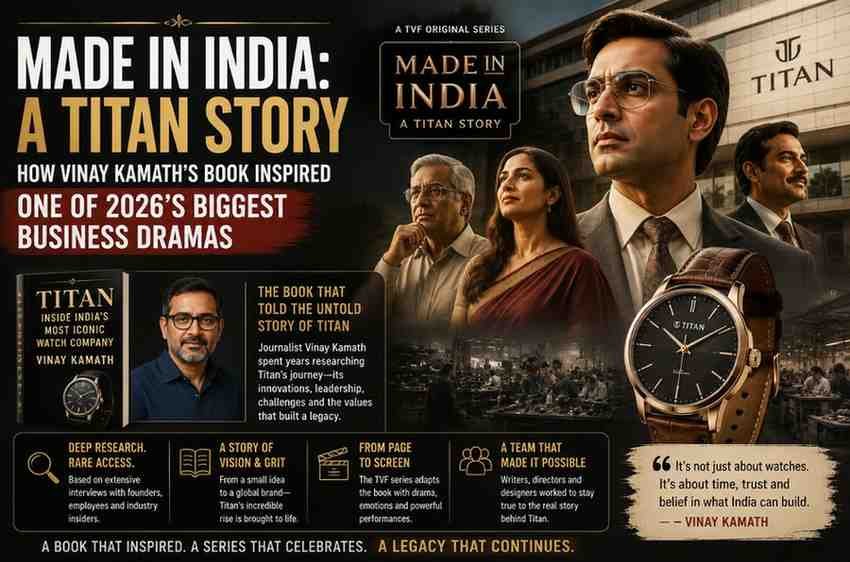
For Kamath, seeing years of reporting transformed into a screen production represents more than personal satisfaction. It reflects a changing Entertainment landscape where audiences increasingly seek stories built on real entrepreneurship, innovation, leadership and resilience rather than purely fictional narratives.
The adaptation also signals a growing recognition that India’s corporate history contains stories every bit as compelling as political dramas, crime thrillers and historical epics.
From Newsroom to Streaming Platform
Journalists spend years researching facts, interviewing key figures and documenting milestones that shape industries. Unlike fictional storytelling, Business reporting demands accuracy, context and careful verification.
Transforming such material into a dramatic series requires preserving factual integrity while introducing compelling characters, emotional depth and cinematic pacing.
The journey of Made in India: A Titan Story demonstrates how carefully researched nonfiction can become engaging mainstream entertainment without losing its historical significance.
Why Titan’s Story Resonates With Audiences
Titan’s growth represents far more than the success of a single company. It mirrors India’s economic transformation, changing consumer aspirations, evolving retail culture and the rise of trusted Indian brands.
From watches to jewellery and lifestyle products, Titan became part of everyday life for millions of consumers, making its corporate journey familiar even to people who know little about business history.
This combination of entrepreneurial ambition and cultural relevance gives the story broad appeal beyond business enthusiasts.
The Value of Long-Form Business Journalism
Business reporting often focuses on quarterly earnings, product launches and financial results. Books, however, allow journalists to explore the people, decisions and long-term strategies behind those headlines.
Through extensive research and interviews, authors can uncover the setbacks, turning points and leadership choices that rarely fit into daily news coverage.
These deeper narratives often provide the foundation for successful screen adaptations because they reveal the human side of corporate success.
Why Authentic Stories Are Winning
Streaming audiences have shown increasing interest in true stories across multiple genres. Whether based on sports, entrepreneurship, technology or social change, real events often create stronger emotional connections because viewers know the achievements actually happened.
Authenticity has become a competitive advantage in modern storytelling.
Rather than relying solely on spectacle, productions inspired by real people invite audiences to appreciate determination, innovation and calculated risk-taking.
The Challenge of Adapting a Business Book
Converting a nonfiction business book into a dramatic series is considerably more complex than adapting a novel.
Writers must balance factual accuracy with engaging storytelling while simplifying complex corporate decisions for general audiences.
The adaptation process typically involves deciding which events to emphasize, how to portray real personalities and how to maintain historical credibility without sacrificing entertainment value.
| Business Book | Streaming Adaptation |
|---|---|
| Detailed research | Visual storytelling |
| Chronological narrative | Dramatic pacing |
| Business analysis | Character-driven storytelling |
| Extensive facts | Condensed key moments |
| Industry context | Emotional engagement |
Why Indian Corporate Stories Are Finding New Audiences
For many years, Indian cinema largely celebrated mythology, romance, crime and historical events. Today, audiences are increasingly embracing stories centered on entrepreneurs, innovators, scientists and business leaders.
This shift reflects growing public curiosity about how successful companies are built, how difficult decisions are made and how Indian enterprises compete globally.
Corporate journeys now offer the same dramatic ingredients found in traditional cinema—vision, conflict, setbacks, perseverance and transformation.
The Journalist’s Perspective Matters
Unlike fictional writers, experienced journalists approach storytelling through observation, documentation and verification. Years spent covering industries allow them to identify patterns, ask deeper questions and understand the broader significance of corporate decisions.
This perspective often produces narratives that feel grounded rather than exaggerated.
It also helps audiences appreciate the complexity behind business success, which is rarely the result of a single breakthrough moment.
Business Stories Are Really Human Stories
Behind every successful company are individuals making difficult decisions under uncertainty. Founders, engineers, designers, marketers and employees all contribute to a shared journey filled with challenges and opportunities.
When adapted effectively, business dramas become stories about leadership, teamwork, innovation and resilience rather than balance sheets or financial reports.
This human dimension explains why audiences increasingly connect with corporate narratives.
How Streaming Platforms Are Changing Nonfiction Storytelling
Streaming services have created space for stories that might once have been considered too specialized for mainstream entertainment.
Long-form episodic storytelling allows creators to explore historical context, character development and organizational evolution in greater depth than traditional feature films.
Business books, biographies and investigative journalism have therefore become valuable sources of adaptation.
Lessons for Aspiring Writers and Journalists
The success of Made in India: A Titan Story offers an encouraging message for writers covering business and industry.
- Thorough research creates lasting value.
- Authentic storytelling builds credibility.
- Complex subjects can become engaging narratives.
- Local stories can attract national and global audiences.
- Well-documented nonfiction can enjoy a second life beyond publishing.
In an era of short-form content, carefully researched long-form journalism continues to hold significant cultural value.
| Traditional Business Reporting | Modern Business Storytelling |
|---|---|
| Financial updates | Complete organizational journeys |
| Company performance | Leadership and innovation |
| Market analysis | Human-centered narratives |
| News articles | Books, documentaries and streaming series |
| Industry audience | Mainstream viewers |
The Bigger Picture: India’s Corporate History Is Rich With Untold Stories
The adaptation of Vinay Kamath’s work reflects a broader evolution in Indian entertainment. The country’s business landscape is filled with remarkable stories of innovation, manufacturing, technology, healthcare, retail and entrepreneurship that remain largely unexplored on screen.
As audiences continue seeking authentic narratives, more books written by journalists, historians and researchers may become valuable sources for future films and streaming productions.
This trend has the potential to preserve important chapters of India’s economic history while making them accessible to new generations.
Conclusion
Made in India: A Titan Story represents more than the successful adaptation of a business book. It highlights the growing appreciation for factual storytelling rooted in careful journalism and real-world achievements.
For Vinay Kamath, seeing his research evolve into a widely watched streaming series marks the culmination of years spent documenting one of India’s most influential corporate journeys. For audiences, it offers an engaging reminder that some of the country’s most compelling stories are not fictional—they are found in boardrooms, factories, design studios and the determined people who built iconic Indian brands.
As India’s streaming industry continues to mature, the success of projects like Made in India: A Titan Story suggests that authentic business narratives may become an increasingly important genre, proving that well-researched journalism can inspire stories that entertain, educate and endure.
For breaking news and live news updates, like us on Facebook or follow us on Twitter and Instagram. Read more on Latest Entertainment on thefoxdaily.com.






COMMENTS 0