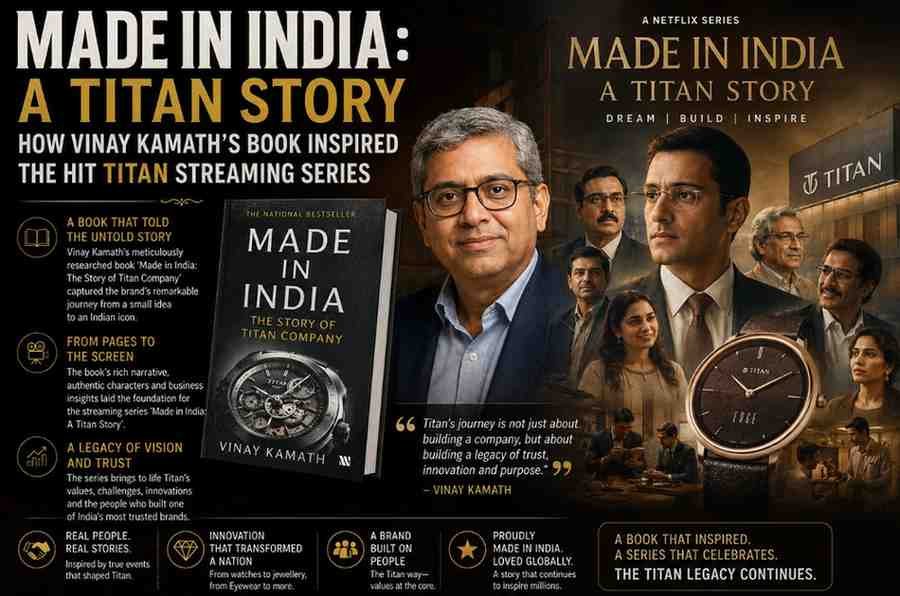
For decades, India’s Business landscape has produced remarkable stories of innovation, resilience, and entrepreneurship. Yet comparatively few of these journeys have made their way to mainstream Entertainment. That narrative is changing. The success of ‘Made in India: A Titan Story’ demonstrates that audiences are increasingly eager for authentic stories rooted in Indian enterprise rather than purely fictional drama.
At the heart of this transformation lies the work of former journalist Vinay Kamath, whose detailed account of Titan’s evolution from an ambitious idea into one of India’s most respected lifestyle brands laid the foundation for the series. Watching years of reporting and research evolve into a successful screen adaptation, Kamath described the experience as something that felt long overdue—an acknowledgement that Indian business history deserves a wider audience.
The adaptation represents more than a successful television series. It signals a growing appreciation for real-world stories that combine entrepreneurship, innovation, leadership, manufacturing excellence, and nation-building into narratives capable of captivating viewers across generations.
How a Business Book Became a Streaming Phenomenon
Business biographies have traditionally been viewed as niche reading material aimed at entrepreneurs, management professionals, or students. Streaming platforms have begun challenging that assumption by demonstrating that compelling storytelling can transform corporate history into engaging entertainment.
Rather than focusing solely on financial milestones, adaptations like ‘Made in India: A Titan Story’ explore the people behind the brand—the difficult decisions, uncertain beginnings, leadership challenges, market disruptions, and moments of breakthrough that shaped one of India’s most admired companies.
This human-first storytelling approach allows viewers with little interest in business to connect emotionally with the journey.
The Story Behind Titan’s Remarkable Growth
Titan’s evolution reflects broader changes in India’s economic landscape over several decades. Beginning with a vision to redefine the Indian watch industry, the company gradually expanded into multiple lifestyle categories while building a reputation for quality, innovation, and consumer trust.
Its journey illustrates how long-term strategic thinking, customer-centric design, technological advancement, and consistent brand building can create enduring business success.
These qualities make Titan’s history particularly well suited for screen adaptation, where business decisions become dramatic turning points rather than mere corporate milestones.
Why Vinay Kamath’s Research Resonated
Journalistic storytelling differs significantly from promotional corporate histories.
Years of reporting, interviews, archival research, and careful documentation allowed Kamath’s work to present Titan’s story with depth and authenticity. Instead of simply celebrating achievements, the narrative explored obstacles, uncertainties, competitive pressures, and the strategic choices that defined the company’s trajectory.
This balanced approach created source material rich enough for screenwriters to build a compelling dramatic narrative while remaining grounded in real events.
What Makes Business Stories Work on Screen?
Successful business dramas rarely focus on numbers alone. Instead, they centre around universal human themes:
- Vision and ambition.
- Leadership under pressure.
- Innovation despite uncertainty.
- Competition and resilience.
- Personal sacrifice.
- Teamwork and long-term thinking.
These themes resonate regardless of whether viewers have an interest in finance or entrepreneurship.
| Traditional Business Biography | Streaming Adaptation |
|---|---|
| Focuses on facts and chronology | Focuses on emotional storytelling |
| Detailed corporate analysis | Character-driven narrative |
| Appeals mainly to business readers | Reaches mainstream audiences |
| Explains strategic decisions | Shows the human impact behind decisions |
| Educational emphasis | Entertainment combined with learning |
The Rise of India’s Business Storytelling Era
For years, Indian cinema largely favoured fictional heroes, historical epics, sports dramas, and crime thrillers. Recently, audiences have shown increasing interest in narratives inspired by real entrepreneurs, innovators, scientists, and corporate pioneers.
This shift reflects changing viewer preferences. Modern audiences increasingly seek stories that inspire while remaining grounded in reality.
Business leaders, engineers, designers, and journalists are now emerging as central characters whose journeys are every bit as dramatic as fictional protagonists.
Why Titan’s Story Connects Across Generations
Few Indian brands enjoy the widespread familiarity that Titan has built over decades.
Many consumers have grown up wearing Titan watches, purchasing jewellery, or interacting with the brand through different stages of life.
This emotional connection creates a unique viewing experience. Rather than introducing an unfamiliar company, the series allows audiences to discover the hidden story behind a brand they already know and trust.
From Journalism to Screen: A Rare Creative Journey
Seeing investigative reporting evolve into a successful television series represents an unusual milestone for any journalist.
Journalists often spend years uncovering stories that inform readers but rarely reach mainstream popular culture. When carefully researched reporting becomes the foundation for high-quality screen storytelling, it significantly expands the audience for that work.
It also highlights the enduring value of thorough journalism in an era increasingly dominated by short-form digital content.
The Importance of Authentic Corporate Histories
Corporate success stories can easily become promotional narratives if they overlook setbacks and difficult decisions.
Authentic storytelling requires acknowledging uncertainty, failures, market challenges, and leadership dilemmas alongside achievements.
This balance not only improves credibility but also makes the narrative more engaging. Viewers connect more deeply with organisations that overcome adversity than with stories portraying uninterrupted success.
Lessons Entrepreneurs Can Learn from Titan’s Journey
- Build trust before chasing rapid growth.
- Innovation requires patience and persistence.
- Strong brands are created over decades, not months.
- Customer experience is as important as product quality.
- Long-term vision often outperforms short-term gains.
- Organisational culture shapes sustainable success.
These principles remain relevant for startups, established businesses, and aspiring entrepreneurs alike.
| Business Lesson | Why It Matters Today |
|---|---|
| Customer trust | Builds lasting brand loyalty |
| Innovation | Maintains competitive advantage |
| Leadership | Guides organisations through uncertainty |
| Quality | Strengthens long-term reputation |
| Adaptability | Helps businesses respond to changing markets |
How Streaming Platforms Are Changing Non-Fiction Storytelling
Streaming services have expanded opportunities for documentaries, historical dramas, and business-inspired series that might previously have struggled to find large audiences.
Long-form episodic storytelling allows creators to explore complex events with greater depth than a conventional feature film.
This format is particularly well suited to corporate histories, where years—or even decades—of growth, setbacks, and innovation can unfold gradually without sacrificing detail.
The Bigger Impact on Indian Publishing
Successful adaptations often lead readers back to the original books, creating renewed interest in long-form journalism and non-fiction publishing.
For authors, this represents an opportunity to reach audiences who may never have discovered their work through bookstores alone.
For publishers, it reinforces the value of investing in carefully researched books capable of inspiring future adaptations across film and streaming platforms.
Why Authentic Business Narratives Matter More Than Ever
In an age of viral content and rapidly changing consumer attention, authentic stories grounded in real achievement provide a refreshing alternative. They remind audiences that meaningful success is often built through persistence, collaboration, thoughtful leadership, and years of consistent effort rather than overnight breakthroughs.
By bringing Titan’s journey to the screen, the adaptation encourages viewers to see entrepreneurship not merely as financial success but as a process of solving problems, building institutions, and creating lasting value.
Looking Ahead: A New Chapter for Indian Corporate Storytelling
The success of ‘Made in India: A Titan Story’ could encourage more adaptations of Indian business histories, biographies, and journalistic works. Companies across sectors—from technology and manufacturing to healthcare and retail—have stories that combine innovation, resilience, and national significance.
If handled with the same commitment to authenticity, these narratives could broaden public understanding of India’s economic evolution while inspiring future entrepreneurs.
Conclusion
Vinay Kamath’s journey from journalist to the inspiration behind one of 2026’s most successful streaming series illustrates the enduring power of well-researched storytelling. His work demonstrates that corporate histories are not merely collections of business milestones but deeply human stories shaped by vision, determination, setbacks, and innovation.
The success of ‘Made in India: A Titan Story’ also marks an important moment for Indian storytelling, proving that audiences are eager to embrace narratives celebrating real achievements alongside compelling drama. As streaming platforms continue exploring authentic stories rooted in India’s entrepreneurial landscape, this adaptation may well become the benchmark for how business history is brought to life on screen.
For breaking news and live news updates, like us on Facebook or follow us on Twitter and Instagram. Read more on Latest Entertainment on thefoxdaily.com.






COMMENTS 0