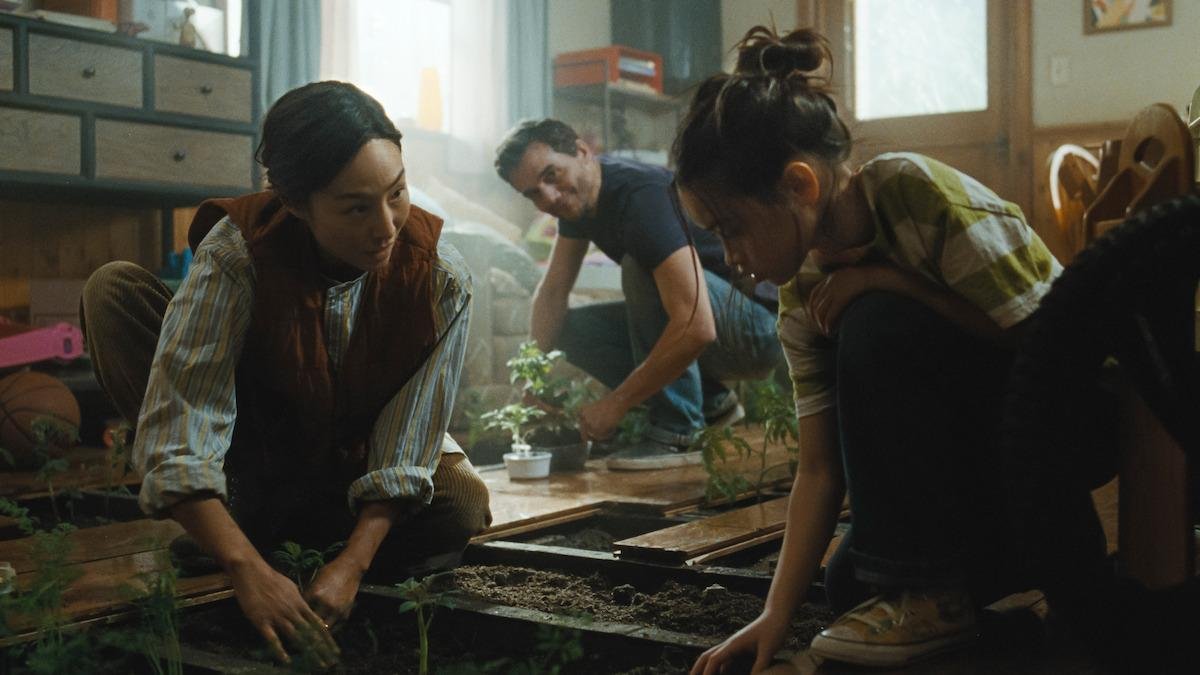
The Last House begins with a premise that feels almost unnervingly familiar. A family is trapped inside its home while something unexplained consumes the world outside. Doors and windows become useless barriers, communication with the outside world disappears, and the ordinary rituals of domestic life suddenly acquire survival value.
That setup should be fertile ground for a gripping psychological thriller. Directed by Louis Leterrier, a filmmaker better known for kinetic action cinema, the film deliberately confines itself almost entirely to a suburban Seattle house. Wagner Moura plays Jason Delgado, an unemployed engineer, while Greta Lee plays his wife Ann. Their two children complete a family suddenly forced to confront an incomprehensible catastrophe without knowing whether anyone beyond their walls has survived.
The film’s central idea is particularly potent because contemporary audiences do not need much imagination to understand the psychological consequences of confinement. The memory of lockdowns, isolation and uncertainty remains part of the cultural vocabulary of the twenty-first century. The Last House has an opportunity to turn that collective experience into something more unsettling than a conventional disaster thriller.
Unfortunately, the screenplay repeatedly approaches fascinating questions without fully investigating them. The house becomes an effective prison, but the film rarely makes its intellectual confinement as compelling as its physical one.
What Is The Last House About?
The story follows Jason and Ann Delgado and their children as an unexplained phenomenon suddenly seals their suburban home. Doors and windows can no longer be opened, leaving the family trapped inside while torrential rain lashes the area.
At first, the danger is largely invisible.
There is no conventional monster standing outside the house. There is no obvious enemy to fight. Instead, the family gradually realises that something is happening to the world beyond their walls.
The basic survival questions quickly become unavoidable:
- What has happened outside?
- Why can nobody leave the house?
- Is the phenomenon temporary?
- How long can the family survive with limited resources?
- Can they trust what they hear and see?
- What happens when the familiar world disappears?
These questions establish a promising foundation for a contained survival thriller.
A Strange Career Turn for Louis Leterrier
Louis Leterrier is an unusual choice for a film whose defining feature is stillness.
The director has spent much of his career working in action-driven environments, from The Transporter films to The Incredible Hulk, Now You See Me and Fast X. His filmmaking background is associated with movement, spectacle and large-scale physical action.
The Last House asks him to do almost the opposite.
There are no sprawling chase sequences. There is no conventional battlefield. The dramatic space is deliberately restricted to one domestic environment.
That contrast is intriguing because a director accustomed to spectacle must now generate tension from walls, conversations, household objects and silence.
At its best, the film proves that Leterrier can work within those restrictions. At its weakest, however, the confined setting begins to feel less like a deliberate artistic choice and more like a limitation.
The House Is the Film’s Most Important Character
The strongest aspect of The Last House is its use of domestic space.
A home normally represents safety. It is where people sleep, eat, argue, work and raise children. The film transforms that familiar environment into an enclosed survival system.
Suddenly, ordinary objects acquire new significance.
- Food becomes a finite resource.
- Electricity becomes uncertain.
- Windows become observation points rather than exits.
- Rooms become emotional territories.
- Silence becomes a source of anxiety.
This transformation is effective because the film understands that fear becomes more powerful when it invades familiar spaces.
The family does not need to enter a haunted forest or abandoned building. The nightmare has arrived at home.
The COVID-19 Connection Is Impossible to Ignore
The film’s most fascinating contemporary dimension comes from its relationship with pandemic-era memory.
Long before the story begins, the audience already understands what confinement feels like.
For millions of people, being unable to leave home, watching the outside world through screens and constantly wondering what was happening beyond the front door became part of everyday life.
The Last House therefore does not need to explain the psychological mechanics of isolation from scratch. Its audience brings that experience with them.
This creates an extraordinary storytelling opportunity.
The film could have explored how a society permanently changed by mass confinement might react to another period of isolation. It could have examined whether people would become more resilient, more paranoid or more dependent on technology.
Instead, that fascinating cultural context largely remains unexplored.
The Problem With an Unanswered Mystery
Mystery is an essential ingredient of survival cinema, but mystery works only when curiosity keeps growing.
The Last House introduces an intriguing unexplained phenomenon, yet it often withholds information without replacing that absence with sufficiently compelling character questions.
There is a difference between suspense and simple lack of information.
Suspense asks the audience to anticipate an answer.
Confusion merely asks them to wait.
The film occasionally crosses that line.
Instead of making every unanswered question increasingly urgent, some mysteries begin to feel deliberately protected from investigation.
Wagner Moura Brings Vulnerability to Jason
Wagner Moura gives the film a grounded emotional centre.
Jason is not presented as a conventional action hero capable of solving every problem through physical strength. His engineering background suggests intelligence and practical thinking, but his unemployment and family responsibilities make him vulnerable from the beginning.
That vulnerability is important.
Jason is forced into a situation where technical knowledge may not be enough. He cannot simply engineer his way out of an impossible phenomenon.
Moura plays that uncertainty effectively, allowing frustration and fear to coexist with his instinct to protect his family.
Greta Lee Gives the Family Conflict Its Emotional Weight
Greta Lee’s Ann provides a valuable counterpoint to Jason.
The character is not simply there to react to her husband’s decisions. Her presence introduces another way of processing crisis, particularly when logic begins to fail.
Lee’s performance works best in quieter moments, where fear is expressed through restraint rather than dramatic outbursts.
The chemistry between Moura and Lee also helps the film maintain emotional credibility. Their relationship feels like that of two people trying to protect a family while simultaneously struggling to understand the disaster surrounding them.
Why the Children Matter to the Story
The presence of children automatically changes the emotional stakes of a survival thriller.
Adults can make calculated decisions about risk. Parents must also consider how much truth their children can handle.
This creates several potentially powerful questions:
- Should children be told the full truth during a catastrophe?
- How do parents maintain authority when they are frightened themselves?
- Can protecting children from fear actually make them more vulnerable?
The film occasionally touches these tensions but does not explore them as deeply as its premise allows.
Where The Last House Falls Short
The central weakness is not the concept. It is the screenplay’s failure to extract enough dramatic material from that concept.
A contained thriller requires exceptional attention to character development because the physical environment cannot constantly change.
When characters cannot move, the story must move.
That movement can come from revelations, shifting relationships, moral dilemmas or escalating psychological pressure.
The Last House has opportunities for all four but does not always exploit them fully.
The Film Needed More Curiosity
The irony of the title is that the family is trapped inside a house while the audience can feel that the most interesting story exists outside it.
The unseen world becomes the great unanswered question.
What is happening to society?
How widespread is the phenomenon?
Are other families experiencing the same thing?
Is there a scientific explanation?
Is the catastrophe environmental, technological or something else entirely?
These questions could have expanded the film’s emotional and philosophical scope.
Instead, the screenplay often treats the outside world as a mystery box rather than an opportunity for genuine world-building.
A Survival Thriller That Is More Interesting Conceptually Than Dramatically
| Element | Strength | Limitation |
|---|---|---|
| Premise | Highly compelling and contemporary | Not explored deeply enough |
| Setting | Effective claustrophobic environment | Can become dramatically repetitive |
| Performances | Grounded and emotionally credible | Characters are limited by the screenplay |
| Mystery | Creates immediate curiosity | Some questions feel withheld rather than developed |
| Social commentary | Potentially rich COVID-era metaphor | Its implications remain underdeveloped |
The Missed Opportunity of the Pandemic Metaphor
The most frustrating aspect of the movie is the way it brushes against a defining experience of contemporary life without fully confronting it.
The pandemic changed how people understand homes, isolation and uncertainty.
Home became workplace, classroom, refuge and prison simultaneously.
Technology became the primary connection to a world that could no longer be physically accessed.
A thriller about a family literally trapped inside a house could have explored all of these ideas with extraordinary force.
Instead, the film uses the familiarity of confinement as a shortcut to audience empathy rather than developing it into a larger thematic argument.
Why the Contained Setting Still Works at Times
Despite its limitations, the confined setting creates several genuinely effective sequences.
Everyday domestic routines acquire tension because the family no longer knows how long their resources will last.
Small sounds become suspicious. A change outside the window becomes significant. A disagreement between family members can suddenly feel as dangerous as an external threat.
This is where Leterrier’s controlled direction becomes valuable.
Instead of constantly escalating through spectacle, the film occasionally allows anxiety to emerge from silence and anticipation.
The Film’s Real Theme Is Uncertainty
Ultimately, The Last House is less interested in explaining the catastrophe than in depicting what uncertainty does to people.
When information disappears, imagination takes over.
Fear fills gaps in knowledge.
People begin interpreting ordinary events as threats.
Families are forced to decide whom to trust when there is no reliable authority outside the home.
This is fertile territory for psychological storytelling, and the film is strongest when it concentrates on these human consequences rather than its unexplained phenomenon.
Final Verdict
The Last House is an intriguing but frustrating survival thriller. Louis Leterrier deserves credit for moving away from the large-scale action that has defined much of his career and attempting to create tension almost entirely within a suburban home.
Wagner Moura and Greta Lee provide the film with a credible emotional foundation, and the contained setting occasionally generates genuine claustrophobia. The premise is also perfectly suited to a generation that understands confinement in a way few earlier audiences could.
But that is precisely why the film’s missed opportunities are so noticeable. It has access to a powerful contemporary metaphor and a fascinating speculative premise, yet repeatedly stops short of asking the deeper questions suggested by its own setup.
The result is a movie that is more intriguing to discuss than it is consistently thrilling to watch. The Last House understands that the greatest horror may be uncertainty, but it never quite discovers how much more frightening—and meaningful—that idea could have become.
For breaking news and live news updates, like us on Facebook or follow us on Twitter and Instagram. Read more on Latest Entertainment on thefoxdaily.com.






COMMENTS 0