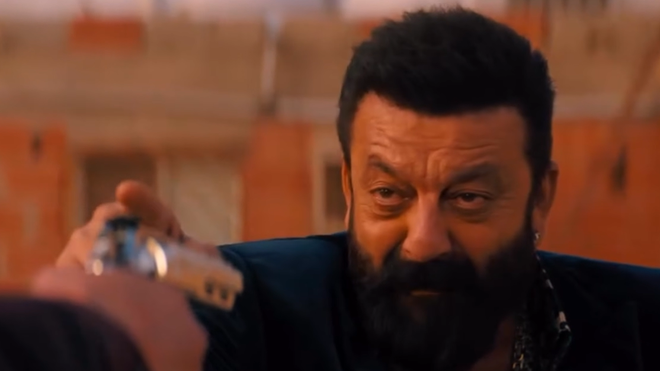
‘7 Dogs’ arrives with the kind of pedigree designed to make action-film fans sit up. Directed by Adil El Arbi and Bilall Fallah, the filmmaking duo behind the Bad Boys franchise, the Arabic-language blockbuster brings together an unusually international cast, including Monica Bellucci, Giancarlo Esposito, Salman Khan and Sanjay Dutt. Its action design also carries the fingerprints of 87Eleven Action Design, the company associated with the modern kinetic language of the John Wick films.
Produced on a scale that reflects Saudi Arabia’s increasingly ambitious push into global entertainment, the film clearly wants to be more than another regional action movie. It aims for the status of an international event: big stars, bigger explosions, glamorous locations and action choreography designed to travel across borders.
That ambition is easy to admire. The problem is that ‘7 Dogs’ often seems more interested in assembling the ingredients of a global blockbuster than discovering what makes its own story emotionally distinctive.
The result is an action film with considerable surface energy but surprisingly little soul underneath it. Sanjay Dutt appears to relish every opportunity to chew the scenery, while Salman Khan’s presence adds another layer of star spectacle. Yet the film’s cultural ambition gets diluted as its influences pile up, leaving behind a movie that sometimes feels caught between identities.
‘7 Dogs’ and the New Global Action Movie
There is something significant about the very existence of a film like 7 Dogs.
For decades, Hollywood has been the dominant exporter of big-budget popular cinema. Its visual language of explosions, elaborate stunts, charismatic stars and globe-spanning criminal conspiracies has been reproduced around the world.
Saudi Arabia’s rapidly developing entertainment industry is now attempting to participate in that global conversation on its own terms.
That makes 7 Dogs interesting even before the opening action sequence. The film represents an attempt to turn financial investment, international talent and local cultural production into a cinematic product capable of competing for attention in markets far beyond the Arab world.
In that sense, the film is almost as much an industrial statement as it is an action thriller.
It says that Arabic cinema can assemble the same international machinery as a Hollywood production. But assembling the machinery is easier than creating a distinctive cinematic voice.
A Star-Studded Formula
The casting strategy is one of the film’s biggest attractions.
Monica Bellucci brings instant international recognition. Giancarlo Esposito carries the authority of one of contemporary television and cinema’s most recognisable performers. Salman Khan arrives with an enormous Indian fan base, while Sanjay Dutt brings decades of Hindi-film history and an unmistakable screen presence.
The combination is undeniably eye-catching.
But star power comes with a challenge: each performer arrives carrying a cinematic identity of their own. Viewers bring memories of their previous roles, mannerisms and screen personas into the film.
That can enrich a movie when the characters are carefully integrated into the story. Here, however, the international casting sometimes feels like part of the spectacle itself.
The film wants its stars to function as characters, but it also wants the audience to enjoy the novelty of seeing these particular stars together.
When Action Becomes the Main Character
There is no shortage of technical ambition in 7 Dogs.
The involvement of 87Eleven Action Design immediately establishes expectations. The company has helped shape the contemporary action aesthetic in which physical movement, stunt choreography and camera placement become central to storytelling.
The film delivers on that promise with large-scale action sequences designed to keep the spectacle moving.
There is an unmistakable emphasis on momentum. Set pieces are constructed to feel expensive, muscular and internationally marketable. The filmmakers understand that modern action cinema is no longer judged only by the size of an explosion. Audiences expect choreography, precision and a sense of physical geography.
Yet technically impressive action can become emotionally empty if the audience has little reason to care about what happens between the explosions.
That is where 7 Dogs struggles.
The ‘John Wick’ Shadow
The influence of the modern John Wick school of action filmmaking is difficult to ignore.
That influence is not necessarily a weakness. The franchise has demonstrated how carefully choreographed movement can become a cinematic language in itself.
But imitation creates a problem when style becomes easier to recognise than personality.
7 Dogs understands the grammar of contemporary action cinema: polished choreography, rapid escalation, imposing villains, international locations and characters who can survive punishment that would send ordinary humans directly to an orthopaedic surgeon.
What it lacks is an equally strong reason for its own visual language to exist.
The question is not whether the action looks good. Much of it does. The question is whether the action tells us something uniquely about these characters and this world.
Sanjay Dutt Knows Exactly What Kind of Movie He Is In
Sanjay Dutt is among the film’s most entertaining elements because he appears to understand the assignment completely.
He brings the kind of larger-than-life physicality that action spectacles demand. There is a mischievous quality to his performance, as though he knows that subtlety has been temporarily suspended in favour of maximum screen presence.
When Dutt gets an opportunity to dominate a scene, he takes it.
His performance works because he does not seem embarrassed by the film’s excesses. Instead, he leans into them.
That willingness to embrace the material gives his scenes some of the personality that the larger film occasionally lacks.
Salman Khan’s Presence Is More Complicated
Salman Khan’s appearance carries a different kind of weight.
His inclusion is clearly designed to connect the production with India’s enormous commercial film market and the actor’s huge fan base.
But celebrity cameos and cross-border casting can create a strange imbalance. When an actor as recognisable as Khan appears, the audience is inevitably aware of the star outside the character.
That can be useful for marketing but distracting for storytelling.
The question becomes whether the character exists because the story requires him or because the movie requires the actor’s star power.
7 Dogs does not always resolve that tension convincingly.
A Film Lost in Translation
The official Hindi dub introduces another layer to the experience.
Dubbing can make international cinema accessible to a much wider audience, and Hindi has become an increasingly important bridge between Indian viewers and films from other parts of the world.
But language is not merely a delivery system.
Dialogue carries rhythm, humour, cultural references and personality. When a film moves between languages, some of those characteristics can inevitably change.
In 7 Dogs, the Hindi version sometimes contributes to the sensation that the film is being experienced through several cinematic filters at once: Arabic storytelling, Hollywood action grammar, international casting and Indian star culture.
Instead of creating a seamless global language, these elements occasionally compete with one another.
The Cultural Soft-Power Experiment
Perhaps the most interesting way to view 7 Dogs is as part of a larger cultural experiment.
Saudi Arabia has been investing heavily in entertainment, sports and international cultural projects as it seeks to expand its global influence and diversify its economy.
Film can play a particularly powerful role in that strategy because successful movies travel emotionally. A country does not simply export a product through cinema; it can export locations, aesthetics, stories, talent and an image of itself.
That makes the ambition behind 7 Dogs significant.
But cultural soft power cannot be manufactured entirely through budgets and famous names. Audiences ultimately respond to stories that feel authentic, memorable and emotionally convincing.
That is where the film’s greatest opportunity also becomes its greatest weakness.
What the Film Gets Right
- International ambition: The film clearly wants to compete on a global action-cinema scale.
- Action craftsmanship: The involvement of 87Eleven Action Design raises the technical standard of the set pieces.
- Star appeal: The multinational cast gives the film immediate commercial curiosity.
- Visual scale: The production aims for spectacle rather than the limitations of a modest regional thriller.
- Sanjay Dutt’s screen presence: He brings an entertaining, unapologetically larger-than-life energy to the film.
Where ‘7 Dogs’ Falls Short
- Emotional depth: The spectacle frequently overwhelms character development.
- Identity: The film borrows heavily from familiar global action conventions without always transforming them into something distinctive.
- Star integration: The famous cast can sometimes feel like a collection of attractions rather than a fully organic ensemble.
- Storytelling: The momentum of the action does not always compensate for the thinness of the emotional stakes.
- Cultural specificity: The movie’s international ambitions occasionally make its own identity less clear.
Hollywood Style Is Not the Same as Hollywood Storytelling
This is perhaps the central lesson of 7 Dogs.
A film can reproduce the visual vocabulary of Hollywood without reproducing the qualities that make the best Hollywood blockbusters effective.
Big action works when spectacle is connected to character. A chase becomes exciting because someone has something meaningful to lose. A fight matters because the people involved have histories. An explosion becomes memorable because it changes the story.
Without those emotional connections, action can become an expensive screensaver.
7 Dogs sometimes approaches that problem. Its technical ambition is obvious, but the emotional architecture underneath the spectacle is less developed.
Is ‘7 Dogs’ Worth Watching?
For viewers who primarily want an international action spectacle featuring a fascinating combination of Arabic cinema, Hollywood-style choreography and Indian stars, 7 Dogs has plenty to offer.
Fans of Sanjay Dutt and Salman Khan may also be curious simply because of their participation in a major Arabic production.
Viewers looking for a tightly written thriller with deeply developed characters, however, may find the film less satisfying.
The movie works best when approached as a cinematic experiment: a large-scale attempt to bring together different film industries, audiences and action traditions.
Final Verdict
‘7 Dogs’ is an ambitious global action project that gets the blood pumping but struggles to give the spectacle a beating heart.
Adil El Arbi and Bilall Fallah bring experience with big, brash action cinema, while 87Eleven Action Design supplies the film with impressive physical choreography. The international cast adds curiosity, and Sanjay Dutt clearly enjoys the opportunity to operate at full scenery-chewing volume.
But the film’s greatest weakness is also its most intriguing contradiction. It wants to demonstrate that Arabic cinema can speak the language of the global blockbuster, yet in adopting so many familiar conventions, it occasionally loses the distinctive voice that could have made the film truly memorable.
As a statement of Saudi Arabia’s growing cinematic ambitions, 7 Dogs is fascinating. As an action movie, it is energetic and technically accomplished. As a piece of emotionally resonant storytelling, however, it leaves something missing.
There is plenty of Hollywood blood in its veins. What it needs more of is a soul of its own.
For breaking news and live news updates, like us on Facebook or follow us on Twitter and Instagram. Read more on Latest Entertainment on thefoxdaily.com.






COMMENTS 0