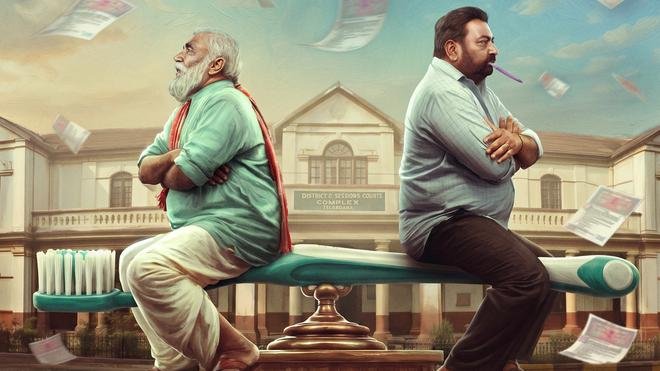
Pallaburusu movie review: Some films announce their emotional ambitions with swelling music and dramatic confrontations. Others arrive more quietly, observe ordinary people and allow their silences to do the heavy lifting. Pallaburusu belongs largely to the latter category. Directed by Uday Chauhan, this intimate drama explores family, ageing and loneliness through relationships that feel recognisable precisely because they are imperfect.
Anchored by the performances of Sudhakar Reddy and Muralidhar Goud, the film examines an increasingly familiar social reality: people can be surrounded by family and still experience profound loneliness. Its concerns are personal, but its implications are much wider. Beneath the domestic drama lies a commentary on changing family structures, generational expectations and the uncomfortable ways in which ageing can alter the balance between dependence and dignity.
Pallaburusu is not interested in offering easy answers. Instead, it asks a more uncomfortable question: what does family mean when affection, responsibility and obligation no longer move in the same direction?
What is Pallaburusu about?
At its heart, Pallaburusu is a story about familial bonding and the emotional distances that can emerge within a family over time. The film’s dramatic conflict grows from relationships rather than from an elaborate external plot, allowing everyday interactions to become its principal source of tension.
This is important because the film understands that family conflict is rarely about a single argument. Years of expectations, disappointments, compromises and unspoken resentment can sit beneath an apparently ordinary conversation.
Ageing adds another layer to those tensions. As parents and older relatives become more dependent, questions that families might previously have avoided become unavoidable. Who takes responsibility? What does care actually look like? Is financial support enough? Can independence coexist with vulnerability?
Pallaburusu uses these questions to construct a drama that is intimate in scale but broad in social relevance.
Sudhakar Reddy and Muralidhar Goud anchor the film
The film’s greatest strength is its performers, particularly Sudhakar Reddy and Muralidhar Goud. Their presence gives the drama the lived-in quality it requires.
Neither performance depends entirely on grand emotional displays. Instead, the actors communicate much of their characters’ inner lives through pauses, expressions and the changing rhythms of conversation.
That restraint matters in a film about ageing. Older characters in cinema are sometimes reduced to symbols of wisdom, helplessness or comic relief. Pallaburusu attempts something more nuanced by allowing its older characters to retain contradictions.
They can be stubborn and vulnerable, affectionate and resentful, proud and lonely. In other words, they remain people rather than becoming convenient representations of “old age”.
Muralidhar Goud brings particular weight to the film’s emotional landscape, while Sudhakar Reddy complements him with a performance that helps ground the family’s internal conflicts. Their chemistry provides the film with much of its dramatic credibility.
The film’s most powerful theme: loneliness within a family
The most compelling aspect of Pallaburusu is its treatment of loneliness.
Loneliness is often represented on screen as physical isolation: an elderly person sitting alone in an empty house or looking out of a window while family members live far away. Pallaburusu engages with a more complicated form of loneliness.
It is possible to be lonely while living with other people.
A person may eat at the same table as their family and still feel unheard. They may receive practical assistance while missing emotional companionship. They may have children who call regularly but rarely ask what they actually want.
This distinction between being cared for and feeling cared about is one of the film’s most important insights.
Modern families often measure responsibility through tangible actions: money transferred, medicines purchased, appointments arranged or household duties completed. Those things matter. But emotional presence is harder to quantify.
The film’s drama emerges from that gap.
Ageing is treated as a social issue, not merely a personal problem
One reason Pallaburusu feels more substantial than a conventional family melodrama is that it places ageing within a larger social context.
India’s family structures are changing. Younger generations increasingly move away from their hometowns for education and employment. Joint families have become less universal, while nuclear households are common in urban areas. Digital communication has made it easier to stay in contact across distances, but a video call cannot necessarily reproduce physical companionship.
That creates a complicated new reality for older people.
They may be financially secure but socially isolated. They may live with relatives but feel excluded from decisions. They may want independence but require assistance. They may resist becoming dependent because dependence can feel like a loss of identity.
Pallaburusu draws emotional power from these contradictions rather than simplifying them into a generational blame game.
There are no easy villains here
Family dramas often become dramatically convenient by assigning responsibility to one person. The selfish child, the controlling parent or the insensitive relative becomes the obvious source of conflict.
Pallaburusu is more interesting when it avoids that trap.
The film’s social commentary works because the characters can be simultaneously right and wrong. A younger family member may genuinely care while being overwhelmed by work and personal responsibilities. An older parent may feel abandoned while failing to recognise the pressures facing their children.
Neither side necessarily has exclusive ownership of the truth.
This ambiguity makes the conflicts feel more recognisable. Real families rarely divide themselves neatly into heroes and villains. Most disputes involve competing definitions of responsibility.
Family obligation versus emotional choice
One of the deeper questions raised by the film concerns the difference between obligation and affection.
When family members care for one another because they believe they have to, the relationship can gradually become transactional. The person receiving care may feel guilty. The caregiver may feel trapped. Both can begin to resent the situation even when neither intends to hurt the other.
This is particularly relevant when ageing changes established family roles.
A parent who once made decisions for everyone may suddenly require help making everyday choices. An adult child who once depended on a parent may become the decision-maker. That reversal can be emotionally difficult for both sides.
Pallaburusu finds drama in this shift in power and dependence.
Uday Chauhan’s direction: intimate rather than spectacular
Uday Chauhan’s direction works best when it trusts the material.
Instead of turning every emotional conflict into a cinematic explosion, the film allows situations to develop through conversations and interpersonal tension. This approach suits the story because the most meaningful conflicts are internal.
There is no need for an enormous external threat when the real question is whether two people can understand each other after years of misunderstanding.
The direction also allows the social commentary to emerge from the characters rather than constantly announcing itself. That makes the film more effective when it works.
At times, however, the dramatic construction can feel deliberately heavy. The film’s emotional seriousness occasionally threatens to slow its momentum, particularly when the same thematic point is revisited instead of being allowed to resonate after a single strong scene.
Still, Chauhan’s overall approach is assured enough to keep the film from becoming merely didactic.
Why the social commentary matters
Pallaburusu is ultimately interested in more than one family.
Its questions reflect broader anxieties surrounding modern Indian life. Economic mobility has transformed where families live. Longer life expectancy means that ageing is a longer phase of life. Technology has changed communication. Women’s participation in the workforce has altered traditional caregiving expectations. Migration has made physical distance increasingly normal.
All of this raises an uncomfortable question: who should provide care when traditional family arrangements no longer function in the same way?
There is no single answer.
Families may need to combine emotional support, professional caregiving, community networks and greater independence for older adults. Treating family duty as the only solution can place unsustainable pressure on both generations.
The film does not necessarily provide a policy blueprint, but its characters make the problem visible.
The generational divide is more complicated than it appears
One of the film’s more valuable insights is that generational conflict is often really a conflict over expectations.
Older generations may expect proximity because they associate family with physical presence. Younger generations may associate love with responsibility expressed through different forms: financial assistance, frequent messages, arranging healthcare or creating comfortable living conditions.
Both may sincerely believe they are doing what is necessary.
The tragedy occurs when neither understands the other’s definition of care.
This is where Pallaburusu moves beyond conventional family melodrama. It does not simply ask whether children are taking care of parents. It asks whether people are actually listening to one another.
What the film gets right about ageing
Ageing is often portrayed through two extremes in mainstream cinema: either the elderly are treated sentimentally as repositories of family values, or they become comic figures whose physical limitations generate humour.
Pallaburusu largely rejects both approaches.
Its older characters have agency. Their feelings matter, their choices create consequences and their flaws remain visible. That makes the film’s treatment of ageing more humane.
The film recognises something that is easy to overlook: growing older does not erase personality.
An elderly person does not suddenly stop wanting privacy, respect, companionship, control over their own decisions or a sense of purpose. Physical dependence can increase while emotional needs remain remarkably unchanged.
Where Pallaburusu could have been sharper
The film’s strengths do not make it flawless.
Its commitment to emotional drama sometimes becomes overly deliberate. Certain scenes appear to underline ideas that the audience has already understood. The pacing could also have been tighter in places, particularly where conversations repeat the film’s central concerns rather than developing them.
There is a fine line between allowing an emotion to breathe and explaining it repeatedly. Pallaburusu occasionally crosses that line.
A more restrained final stretch, in particular, might have given the film’s themes greater power. Sometimes the strongest ending is the one that trusts viewers to complete the emotional argument themselves.
Pallaburusu versus conventional family dramas
| Element | Conventional family drama | Pallaburusu |
|---|---|---|
| Central conflict | Often built around a clearly defined family dispute | Explores emotional distance, ageing and changing expectations |
| Older characters | May be sentimentalised or used for comic relief | Presented with greater emotional complexity |
| Generational divide | Often assigns blame to one generation | Shows competing ideas of responsibility and care |
| Social commentary | Usually secondary to the melodrama | Closely integrated with the family narrative |
| Emotional focus | Reconciliation and familial unity | Understanding loneliness and the meaning of genuine care |
Why Pallaburusu deserves attention
The film’s greatest achievement is its willingness to treat an ordinary family problem as something worthy of serious cinematic attention.
There are no superheroes required here. No elaborate twists are necessary. The central drama comes from people who care about each other but struggle to express that care in ways the other person can recognise.
That is a remarkably universal conflict.
For younger viewers, the film may prompt questions about what ageing parents actually need beyond financial security. For older audiences, it may validate feelings that are difficult to articulate. For families watching together, it could become a conversation starter about caregiving, independence and emotional presence.
That may ultimately be more valuable than simply delivering a tearjerker.
Conclusion: A sensitive drama with something to say
Pallaburusu is not a perfect film, but its imperfections are easier to forgive because its emotional concerns are sincere and relevant. Uday Chauhan creates a thoughtful family drama that uses the intimacy of domestic relationships to explore larger questions about ageing, loneliness and social change.
Sudhakar Reddy and Muralidhar Goud provide the film with its emotional backbone, giving weight to characters who could easily have become stereotypes. Their performances help transform the film’s themes from abstract social commentary into lived human experiences.
The film’s most important observation is also its simplest: being surrounded by family is not the same as feeling connected to family.
As Indian families continue to change, that distinction will become increasingly important. Pallaburusu recognises the tension without reducing it to a simple generational argument, and that gives this modest drama a relevance beyond its immediate story.
For viewers looking for a family film that values emotional complexity over easy answers, Pallaburusu is a worthwhile watch — dramatic, occasionally heavy, but ultimately compassionate in the questions it chooses to ask.
For breaking news and live news updates, like us on Facebook or follow us on Twitter and Instagram. Read more on Latest Entertainment on thefoxdaily.com.






COMMENTS 0