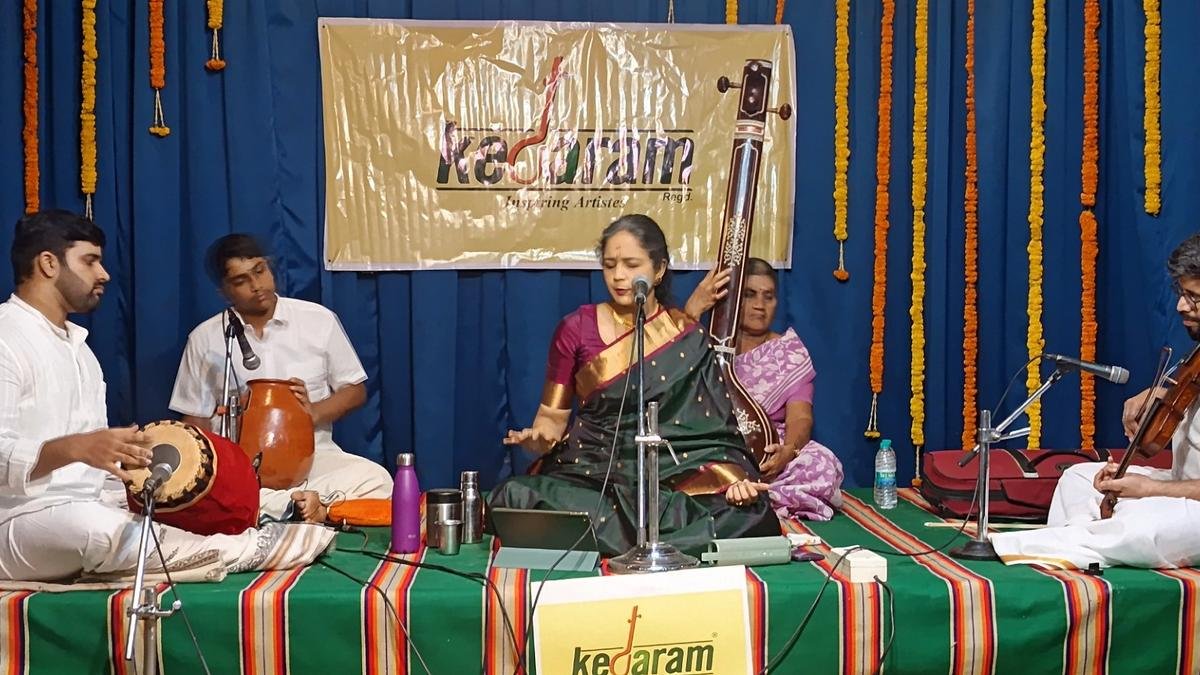
Carnatic music concerts often reveal the artistic personality of a musician through the choices they make. Beyond vocal ability, the selection of ragas, compositions, pacing and interpretation determines whether a performance becomes merely competent or genuinely memorable. Bhavana Iyer’s vocal recital at Kedaram’s 11th anniversary celebrations stood out for precisely this reason. Her carefully planned repertoire reflected respect for tradition while allowing enough space for creative exploration.
Held at Ragasudha Hall in Mylapore, Chennai, the concert brought together a combination of established compositions and thoughtful raga presentations. Supported by Pappu Gyanadev on the violin, Ajith Sridhar on the mridangam and young percussionist Master Skandan Manjunath on the ghatam, Bhavana created an evening that highlighted the collaborative spirit at the heart of Carnatic music.
The recital showcased her ability to approach both devotional compositions and complex classical structures with sensitivity, while also revealing areas where continued refinement can further strengthen her musical expression.
The Importance of Repertoire Selection in Carnatic Music
A successful Carnatic concert is not simply a collection of individual songs. It is a carefully constructed musical journey where every composition contributes to the overall mood and progression of the evening.
Experienced musicians often design their programmes by considering:
- The variety of ragas presented.
- The emotional character of each composition.
- The balance between fast and slow pieces.
- The opportunities for improvisation.
- The connection between lyrics and musical expression.
Bhavana Iyer’s selection demonstrated awareness of these elements. The concert moved naturally from devotional openings to elaborate raga exploration before reaching the grandeur of the main composition.
An Energetic Beginning With Bhairavi
Bhavana opened the recital with Tyagaraja’s Upacharamu cheseva in Bhairavi, one of Carnatic music’s most revered ragas.
Bhairavi offers enormous possibilities for interpretation because of its emotional range. It can express devotion, melancholy, grandeur and tenderness depending on how the musician approaches it.
Beginning at the anupallavi line gave the presentation a brisk start while immediately introducing listeners to the melodic richness of the raga. The concluding swarakalpana section added further energy and demonstrated Bhavana’s comfort with rhythmic improvisation.
Exploring Navarasakanada and Vasantha With Sensitivity
The transition to Swati Tirunal’s Vande sada padmanabham in Navarasakanada expanded the musical landscape of the concert.
Rather than treating each composition as an isolated item, Bhavana maintained a smooth emotional flow between pieces.
This was followed by an elaborate alapana in Vasantha, setting the stage for Muthuswami Dikshitar’s Brahadambikayai namaste.
Vasantha is a raga that demands careful handling because its beauty depends on subtle movement rather than excessive ornamentation. Bhavana’s approach highlighted the elegance of the raga while maintaining clarity in presentation.
Surutti: A Display of Imagination and Control
The Surutti alapana was one of the notable sections of the recital.
Known for its devotional character and scope for creative interpretation, Surutti requires a musician to balance tradition with imagination.
Bhavana explored the raga patiently, building its contours with confidence before moving into Dikshitar’s Sri venkatagireesam.
The niraval at Alamelumanga sametham was thoughtfully developed, showing attention to both musical structure and lyrical meaning.
This connection between sahitya and melody remains one of the defining strengths of Carnatic music, and Bhavana approached it with sensitivity.
Chintamani and the Emotional Power of Syama Sastri
A Carnatic recital is often considered incomplete without a Syama Sastri composition, and Bhavana chose the rare Chintamani raga for Devi brova samayamithe.
Chintamani is not frequently heard in concerts, making the choice particularly interesting.
The composition requires an understanding of the raga’s unique character, and Bhavana brought out its distinctive shades with care.
The performance also demonstrated the importance of exploring less frequently presented compositions, as they introduce audiences to the wider richness of the Carnatic tradition.
A Change of Mood With Malayamarutham
The concert shifted into a different emotional space with Arunachala Kavi’s Tamil composition Hanumane swamikkinda in Malayamarutham.
The raga’s bright and expressive nature created contrast after the deeper devotional mood of Chintamani.
Bhavana’s interpretation brought freshness to the composition while maintaining respect for its traditional character.
The Grand Finale: Sankarabharanam as the Main Offering
The highlight of the evening was undoubtedly the expansive presentation of Sankarabharanam.
Among the most important ragas in Carnatic music, Sankarabharanam provides extraordinary scope for both technical exploration and emotional expression.
Its universal appeal comes from its ability to accommodate grandeur, serenity and melodic complexity.
Bhavana approached the raga with preparation and imagination, revealing several dimensions of its beauty through her alapana.
Her choice of Tyagaraja’s monumental composition Entuku peddala was appropriate, as the kriti carries both musical sophistication and philosophical depth.
Balancing Technical Excellence With Vocal Refinement
While the Sankarabharanam presentation demonstrated Bhavana’s strengths, it also highlighted areas where further vocal refinement can enhance her future performances.
During some upper-register passages, particularly in higher sancharas, the voice occasionally became slightly sharp in tone.
Such moments are not unusual in demanding ragas, especially when navigating extensive melodic exploration. Continued focus on voice control, tonal stability and breath management can help transform these challenging passages into greater strengths.
The foundation, however, remains strong, with clear evidence of disciplined training and musical understanding.
Niraval and Swara Exchanges Add Depth
The niraval at Veda sastra tatvarthamu telisi reflected Bhavana’s awareness of the composition’s deeper meaning.
Rather than treating the line purely as a rhythmic exercise, she allowed the emotional significance of the lyrics to influence the musical development.
The subsequent swara exchanges with violinist Pappu Gyanadev were among the concert’s engaging moments.
The gandharam-focused phrases created a satisfying conclusion and demonstrated strong musical communication between vocalist and violinist.
Instrumental Support Enhances the Concert Experience
A Carnatic recital depends heavily on the interaction between vocalist and accompanying artists.
Pappu Gyanadev provided violin support that was sensitive and balanced, complementing Bhavana’s voice without overpowering it.
Ajith Sridhar’s mridangam playing maintained rhythmic stability while responding creatively to the vocalist’s improvisations.
Special appreciation belongs to young ghatam artiste Master Skandan Manjunath, whose mature rhythmic understanding stood out.
Despite his young age, his playing displayed confidence, precision and excellent coordination with the percussion ensemble.
Concert Structure and Musical Highlights
| Raga/Composition | Composer | Highlight |
|---|---|---|
| Upacharamu cheseva – Bhairavi | Tyagaraja | Energetic opening with structured swarakalpana |
| Vande sada padmanabham – Navarasakanada | Swati Tirunal | Expanded devotional mood |
| Brahadambikayai namaste – Vasantha | Muthuswami Dikshitar | Elegant raga exploration |
| Sri venkatagireesam – Surutti | Muthuswami Dikshitar | Thoughtful niraval and swara development |
| Entuku peddala – Sankarabharanam | Tyagaraja | Main piece showcasing musical depth |
The Role of Cultural Organisations in Sustaining Carnatic Music
Kedaram’s anniversary celebrations represent the continuing importance of cultural organisations in preserving and promoting classical arts.
Such platforms provide musicians opportunities to present traditional repertoire while allowing audiences to experience the diversity of Carnatic music.
In a rapidly changing entertainment landscape, these organisations ensure that classical traditions remain accessible to new generations.
Why Bhavana Iyer’s Concert Matters
The strength of Bhavana’s recital lay not only in individual performances but in her overall musical approach.
She demonstrated:
- Respect for classical tradition.
- Thoughtful repertoire planning.
- Ability to explore diverse ragas.
- Sensitivity toward lyrical meaning.
- Strong collaboration with accompanists.
These qualities are essential for musicians seeking to create meaningful concert experiences rather than simply showcase technical ability.
Final Verdict
Bhavana Iyer’s Carnatic vocal recital at Kedaram’s 11th anniversary celebrations was a well-crafted musical presentation that highlighted the richness of traditional repertoire.
From the opening Bhairavi to the expansive Sankarabharanam finale, the concert reflected careful planning, artistic sincerity and a deep connection with classical compositions.
Supported by accomplished accompanists, Bhavana created an engaging evening that celebrated the emotional and technical possibilities of Carnatic music.
With continued attention to vocal refinement in challenging upper registers, she has the potential to further strengthen an already promising musical journey. Her recital reaffirmed an enduring truth of Classical Music: when tradition is approached with understanding and imagination, it continues to speak powerfully to every generation.
For breaking news and live news updates, like us on Facebook or follow us on Twitter and Instagram. Read more on Latest Entertainment on thefoxdaily.com.

COMMENTS 0