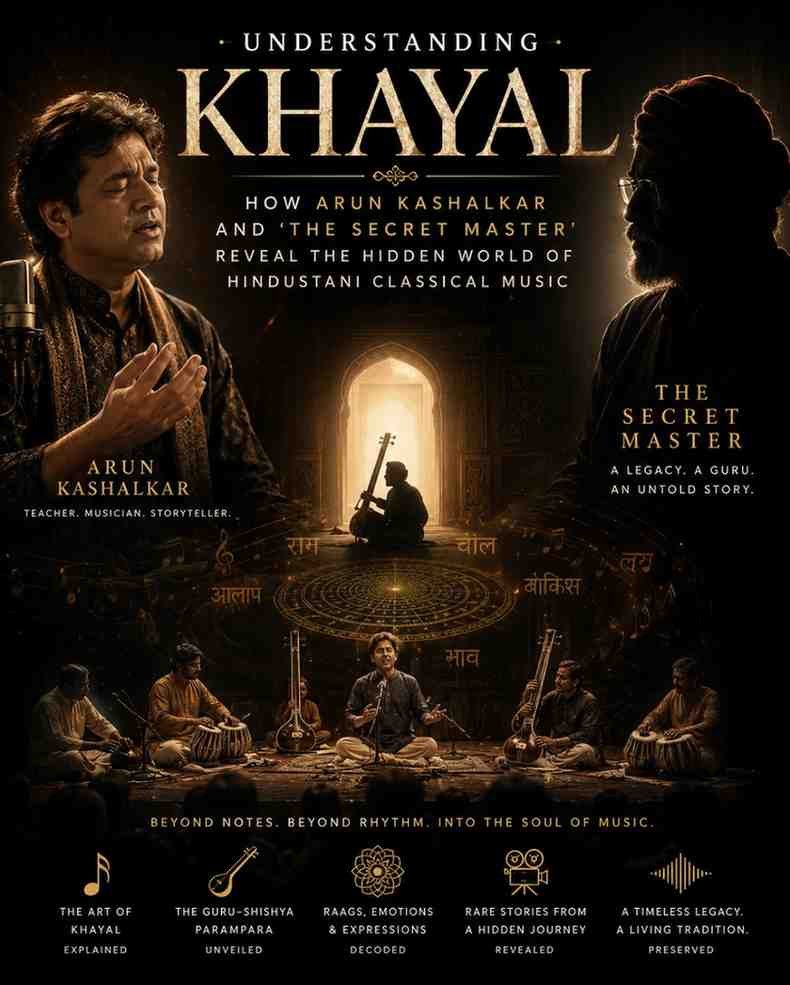
In an era dominated by streaming algorithms and viral music trends, some of India’s richest artistic traditions continue to flourish quietly, often away from mainstream attention. Among them is khayal, the most widely practiced form of Hindustani classical vocal music. Built on improvisation, emotion, and centuries-old traditions, khayal remains one of the subcontinent’s most sophisticated art forms.
Yet behind the beauty of ragas and elaborate performances lies a less visible reality. Many of the musicians, teachers, accompanists, and scholars who sustain this ecosystem live outside the spotlight. Sumana Ramanan’s book The Secret Master, which chronicles the musical journey of veteran vocalist Arun Kashalkar, shines a light on this hidden world and raises larger questions about the future of Hindustani classical music.
At a recent discussion with TM Krishna in Chennai, Ramanan reflected on the challenges confronting the art form, including commodification, shrinking performance spaces, and the urgent need for institutional support.
What Is Khayal and Why Is It Central to Hindustani Classical Music?
Khayal, derived from the Persian word meaning “imagination” or “thought,” emerged as a dominant form of Hindustani classical music several centuries ago. Unlike fixed compositions, khayal encourages extensive improvisation, allowing artists to interpret ragas through their own creativity.
A typical khayal performance unfolds gradually, beginning with slow and meditative exploration before progressing toward faster and more intricate passages.
Its beauty lies not merely in technical precision but in emotional expression and spontaneity.
- Improvisation is central to the form.
- Each performance is unique.
- The same raga can sound different depending on the artist.
- The guru-shishya tradition remains essential.
- Patience and years of training are required.
This emphasis on individual interpretation makes khayal one of the most intellectually and emotionally demanding musical traditions in the world.
The Story of Arun Kashalkar: A Master Away From the Limelight
Despite being respected among musicians and connoisseurs, Arun Kashalkar never became a household name in the way popular singers do.
That, according to Sumana Ramanan, is precisely why his story matters.
Her book The Secret Master explores the life of a musician whose influence extends beyond recordings and concerts. Kashalkar represents a generation of artists whose greatest contributions lie in teaching, preserving traditions, and transmitting knowledge across generations.
Such musicians form the backbone of Hindustani classical music, even if they rarely receive mainstream recognition.
The Invisible Ecosystem Behind Great Music
Listeners often focus on star performers, but classical music depends on a far more complex network.
This ecosystem includes:
- Gurus and teachers.
- Accompanists and instrumentalists.
- Musicologists and archivists.
- Organizers and sabhas.
- Students and disciples.
- Dedicated audiences.
Without these interconnected relationships, traditions cannot survive.
Yet many of these contributors remain financially vulnerable and culturally marginalized.
The Guru-Shishya Tradition: More Than Music Lessons
Unlike modern classroom education, Hindustani classical music evolved through the guru-shishya tradition, where students spent years learning not just compositions but also philosophy, discipline, and aesthetics.
Knowledge was transmitted gradually through observation and personal interaction.
The relationship between teacher and disciple often extended beyond technical training into a lifelong bond.
However, changing lifestyles and economic pressures have made such immersive systems increasingly difficult to sustain.
Comparison: Traditional Learning vs Contemporary Music Education
| Guru-Shishya Tradition | Modern Music Training |
|---|---|
| Personal mentorship | Structured courses |
| Years of immersion | Limited class schedules |
| Oral transmission | Digital resources |
| Holistic learning | Technical emphasis |
| Lifelong relationship | Professional instruction |
Both systems have strengths, but many musicians worry that something irreplaceable could be lost if traditional mentorship disappears entirely.
The Threat of Commodification
During her conversation with TM Krishna, Sumana Ramanan spoke about the increasing commodification of music.
Modern audiences often consume music through short clips, playlists, and algorithms designed to maximize engagement.
Khayal, by contrast, demands patience.
A single raga may unfold over an hour or more, inviting listeners into a deeper and slower experience.
This contrast creates challenges in a fast-paced digital culture where attention spans are shrinking.
The pressure to adapt sometimes risks reducing complex traditions into easily consumable products.
Why Performance Spaces Matter
Classical music thrives through live interaction.
Concert halls, cultural institutions, and intimate baithaks provide environments where artists and audiences share experiences impossible to replicate digitally.
However, performance opportunities have become increasingly limited.
Commercial entertainment often dominates cultural infrastructure, leaving fewer spaces dedicated to serious classical music.
Many musicians believe expanding performance venues is essential for preserving artistic traditions.
Institutional Support Is More Important Than Ever
One of the strongest themes emerging from discussions around The Secret Master is the need for institutional support.
Individual passion alone cannot sustain centuries-old traditions indefinitely.
Experts argue that support should include:
- Scholarships for students.
- Financial security for senior gurus.
- More festivals and concert venues.
- Archiving and documentation projects.
- Educational initiatives for younger audiences.
Without such efforts, invaluable knowledge risks fading with each passing generation.
An Insight Often Overlooked: Classical Music Needs Communities, Not Just Stars
Much attention in modern culture revolves around celebrity.
But classical music traditions survive because of communities rather than individual fame.
Great artists emerge from ecosystems built by teachers, listeners, organizers, and fellow musicians.
Arun Kashalkar’s story reminds us that influence cannot always be measured through popularity.
Sometimes the most important figures are those who quietly preserve traditions and nurture future generations.
In that sense, the “secret masters” are not exceptions they are the foundation.
How Younger Audiences Are Rediscovering Classical Music
Despite concerns about declining attention spans, there are signs of renewed interest among younger listeners.
Digital platforms have made recordings more accessible than ever. Collaborations between classical and contemporary artists have introduced new audiences to traditional forms.
Musicians like TM Krishna have also demonstrated that classical music can engage with social and cultural issues without losing artistic integrity.
The challenge lies in balancing innovation with preservation.
The Future of Khayal
Khayal has survived political changes, technological revolutions, and shifting cultural tastes over centuries.
Its resilience stems from its adaptability and emotional depth.
Yet survival cannot be taken for granted.
Supporting teachers, expanding performance spaces, and fostering informed audiences will be crucial in ensuring that future generations continue to experience this extraordinary tradition.
Conclusion
Sumana Ramanan’s The Secret Master and the life of Arun Kashalkar illuminate a world that often exists beyond public recognition. Their story is not merely about one musician but about an entire ecosystem that sustains Hindustani classical music.
As commercialization and cultural shifts reshape artistic landscapes, the future of khayal will depend not only on celebrated performers but also on the teachers, accompanists, institutions, and communities that nurture the tradition.
Ultimately, the greatest secret of khayal may be this: its enduring power lies not in fame, but in devotion, patience, and the invisible networks of people who keep its melodies alive.
For breaking news and live news updates, like us on Facebook or follow us on Twitter and Instagram. Read more on Latest Entertainment on thefoxdaily.com.

COMMENTS 0