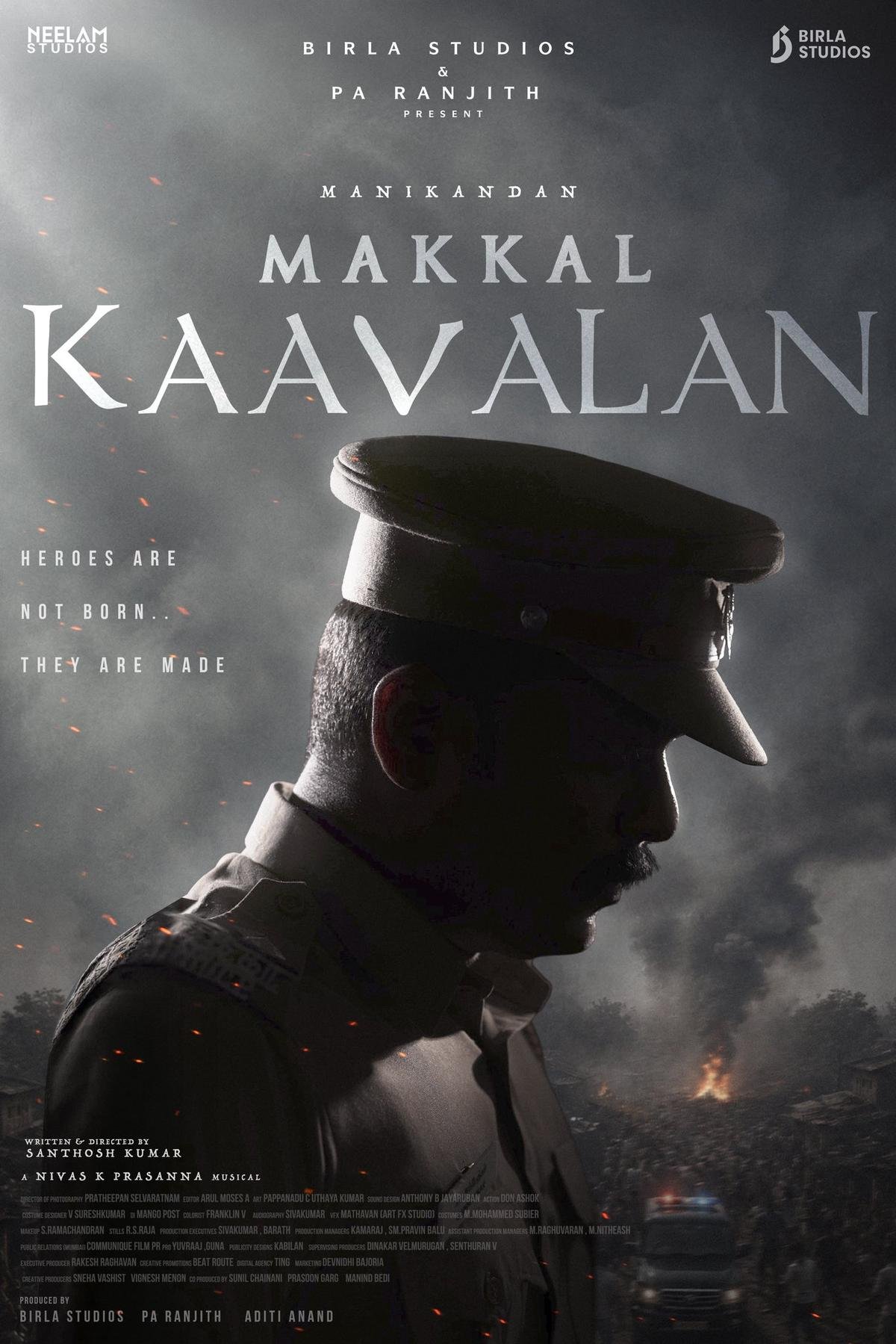
Makkal Kaavalan is being introduced as an action drama, but its first-look poster and premise suggest that the film is interested in something more complicated than a straightforward police-versus-criminal story. Headlined by Tamil actor K Manikandan and written and directed by Santhosh Kumar, the project places an ordinary man inside a corrupt system and asks what happens when survival itself begins to demand resistance.
The film was announced on August 5, 2026, with its first look showing Manikandan as a police officer positioned amid a riot. Produced by Birla Studios and Neelam Studios, Makkal Kaavalan is built around a protagonist who initially wants little more than to live with dignity. Circumstances, however, push him towards a much larger confrontation.
That premise gives the film an important distinction. The central character is not introduced as a larger-than-life hero seeking power. Instead, the story appears to follow the gradual transformation of an ordinary individual into someone who becomes a protector of the people.
What is Makkal Kaavalan about?
According to the makers, Makkal Kaavalan follows a simple man whose desire to live with dignity is threatened by a corrupt system. He is eventually left with two choices: surrender or resist.
His decision to resist becomes the starting point for a much larger conflict.
As the struggle escalates, he is forced into a leadership role that he never actively wanted. The story therefore appears to be built around a transformation: an ordinary man becomes increasingly important to a community because circumstances force him to act.
This is a familiar dramatic idea, but the effectiveness of such a story depends heavily on execution.
A hero who begins powerful has nowhere obvious to go except towards greater power. A reluctant protagonist offers a more interesting trajectory because every step towards confrontation can carry a personal cost.
The real dramatic question in Makkal Kaavalan may therefore not be whether Manikandan’s character wins, but what he has to lose before he becomes the person others expect him to be.
Why the first look matters
The first-look poster places Manikandan in the middle of a riot, immediately connecting the character to social unrest rather than an isolated police investigation.
That visual choice is consistent with the film’s stated premise. The conflict appears to move from an individual’s struggle to a collective confrontation.
In conventional cop dramas, the police protagonist often stands on the side of institutional authority. Makkal Kaavalan appears to introduce a more complicated relationship between the individual policeman and the system he is part of.
If the institution itself becomes corrupt, the protagonist faces a dilemma that is more difficult than simply identifying criminals.
He must decide whether loyalty to an organisation is more important than loyalty to the people he is supposed to protect.
Manikandan is an intriguing choice for the role
Manikandan’s casting is one of the most interesting elements of the announcement.
He has increasingly demonstrated an ability to anchor characters through emotional detail rather than relying solely on conventional star mannerisms. That quality could prove particularly useful for a story that depends on transformation.
A character who becomes a people’s protector has to feel believable before the transformation occurs.
If the protagonist appears heroic from his first appearance, the central journey loses much of its emotional value. Manikandan’s relatively grounded screen persona creates an opportunity to begin with vulnerability and gradually build intensity.
That could also allow the action sequences to carry greater narrative weight.
When an established action hero fights, the audience generally expects the outcome. When an apparently ordinary character is pushed into violence, every confrontation can reveal something new about him.
From survival to resistance
The strongest idea in the film’s premise is the progression from survival to resistance.
Initially, the protagonist appears to want a basic form of security and dignity. He is not trying to change society. He simply wants to live within it.
Corruption changes that equation.
Once an individual’s ordinary choices are repeatedly blocked by an unjust system, resistance can become less about ideology and more about necessity.
This creates an important emotional foundation for the film.
The protagonist’s eventual leadership should ideally feel like something that happens to him rather than something he announces for himself.
That distinction can turn a familiar “common man fights the system” story into a character-driven political action drama.
Why the reluctant leader is more compelling than the chosen hero
Indian action cinema has a long tradition of protagonists who enter a conflict with extraordinary confidence. They know their strength, understand their enemies and often seem destined to become symbols of justice.
Makkal Kaavalan appears to be taking the opposite route.
Its protagonist does not initially seek leadership. The system pushes him into it.
That opens up several dramatic possibilities.
- Personal cost: Resistance can threaten the protagonist’s family, career and safety.
- Moral uncertainty: Fighting a corrupt system does not automatically make every decision morally correct.
- Public responsibility: Once people begin depending on him, his choices affect more than his own life.
- Identity transformation: The man who wanted an ordinary life may eventually find that he can no longer return to it.
The final point could become the emotional core of the film.
The police angle could add another layer
The first look identifies Manikandan as a cop, which makes the conflict potentially more complicated than a conventional civilian-versus-state narrative.
A police officer is simultaneously part of an institution and responsible for protecting citizens.
If corruption has infiltrated that institution, the protagonist cannot simply walk away from the system. He has to navigate it from within.
That provides Santhosh Kumar with an opportunity to explore the contradiction between institutional power and individual conscience.
The most interesting version of this story would avoid treating every police officer as corrupt or every protester as automatically righteous. Real institutions contain competing interests, personal loyalties and conflicting interpretations of duty.
Giving those tensions space could make the film’s world feel considerably more authentic.
Action should serve the character
The film has been positioned as an action drama, but the premise suggests that the action has a specific narrative function.
The protagonist’s physical confrontations should ideally correspond to stages in his transformation.
Early action could represent desperation. Later confrontations might demonstrate growing confidence. Eventually, violence could become a burden rather than simply a source of triumph.
This approach would distinguish Makkal Kaavalan from action films in which fight sequences exist primarily to reinforce the hero’s invincibility.
The best action scenes in a character-driven drama do not merely show what the protagonist can do; they reveal who the protagonist is becoming.
The significance of the title Makkal Kaavalan
The title translates broadly to “protector of the people,” and it provides a direct clue to the film’s thematic direction.
However, the title also creates a challenge for the screenplay.
If the protagonist becomes a protector simply because the story declares him one, the transformation could feel superficial. The title becomes meaningful only when the audience sees why people begin trusting him.
That trust needs to be earned through choices.
Perhaps he protects someone when it is personally dangerous. Perhaps he refuses an order that would harm ordinary citizens. Perhaps he accepts responsibility for a community when escaping would be easier.
Those moments would gradually turn a job title into an identity.
Santhosh Kumar’s biggest storytelling challenge
For writer-director Santhosh Kumar, the biggest challenge will be balancing the film’s social themes with the expectations of mainstream action cinema.
A story about corruption and resistance can quickly become predictable if every scene simply reinforces the same message.
The film will need characters with competing motivations rather than a simple division between good people and bad people.
The antagonist or corrupt system should ideally have believable mechanisms of power. Otherwise, the protagonist’s victory risks feeling too easy.
Similarly, the screenplay must explain why the protagonist becomes important to ordinary people without turning the community into a passive crowd waiting for a saviour.
That is where the film can either become a standard action drama or something more socially textured.
A familiar formula with a potentially different emotional centre
| Conventional action drama | Potential direction for Makkal Kaavalan |
|---|---|
| Hero seeks revenge or justice | Ordinary man is pushed into resistance |
| Hero begins with power | Protagonist gradually discovers his ability to lead |
| Institution is usually clearly good or bad | Police identity creates an internal conflict |
| Action establishes heroism | Action can reveal the cost of resistance |
| Leadership is a personal ambition | Leadership emerges from public trust and necessity |
Why the film’s social theme could resonate
Stories about ordinary people confronting powerful systems remain popular because they turn abstract ideas such as corruption, inequality and institutional failure into personal conflicts.
But audiences have also become increasingly familiar with the formula.
For Makkal Kaavalan to stand apart, it needs to make the consequences feel specific.
What exactly does corruption cost this protagonist?
Who suffers when he refuses to cooperate?
Why do ordinary people eventually rally behind him?
And what happens when the man who wanted only a dignified life becomes responsible for others?
These questions can provide the film with emotional depth without reducing it to a lecture about social injustice.
The Manikandan factor
The casting also gives the film an opportunity to approach mainstream action through a more restrained performance style.
Manikandan does not need to be presented as an unstoppable force from the beginning. In fact, the premise may benefit if his character initially appears physically and emotionally vulnerable.
The audience should be able to recognise the ordinary man before they begin recognising the protector.
That gradual evolution could make the eventual action more satisfying because it represents earned confidence rather than predetermined heroism.
It also fits the larger trend of contemporary Tamil Cinema in which performers associated with grounded, character-oriented roles increasingly move into larger-scale genres.
What could make Makkal Kaavalan stand out
The film has several ingredients that could work in its favour: a socially relevant premise, a protagonist with an internal conflict, an action framework and an actor capable of carrying a transformation-driven role.
But its distinctiveness will ultimately depend on the screenplay.
The film needs to avoid turning corruption into a vague monster that exists only to justify action scenes. It needs to show how systems affect individuals and how individuals respond when those systems stop serving their intended purpose.
The strongest version of Makkal Kaavalan would therefore make its action inseparable from its central moral question:
How far should an ordinary person go when following the rules means accepting injustice?
The bigger opportunity for Tamil action cinema
There is room within commercial Tamil cinema for action stories that retain spectacle while giving their protagonists more complicated emotional journeys.
Makkal Kaavalan could occupy that space if it treats its social premise seriously.
The combination of a police setting and a reluctant leader is particularly promising because it allows the film to explore both sides of the conflict: the institution that claims to protect society and the individual who must decide what protection actually means.
That tension can generate action, but it can also generate drama.
Conclusion: Makkal Kaavalan has the ingredients for a grounded action drama
Makkal Kaavalan may initially look like another action film built around a man confronting a corrupt system. Its first look, however, points towards a more character-driven possibility.
Manikandan’s protagonist begins as an ordinary man seeking dignity and is gradually forced into resistance. His journey from survival to leadership gives the story a natural emotional arc, while his identity as a police officer introduces an additional conflict between institutional loyalty and individual conscience.
For Santhosh Kumar, the challenge will be to ensure that the film’s social themes do not become predictable slogans and that its action sequences remain connected to the protagonist’s transformation.
If the screenplay succeeds in doing that, Makkal Kaavalan could offer something more interesting than another invincible hero story. It could become a drama about how ordinary people acquire extraordinary responsibilities when the systems around them fail.
The most compelling protector, after all, is not necessarily the man who always wanted to be a hero. It may be the man who never wanted the role but refuses to walk away when everyone else needs him.
For breaking news and live news updates, like us on Facebook or follow us on Twitter and Instagram. Read more on Latest Entertainment on thefoxdaily.com.






COMMENTS 0