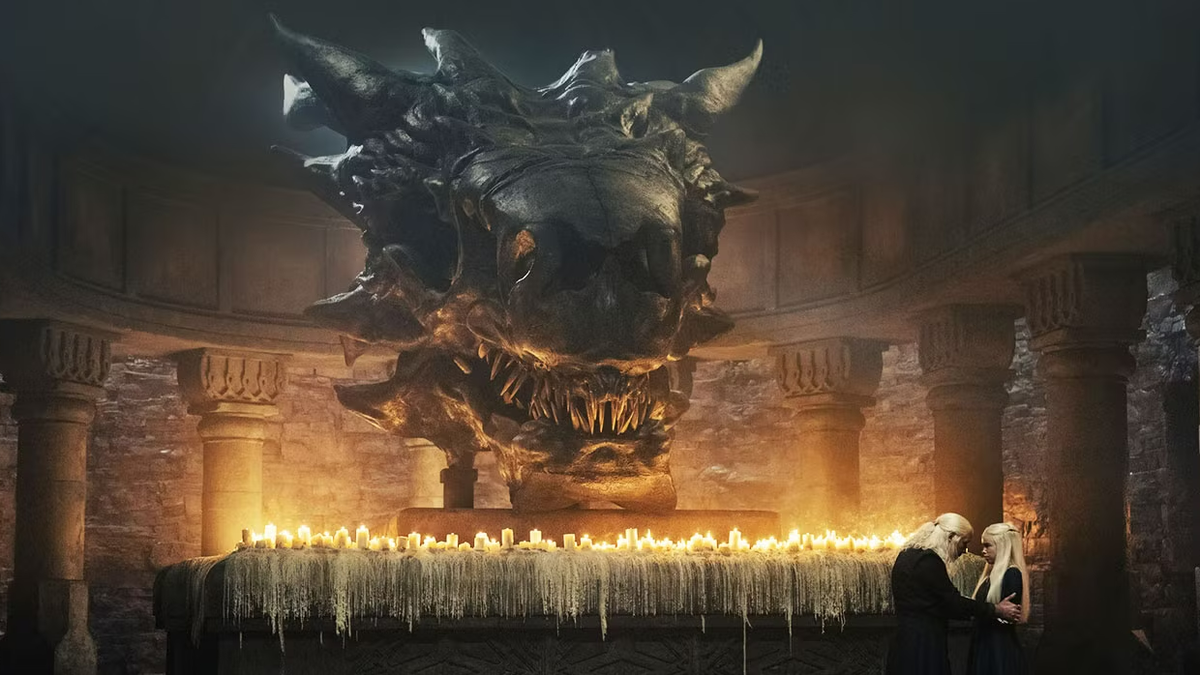
The Game of Thrones universe is finally preparing to leave Westeros behind on television screens and make its first planned journey to cinemas. Warner Bros. has confirmed that Game of Thrones: Aegon’s Conquest is part of its theatrical slate beyond 2027, giving the long-running fantasy franchise a significant new direction after years of expanding through HBO series.
There is no confirmed release date, director or cast yet, and the project remains in the early stages of development. That makes 2028 the earliest realistic possibility based on the current announcement, while 2029 could provide a more practical window. What is already clear, however, is the ambition: the first theatrical Game of Thrones feature will revisit one of the most consequential events in the history of Westeros.
The story will centre on Aegon I Targaryen and his conquest of much of Westeros with the help of his sisters Visenya and Rhaenys and their dragons. The campaign united six of the Seven Kingdoms under Targaryen rule, while Dorne resisted and remained independent from the initial conquest.
For a franchise whose television identity was built around sprawling political conflict, dragons and dynastic warfare, the decision to bring Aegon’s campaign to the big screen is more than a change of format. It could be Warner Bros.’ attempt to turn the history of Westeros into a cinematic event on a scale that television has rarely attempted.
What is Game of Thrones: Aegon’s Conquest about?
Game of Thrones: Aegon’s Conquest will dramatise the campaign through which Aegon Targaryen conquered most of Westeros and established the political foundation of the dynasty that would eventually rule the Seven Kingdoms for generations.
The story is chronicled in George R.R. Martin’s Fire & Blood, the historical chronicle that also serves as the source material for House of the Dragon.
Aegon did not conquer Westeros through military force alone. His dragons fundamentally changed the balance of power. Aegon rode Balerion the Black Dread, while his sisters Visenya and Rhaenys rode Vhagar and Meraxes respectively.
The combination of dragons, armies and political calculation allowed the Targaryens to defeat or compel submission from most of the kingdoms.
Dorne was the major exception.
That distinction matters because the conquest was not a clean or complete victory. It was the beginning of a complicated political order that would continue to face resistance, rebellion and questions of legitimacy.
Why Aegon’s Conquest is the right story for a Game of Thrones movie
The decision to adapt Aegon’s conquest for cinema makes sense for one obvious reason: it is one of the few stories in the Westerosi timeline that naturally lends itself to a large-scale theatrical experience.
The original Game of Thrones series frequently suggested that the Targaryen conquest was almost mythical in scale. Characters spoke about dragons, ancient kings and the founding of the dynasty, but viewers never saw the complete campaign unfold.
House of the Dragon subsequently explored a later period of Targaryen history, focusing on the civil war known as the Dance of the Dragons.
Aegon’s Conquest would move the timeline backwards and show the moment when the Targaryen political order was created in the first place.
That gives the film an advantage over a completely disconnected spin-off.
Audiences already understand the consequences.
They know what the Iron Throne eventually becomes. They know the Targaryen dynasty will dominate Westeros for centuries. They know dragons will become symbols of power, fear and legitimacy.
The movie can therefore tell a story whose ending is historically familiar while still exploring how that world was created.
The three Targaryens at the centre of the story
Aegon is obviously the central figure, but the conquest would be incomplete without Visenya and Rhaenys.
The three siblings represent different dimensions of Targaryen power.
Aegon is the conqueror and political centre of the campaign. Visenya is associated with military strength and the fearsome Vhagar. Rhaenys brings a different temperament and perspective while riding Meraxes.
This creates an opportunity for the film to avoid becoming a conventional hero story.
The conquest was not accomplished by one man acting alone.
The relationships between Aegon, Visenya and Rhaenys could become the emotional foundation of the film, giving the enormous military campaign a family drama at its centre.
That is particularly important because dragons and battles, however spectacular, can become emotionally distant if audiences do not have characters whose decisions carry personal consequences.
Balerion the Black Dread could become a cinematic icon
If there is one creature capable of defining the theatrical identity of Aegon’s Conquest, it is Balerion the Black Dread.
Aegon’s dragon was one of the largest and most formidable creatures in Targaryen history. His presence fundamentally altered the nature of warfare in Westeros.
Television has already demonstrated how powerful dragons can be as visual attractions through Game of Thrones and House of the Dragon.
A feature film, however, could potentially present the conquest on a considerably larger scale.
Instead of using dragons primarily as individual dramatic characters, the movie could show how the existence of these creatures transformed entire military campaigns.
Castles that had resisted armies for generations could suddenly become vulnerable. Armies could be destroyed from the sky. Political leaders could surrender without fighting because the cost of resistance was simply too high.
That is the important distinction between a dragon as a monster and a dragon as a weapon of empire.
The conquest was also a political revolution
It would be easy for the movie to become a sequence of battles, but the most interesting version of Aegon’s Conquest would treat warfare as only one part of the story.
Aegon was not simply trying to defeat individual kings. He was attempting to create a unified political structure from kingdoms with their own histories, traditions and identities.
That raises questions that remain relevant throughout the Game of Thrones universe.
What makes a ruler legitimate?
Does military victory create political authority?
Can fear establish a stable kingdom?
And what happens when conquered populations accept a ruler because resistance appears impossible rather than because they genuinely support him?
Those questions could give the film the political complexity audiences associate with the franchise.
Dorne could be the key to making the story more complicated
The fact that Dorne resisted the initial conquest is particularly important.
If the film presents Aegon’s campaign as an unstoppable march towards victory, the narrative could become dramatically predictable.
Dorne provides a natural counterpoint.
Its resistance demonstrates that dragons did not make the Targaryens invincible. Even overwhelming military power had limits.
More importantly, Dorne introduces the idea that conquest and control are not necessarily the same thing.
A ruler can win battles without winning the loyalty of the people he seeks to govern.
That distinction could become one of the film’s strongest themes: the difference between conquering a kingdom and actually ruling it.
Why the move from television to cinema matters
The Game of Thrones universe has become one of television’s most recognisable fantasy properties. Moving it to theatres therefore carries significant creative and commercial implications.
Television allows stories to breathe over multiple episodes and seasons. A film has a much shorter window in which to establish characters, explain political relationships and deliver its central conflict.
That could force the filmmakers to make Aegon’s conquest more focused than the sprawling historical account in Fire & Blood.
This could actually benefit the story.
The source material contains generations of history, competing accounts and numerous political developments. A theatrical adaptation will need to identify the emotional spine of the conquest and build the film around it.
Television versus cinema: what changes?
| Television storytelling | Theatrical storytelling |
|---|---|
| Can develop multiple characters over several episodes | Must establish its central characters more quickly |
| Political subplots can unfold gradually | Major conflicts need tighter narrative focus |
| Dragons can be introduced within an extended story | Dragon sequences can become major cinematic set pieces |
| Season-long arcs create gradual escalation | The film needs a concentrated dramatic trajectory |
| Audience engagement develops over weeks or seasons | The theatrical experience depends heavily on immediate spectacle and emotional impact |
The unusual journey of Aegon’s Conquest
The project has already taken an unusual path before reaching the big screen.
Warner Bros. and HBO had previously explored versions of an Aegon conquest story for television. A separate project was reportedly developed with The Batman Part II writer Mattson Tomlin involved.
The theatrical version eventually moved forward after Andor writer Beau Willimon developed a screenplay that convinced Warner Bros. the story could work as a feature.
That shift from television development to cinema is significant.
It suggests that the studio eventually saw the conquest not merely as another long-form Westeros story, but as an event capable of supporting a theatrical format.
Beau Willimon’s involvement raises expectations
Beau Willimon’s association with the project is potentially important because the success of Aegon’s Conquest will depend on more than world-building.
The film needs a screenplay capable of compressing a huge historical event into a focused dramatic experience.
The conquest contains enormous amounts of material, but audiences cannot emotionally invest in history alone.
They need individuals with competing desires, relationships and vulnerabilities.
If Willimon’s screenplay finds that human core, the film could avoid becoming a two-hour historical summary with dragons.
The biggest challenge is not scale — it is perspective
There is a temptation to assume that a Game of Thrones movie must automatically be enormous.
But scale alone will not make the film successful.
The franchise has already shown audiences enormous battles, dragons, castles and armies.
What Aegon’s Conquest can provide is perspective.
The audience could experience the conquest through the eyes of the Targaryens, the kings who lose their kingdoms, ordinary people caught in the fighting or even characters who initially believe Aegon’s arrival will bring stability.
A shifting perspective could preserve the moral ambiguity that made the original franchise compelling.
Aegon can be a visionary unifier from one perspective and a foreign conqueror from another.
That ambiguity is far more interesting than simply deciding whether he is a hero or villain.
Why the timing after 2027 could be strategically useful
Warner Bros. has placed Aegon’s Conquest among its theatrical projects beyond 2027 rather than giving it an immediate release date.
That uncertainty may actually benefit the franchise.
The wider Westeros television slate still has major chapters to complete. A Knight of the Seven Kingdoms is expected to continue with a second season in 2027, while House of the Dragon is scheduled to conclude with its fourth season in 2028.
A theatrical release in 2029 could therefore create a natural handover from television to cinema.
Rather than competing directly with multiple Westeros shows at the same time, the movie could become the next major franchise event.
In other words, the delay may allow Warner Bros. to turn the first Westeros movie into an occasion rather than simply another entry in a crowded release calendar.
Aegon’s Conquest could reconnect the franchise with its original mythology
One of the more interesting advantages of this story is that audiences have already heard about Aegon’s conquest throughout the wider franchise.
The Iron Throne, the Targaryen dynasty and the political structure of Westeros all exist because of the events surrounding the conquest.
Yet the conquest itself remains largely an off-screen historical event.
The movie can therefore transform mythology into lived drama.
Places that viewers know from Game of Thrones could be shown during an entirely different era, before centuries of political history changed them.
Familiar names could acquire new meanings.
And the Iron Throne itself could be presented not as an ancient institution but as the symbol of a newly created political order.
The risk of franchise fatigue
There is, however, a significant challenge facing the project.
The Game of Thrones brand has expanded considerably since the original series ended. House of the Dragon introduced a new generation of viewers to Westeros, while A Knight of the Seven Kingdoms offers another perspective on the world.
Adding a theatrical film increases the amount of content available under the same franchise.
The danger is that audiences may eventually feel that every historical period in Westeros is being mined for another story.
The solution is not necessarily to make the film bigger.
It is to make it necessary.
If Aegon’s Conquest offers a perspective or emotional experience that television cannot provide, its theatrical existence becomes easier to justify.
What could make Aegon’s Conquest genuinely cinematic?
- The dragons: Balerion, Vhagar and Meraxes provide opportunities for enormous aerial and battlefield sequences.
- The scale of conquest: Multiple kingdoms create a natural epic structure.
- The family dynamic: Aegon, Visenya and Rhaenys can provide an intimate story within the larger war.
- Dorne’s resistance: The failed attempt to completely subdue Dorne prevents the conquest from becoming a simple victory march.
- The birth of a dynasty: The film can show how the political foundations of Westeros were created.
- The moral ambiguity: The Targaryens can be presented as both builders of a kingdom and agents of conquest.
The franchise’s biggest cinematic test yet
Game of Thrones became famous partly because it challenged the conventions of fantasy television. Its characters could die unexpectedly, political victories could produce devastating consequences and moral choices were rarely straightforward.
A theatrical Aegon’s Conquest should preserve that spirit.
The easiest route would be to turn Aegon into a conventional fantasy hero who unites a divided land and defeats his enemies with the help of magnificent dragons.
The more compelling route would be to ask what conquest actually means.
Victory can create a kingdom, but it can also create resentment. A ruler can bring political unity while imposing his authority through fear. A dynasty can become legendary while its foundations remain violent.
Those contradictions are precisely what can make the story feel like Game of Thrones rather than a generic medieval fantasy epic.
What we know and what remains unknown
| Confirmed or reported element | Current status |
|---|---|
| Film title | Game of Thrones: Aegon’s Conquest |
| Format | Theatrical feature |
| Release window | After 2027; no specific date announced |
| Story | Aegon Targaryen’s conquest of Westeros |
| Source material | George R.R. Martin’s Fire & Blood |
| Screenplay development | Beau Willimon developed the theatrical screenplay |
| Director | Not announced |
| Cast | Not announced |
| Production stage | Early development |
What audiences should expect next
The next major milestones will be the appointment of a director and the announcement of the principal cast.
Those choices will reveal how Warner Bros. intends to position the film.
A director known primarily for spectacle could signal an effects-driven fantasy epic, while a filmmaker with a strong character and political-drama background could indicate a more intimate interpretation of the conquest.
Casting will be equally important.
Aegon needs an actor capable of projecting authority without making the character one-dimensional. Visenya and Rhaenys will need equally strong performers because the conquest depends on the three Targaryen siblings functioning as a believable political and personal unit.
The dragons, meanwhile, will have to feel like characters and strategic forces rather than simply visual effects.
Conclusion: Aegon’s Conquest could be the definitive big-screen Westeros event
Game of Thrones: Aegon’s Conquest represents a major evolution for one of television’s most influential fantasy franchises. Warner Bros.’ decision to place the film on its theatrical slate beyond 2027 confirms that Westeros is being prepared for its first planned big-screen feature.
The project has obvious cinematic advantages: dragons, armies, castles, dynastic conflict and one of the most important turning points in the fictional history of Westeros.
But spectacle alone will not be enough.
The film’s real opportunity lies in exploring the human and political consequences behind the conquest. Aegon, Visenya and Rhaenys can provide the intimate family drama; the conquered kingdoms can provide political conflict; and Dorne’s resistance can challenge the idea that military victory automatically creates lasting authority.
The absence of a confirmed director, cast and release date means the project is still some distance from becoming a finished film. That also means its creative identity remains open.
If Warner Bros. can combine the enormous visual scale of a theatrical fantasy epic with the moral complexity that defined the best of Game of Thrones, Aegon’s Conquest could do more than bring Westeros to cinemas. It could establish an entirely new cinematic chapter for the franchise.
For breaking news and live news updates, like us on Facebook or follow us on Twitter and Instagram. Read more on Latest Entertainment on thefoxdaily.com.

COMMENTS 0