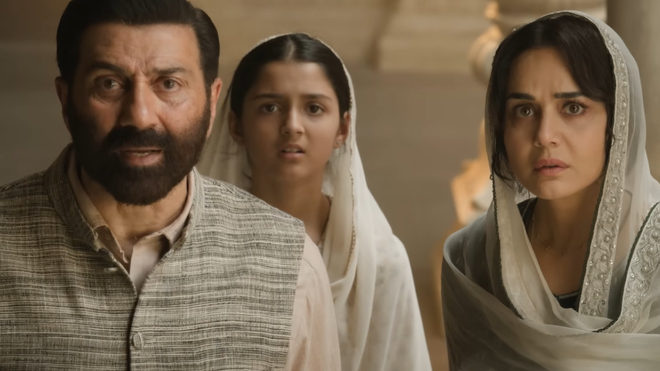
Batwara 1947 brings together Sunny Deol, Preity Zinta and filmmaker Rajkumar Santoshi for a story rooted in one of the most painful chapters of South Asian history. As the team revisits the human cost of Partition, the film also raises a larger question: how should cinema remember an event that changed millions of lives while still speaking to generations who did not experience it?
Partition is often remembered through dates, political decisions, maps and statistics. But its deepest legacy exists in memories passed from grandparents to children: abandoned homes, disrupted families, journeys across newly created borders and the sudden transformation of familiar neighbours into strangers. That human dimension is where Batwara 1947 seeks to place its emphasis.
For Sunny Deol, Preity Zinta and Rajkumar Santoshi, returning to Partition is therefore not simply an exercise in recreating the past. It is an attempt to understand how an event from 1947 continues to influence identity, memory, relationships and popular culture decades later. The reaction of veteran actor Dharmendra after watching the film adds another personal layer to the conversation, connecting a younger generation of filmmakers and performers with memories associated with an older generation.
Why Batwara 1947 matters beyond another Partition film
Indian cinema has returned to Partition repeatedly, but not every Partition story approaches the subject in the same way. Some films have focused on political upheaval, others on migration, communal violence, lost love or fractured families. The challenge for a new film is not merely to revisit familiar imagery but to find a reason for audiences to look at the history again.
That challenge is particularly important in 2026. For younger viewers, 1947 is increasingly distant history rather than lived memory. At the same time, families across India and Pakistan continue to preserve stories of displacement and separation. A film such as Batwara 1947 occupies an unusual space between these two realities.
Its relevance comes from making history personal. Instead of treating Partition only as an event that happened between political leaders, a human-centred narrative can explore what happened inside homes, families and communities when an entire social landscape changed.
Partition 1947: the historical context behind the story
British India was divided in August 1947, resulting in the creation of India and Pakistan. The political transition brought independence but also one of the largest and most traumatic episodes of mass displacement in modern history.
Millions of people crossed the newly drawn borders. Families were separated, property was abandoned, communities were uprooted and countless lives were permanently altered. The violence surrounding Partition left psychological scars that did not disappear when the immediate crisis ended.
One reason Partition remains so powerful as a subject for cinema is that its consequences cannot be confined to a single year. Migration changed family histories, cities and communities. People who left one side of the border often rebuilt their lives elsewhere while carrying memories of places they could no longer return to.
This makes Partition different from a conventional historical backdrop. It is simultaneously political history, family history and memory.
The human cost is bigger than the map
A map can show where a border was drawn. It cannot show what happened to the person whose childhood home suddenly fell on the other side.
This distinction is central to understanding why Partition stories continue to resonate. Political history tends to explain decisions and consequences at a large scale. Personal memory explains what those consequences felt like.
For cinema, that difference is crucial. A character saying goodbye to a home can communicate the emotional meaning of displacement more effectively than a long explanation of territorial changes. A family searching for missing relatives can transform an abstract historical statistic into something audiences can emotionally understand.
Batwara 1947 has an opportunity to use that emotional language to make Partition accessible to viewers who may know the history academically but have never considered its intimate consequences.
Sunny Deol and the emotional weight of Partition stories
Sunny Deol has spent much of his career playing characters associated with intensity, resilience and emotional confrontation. His presence in a Partition story naturally creates expectations because Partition narratives often demand performances that can carry both personal grief and historical scale.
However, the most effective Partition performance does not necessarily depend on loud emotion. The subject itself carries enormous weight. Small moments—silence, hesitation, a remembered name or the sight of a familiar place—can sometimes communicate more than dramatic speeches.
For an actor, that creates a difficult balance. The performance must acknowledge the magnitude of history without turning suffering into spectacle. The emotional objective should be to make audiences understand the characters rather than simply observe their pain.
That distinction could be especially important for Batwara 1947. The film’s success as a historical drama will depend not only on how convincingly it recreates the period but also on whether its characters feel like people rather than symbols representing an argument about history.
Preity Zinta’s return adds another dimension
Preity Zinta’s association with the project brings a different performance energy to the film. Partition stories frequently revolve around women whose lives are transformed by political decisions made far beyond their control.
That perspective can broaden the conversation around Partition. Women were not simply witnesses to migration and upheaval. Families were reorganised, relationships were disrupted and questions of safety, identity and belonging became part of everyday survival.
A strong Partition narrative therefore has room to explore history through multiple perspectives. The experiences of men, women, children, elderly people and families could differ dramatically even when they lived through the same political crisis.
This is one area where contemporary historical cinema can improve upon conventional storytelling: rather than presenting one universal Partition experience, it can show how the same event produced different realities for different people.
Rajkumar Santoshi and the responsibility of revisiting history
For director Rajkumar Santoshi, Batwara 1947 presents a particularly demanding filmmaking challenge. Historical cinema requires more than period costumes, old-style architecture and recreated locations. Authenticity also depends on the social atmosphere of the time.
That means understanding how people spoke, travelled, communicated, lived together and responded to uncertainty. It also means resisting the temptation to judge every character exclusively through contemporary assumptions.
A historical film becomes more powerful when it allows audiences to understand the circumstances that shaped its characters. That does not mean excusing harmful actions. It means presenting history with enough complexity to make viewers think rather than simply telling them what to think.
Dharmendra’s reaction gives the film a generational connection
The discussion around Batwara 1947 also includes Dharmendra’s reaction after watching the film. His response is significant not simply because he is a celebrated actor, but because it represents a connection between generations of Indian cinema.
Dharmendra belongs to a generation whose formative years were much closer to the social memory of Partition. Even when an individual did not directly experience the events of 1947, the stories of migration, displacement and divided families were often present in the lives of people who grew up in its aftermath.
That makes his response emotionally interesting. When an older generation watches a new interpretation of a historical trauma, it creates a conversation between memory and cinema. The filmmaker reconstructs the past; the viewer brings personal or inherited memories to that reconstruction.
In that sense, Dharmendra’s reaction can be seen as part of a larger generational dialogue rather than merely a promotional detail surrounding the film.
Partition films: from political history to inherited memory
One of the most interesting changes in Partition cinema is the movement from explaining the event to exploring its afterlife.
Earlier historical narratives often concentrated on the immediate chaos of 1947. Contemporary audiences, however, may be equally interested in what happened afterwards. How did displaced families rebuild? How did people preserve memories of lost homes? How did children inherit stories about places they had never seen?
This creates an important comparison between two approaches:
| Traditional historical approach | Memory-centred approach |
|---|---|
| Focuses on political events and major developments | Focuses on families and individual experiences |
| Emphasises dates, locations and historical milestones | Emphasises memory, identity and belonging |
| Explains what happened | Explores what it meant to people |
| Looks primarily at 1947 | Examines the long-term legacy of Partition |
The second approach may be especially relevant for younger audiences because it connects historical events to themes they understand: family, home, identity, separation and belonging.
Why Partition still resonates with younger audiences
There is a misconception that younger audiences are uninterested in historical stories. In reality, audiences often respond strongly when history is presented through emotionally understandable experiences.
A teenager may not immediately connect with a political discussion about the boundary commissions of 1947. But the idea of losing a home, being separated from relatives or leaving behind everything familiar is much easier to understand emotionally.
This is where films can perform an important educational function without becoming textbooks. Good historical cinema can encourage viewers to ask questions, research the period and discuss family histories.
For Batwara 1947, this could become one of its most meaningful contributions. If the film encourages younger viewers to ask their grandparents or older relatives about their family’s history, its impact can extend beyond the cinema screen.
The danger of turning historical trauma into spectacle
There is another side to making Partition cinema. The violence and suffering associated with 1947 are powerful cinematic material, but they also carry ethical responsibilities.
A film can depict tragedy without exploiting it. The distinction lies in what the camera asks audiences to feel. If violence exists only to create shock, historical suffering risks becoming entertainment. If it serves character, context and understanding, it can deepen the narrative.
The strongest historical dramas often understand that restraint can be more powerful than excess. The emotional aftermath of an event may sometimes matter more than the event itself.
For Batwara 1947, maintaining that balance could be central to its credibility. The film does not need to make Partition appear larger than it was. The history is already enormous.
What makes the film relevant in 2026?
Nearly eight decades after Partition, the central challenge has changed. The immediate witnesses are becoming fewer, while inherited memories are becoming increasingly important.
That creates a race against time for oral history. Stories that once travelled naturally from grandparents to grandchildren can disappear when the people who carried them are no longer able to tell them.
Cinema can never replace firsthand testimony, but it can help preserve public interest in those stories. A film can become a starting point for conversations about history, migration and memory.
This is arguably a more significant reason for revisiting Partition today than simply marking another anniversary. The question is no longer only, “What happened in 1947?” It is also, “What have generations since then inherited from it?”
A prediction for Partition storytelling in Indian cinema
The next phase of Partition cinema is likely to become more personal and less dependent on familiar political imagery. Instead of repeatedly recreating the moment borders were drawn, filmmakers can explore the decades that followed.
Stories about refugee settlements, second-generation identity, inherited homes, family archives and relationships across borders could offer fresh perspectives. Such narratives would not make Partition less important; they would demonstrate how deeply its consequences travelled through time.
Batwara 1947 arrives within this broader opportunity. Its strongest potential lies in treating Partition not as a closed chapter but as a historical experience whose emotional consequences continued long after 1947.
What audiences should look for in Batwara 1947
- The human story: How the film translates a massive historical event into individual experiences.
- Character depth: Whether the central characters exist as fully developed people rather than historical symbols.
- Historical atmosphere: How convincingly the film recreates the social world surrounding Partition.
- Emotional restraint: Whether the film respects the seriousness of the subject without turning suffering into spectacle.
- Generational relevance: Whether it gives younger audiences a reason to engage with Partition beyond memorising historical facts.
- Memory and identity: How the film explores the idea of home and belonging after displacement.
The bigger story behind Batwara 1947
The most important question surrounding Batwara 1947 is ultimately not whether Indian cinema has already told stories about Partition. It has. The more meaningful question is whether there are still stories about Partition that have not been emotionally understood.
The answer is clearly yes.
Every generation inherits history differently. For people who lived through Partition, it could be a personal memory. For their children, it may be a collection of family stories. For grandchildren and great-grandchildren, it can become something encountered through books, documentaries, photographs and films.
That changing relationship with history makes every new serious Partition film an opportunity—and a responsibility.
Conclusion: Why Batwara 1947 is more than a period drama
Batwara 1947, with Sunny Deol, Preity Zinta and Rajkumar Santoshi at its centre, arrives with the difficult task of revisiting a historical trauma that Indian cinema has explored many times. Its real opportunity lies in moving beyond familiar images of borders and violence to examine the people who had to live with the consequences.
The involvement of Dharmendra and the discussion surrounding his reaction to the film adds a valuable generational dimension. It connects the memories associated with an older era of Indian cinema to a new attempt to interpret one of the subcontinent’s defining historical moments.
Ultimately, the success of a Partition film should not be measured only by how convincingly it recreates 1947. It should also be judged by what it makes audiences think about after the story ends.
If Batwara 1947 can turn history into a conversation about family, memory, displacement and the meaning of home, it can offer something more enduring than another retelling of Partition. It can remind audiences that while borders may be drawn on maps in a single moment, their consequences can continue across generations.
For breaking news and live news updates, like us on Facebook or follow us on Twitter and Instagram. Read more on Latest Entertainment on thefoxdaily.com.

![Mirzapur The Movie Box Office Collection Day 7 [LIVE]: Pankaj Tripathi, Ali Fazal, Ravi Kishan Film Crosses Rs 143 Crore India Net Ahead of Haiwaan Releases](https://thefoxdaily.com/wp-content/uploads/2026/09/tfd-img-20222-1789055849-120x68.jpg)




COMMENTS 0